
Automotive industry Quality and Engineering · Veljko Massimo Plavsic
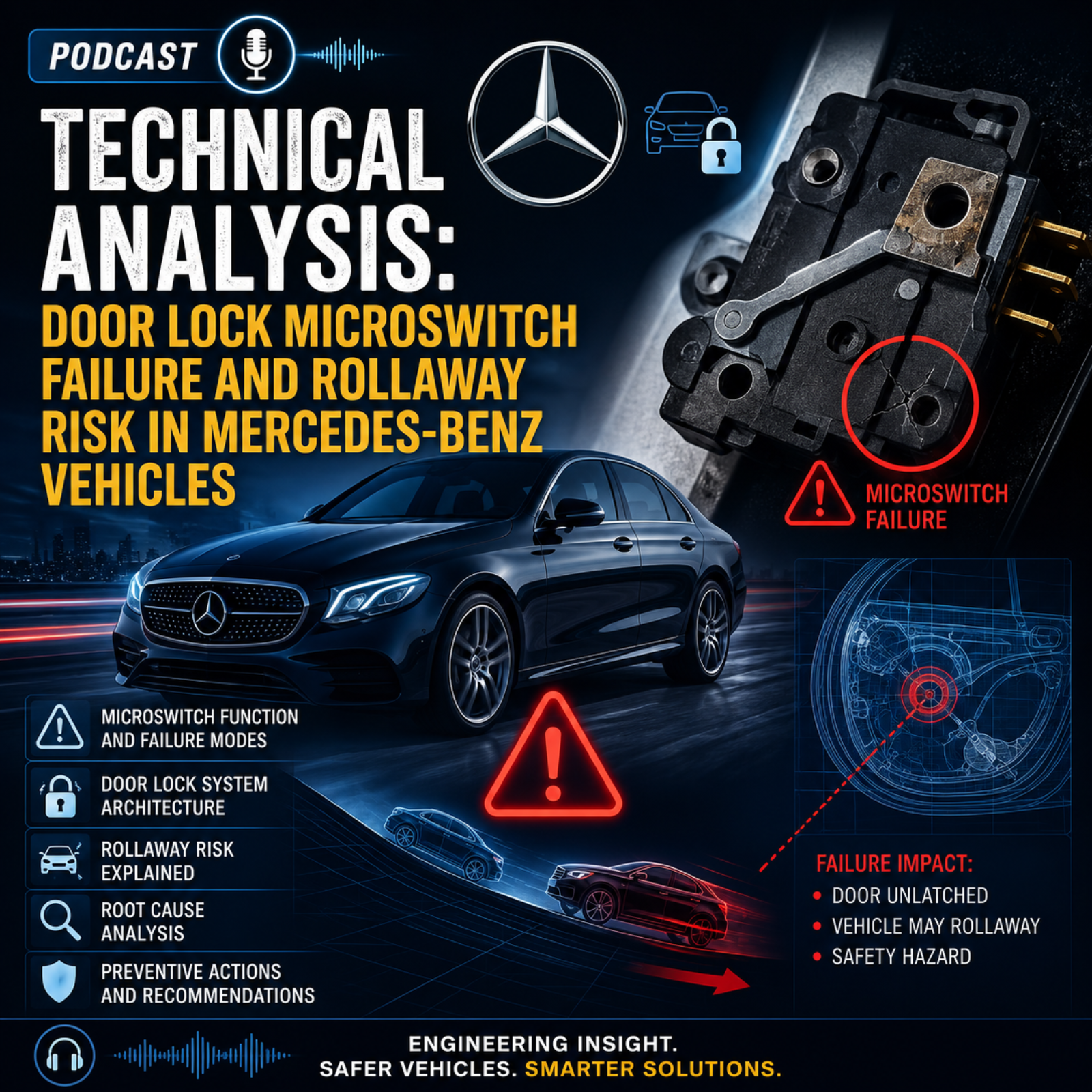
Got something to say to this podcast? Send a voicemail, and you might hear yourself on the next episode! You can use my promo code AUTO25 to get discount on many great deals Follow my deals page on link below: https://mydeals.page/sc8t Technical Overview and Incident Trajectory This report provides a strategic analysis of a significant safety recall initiated by Mercedes-Benz, affecting approximately 310,000 vehicles. In the context of modern integrated vehicle architectures, components formerly classified as "peripheral" or "convenience-oriented"—such as door lock assemblies—now function as primary sensors for the vehicle’s safety logic. The failure of these components represents a systemic liability, as it neutralizes automated safeguards designed to mitigate human error. The evolution of this issue underscores the danger of dismissing sensor irregularities as mere quality nuisances. For five years, the following trajectory was observed: 2021 – Initial Field Reports: Mercedes-Benz received the first set of consumer complaints regarding accessory power persistence (radios and interior lights remaining active after the ignition was terminated and the driver had exited). 2021–2024 – Misdiagnosis as Quality Failure: During this period, the phenomenon was treated as a "comfort function" quality defect. Technical investigations focused on battery drain and owner annoyance rather than a compromise of primary safety systems. 2024–2026 – Safety Reclassification: Following 176 field reports and a more rigorous technical audit, the failure was correctly reclassified. Engineers confirmed that the corruption of the door status signal not only affected accessory power but also suppressed the logic required to secure the vehicle’s transmission. July 2026 – Formal Recall: Mercedes-Benz filed documentation with the NHTSA identifying a widespread risk of vehicle rollaway due to electronic state blindness. This progression demonstrates how a hardware-level failure can effectively "blind" the vehicle's central logic, transitioning a minor electrical glitch into a high-consequence physical hazard.
0:00Imagine parking your car on a slight incline.
0:03Right. Like maybe you're just running into a
0:04coffee shop for a second. Yeah, just a quick
0:06stop. Exactly. You get out, you shut the door,
0:09and, you know, as you're waiting for your latte,
0:12you glance out the window only to see your 4
0:15,000 pound luxury vehicle silently rolling backwards
0:19down the hill. Oh, man. Just straight through
0:22a busy intersection. Yes. I mean, it's the ultimate
0:25nightmare scenario for any driver. And usually,
0:28when we talk about a catastrophic failure like
0:31a runaway car, we expect the root cause to be,
0:34well, equally catastrophic. Right. You expect
0:36a big... Noisy break. Totally. Like we picture
0:40a snapped parking pole inside the transmission