
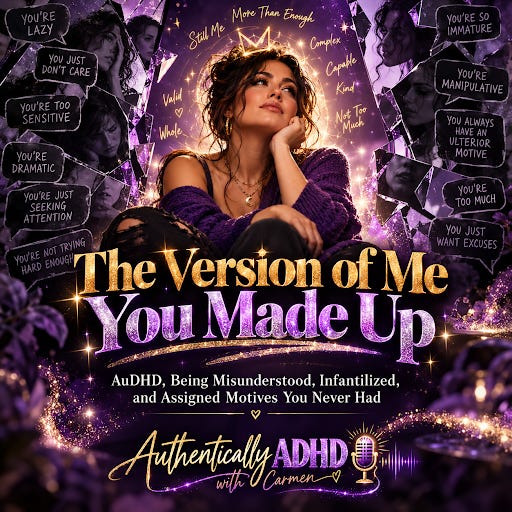
Authentically ADHD with Carmen · Where the chaos of ADHD meets self-acceptance, growth, and a whole lot of authenticity
RESEARCH NOTES / SHOW-NOTES SOURCES In this episode of Authentically ADHD with Carmen, we’re talking about what happens when people don’t just misunderstand you—they confidently decide what your behavior means, assign motives you never had, and then treat that interpretation like fact. For AuDHD adults, especially those diagnosed later in life, this can feel painfully familiar. A clarifying question becomes “attitude.” A pause becomes “ignoring.” Asking for help becomes proof you can’t handle adulthood. Intensity becomes aggression. Shutdown becomes manipulation. And suddenly, you’re not just trying to explain what happened—you’re trying to defend who you are. Carmen shares a deeply personal story from her second year of teaching, when a toxic medication combination led to a mental health crisis and psychiatric hospitalization. What followed was not just recovery, but the painful experience of being reduced to a distorted story by the people around her. Years later, through therapy, coaching, self-understanding, and late neurodivergent discovery, she began to understand why being confidently misread can hurt so much more than an ordinary misunderstanding. This episode explores the neuroscience behind ADHD executive functioning, autistic communication differences, masking, emotional regulation, the double empathy problem, late diagnosis, and the ways neurodivergent adults are often infantilized or treated as less capable simply because they need support. Most importantly, this is an episode about reclaiming your own narrative. You’ll learn how to separate observation from interpretation, communicate your needs more clearly, recognize when you’re over-explaining to someone committed to misunderstanding you, protect your autonomy while still accepting support, and stop letting other people’s assumptions become your identity. Because being misunderstood doesn’t mean you are unknowable. And needing clarification, support, processing time, or accommodation does not make you difficult, immature, or incapable. Sometimes the most powerful thing you can say is: “Please ask me what I mean before deciding who I am.” The double-empathy and cross-neurotype communication research: Research by Crompton and colleagues found effective information transfer between autistic people and has also shown that neurotype matching can influence interpersonal rapport. This supports a more relational understanding of at least some autistic/non-autistic communication difficulties rather than automatically locating every breakdown within the autistic person. First impressions and social perception: Research has also found that non-autistic observers can form less favorable first impressions of autistic adults from brief social information, illustrating how judgments about an autistic person may arise rapidly and before meaningful interaction has even developed. ADHD and emotion regulation: A systematic review of adults with ADHD found meaningful associations among ADHD,...
0:14SPEAKER_01The version of me
0:15SPEAKER_00that you made up.
0:17SPEAKER_00I asked one question.
0:19SPEAKER_00By the end of the conversation,
0:21SPEAKER_00I had apparently challenged their authority,
0:24SPEAKER_00rejected their advice, and developed a tone.
0:29SPEAKER_00Fascinating.
0:32SPEAKER_00Because I was just trying to find out what time we were leaving.
0:36SPEAKER_00And if you're autistic, ADHD,
0:39SPEAKER_00or both,
0:40SPEAKER_00especially if you weren't diagnosed until adulthood,
0:42SPEAKER_00you probably know exactly what I'm talking about.
0:46SPEAKER_00There is one thing that you actually did,
0:50SPEAKER_00and then there is the entire unauthorized biopic someone else produced
0:57SPEAKER_00about why you did what you did.