
Astronomy Daily: Latest Space News · bitesz.com
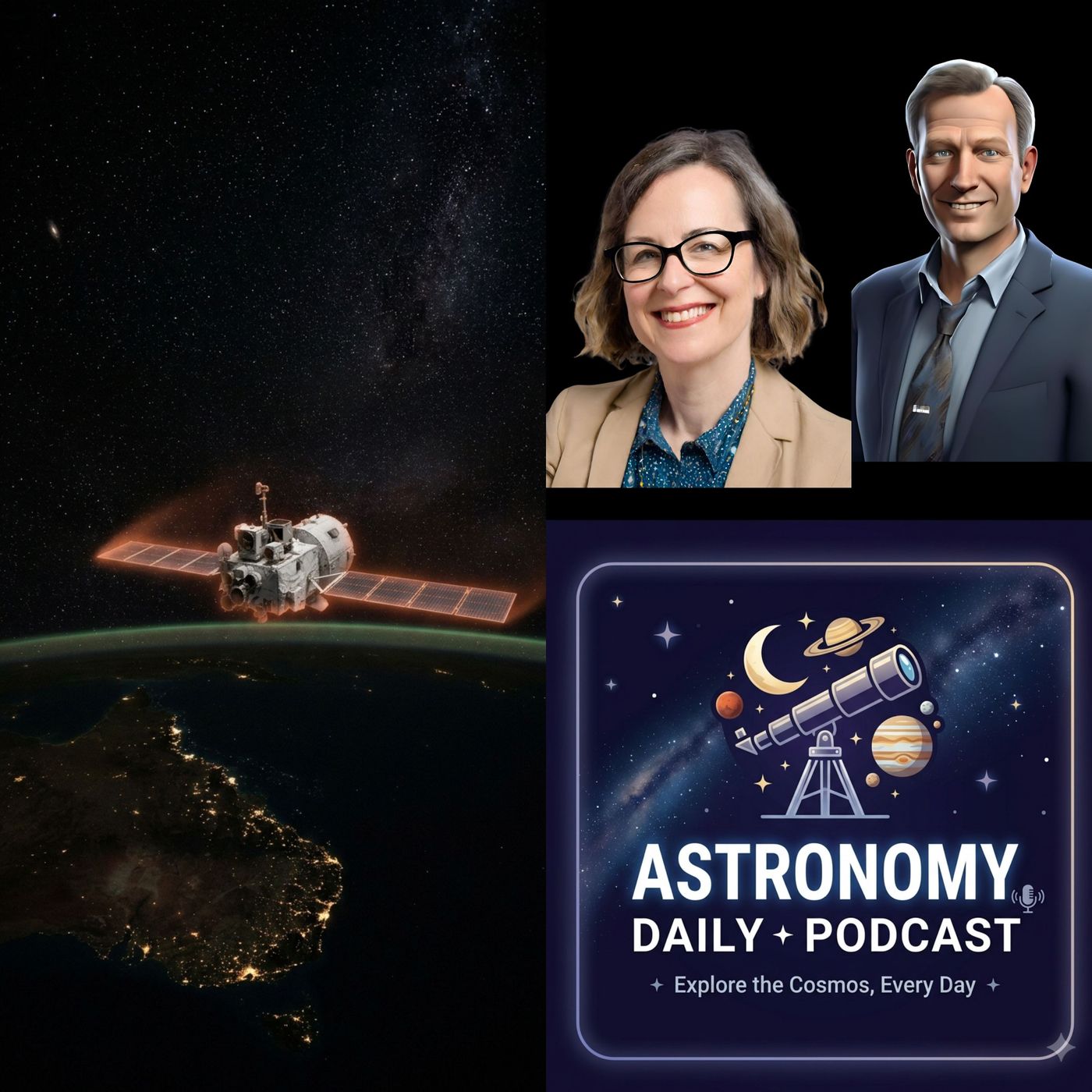
Show notes Swift's Last Orbit: NASA's burst hunter falls home, a gamma-ray burst that is two explosions in one, and 3I/ATLAS's dusty ice. Swift's Last Orbit NASA's Neil Gehrels Swift Observatory is expected to re-enter Earth's atmosphere on Wednesday 4 November; the US Space Force prediction is about 03:30 EST (08:30 UTC, 19:30 AEDT), plus or minus 11 hours. Surviving fragments are confined between 20.6°N and 20.6°S, a band that includes northern Australia; NASA puts the risk of harm to anyone at about 1 in 2,100. We look back at 22 years of science from a two-year mission: more than 2,000 gamma-ray bursts, the first short-burst afterglow in 2005, the BOAT in 2022, and about 7,000 papers. Two Bursts, Two Births GRB 160425A, caught by Swift in April 2016, is a 1.7-second short spike, four minutes of silence, then a 51-second long burst from the same place. A Nature Astronomy paper (Li, Wang, Zhang, Cai et al., 23 October; preprint March) argues the first is merger-like and the second collapsar-like. One event, no confirmed supernova or kilonova. 3I/ATLAS's Dusty Ice Webb's NIRSpec found the interstellar comet's ice grains are about a micron across and mixed with lots of dust, resembling some trans-Neptunian objects more than familiar comets (Protopapa et al., ApJL, 26 October; preprint September). Quick Hits Starship Flight 15 targeted NET 12 November per the FAA (unconfirmed by SpaceX); BepiColombo's Mercury orbit insertion on 21 November; Voyager 1 reaches one light-day around 18 November. Skywatch Venus near Spica before dawn, joined by a 5%-lit crescent Moon on Saturday 7 November; Mars and Jupiter closing to 1.2° by 16 November (high from the north); Saturn high in southern evening skies; New Moon 9 November; Leonids 17–18 November. ISO 12312-2 solar safety Become a supporter of this podcast: https://www.spreaker.com/podcast/astronomy-daily-latest-space-news--5648921/support. Sponsor Details: Ensure your online privacy by using NordVPN. To get our special listener deal and save a lot of money, visit www.astronomydaily.io/nordvpn. You'll be glad you did! Get the best secure and private email on the planet. Stop your Government, google and who knows who else spying on every email you write. Do what we did and use ProtonMail. They beleive in privacy and there are no ads in their business model...yet they still provide a free forever service. Check them out and get out special deal at www.astronomydaily.io/protonmail Become a supporter of Astronomy Daily by joining our Supporters Club. Commercial free episodes daily are only a click way... Click Here This episode includes AI-generated content.
0:00Anna: Hello and welcome back.
0:0222 years ago this month NASA launched
0:05a satellite designed to last two years.
0:08Right now it is skimming the top of the
0:10atmosphere, falling a little lower on every
0:13orbit and by the time some of you hear this
0:17it may already be gone.
0:18Avery: Today, Swift's last orbit.
0:22What it found, where it could come down
0:25and why Northern Australia sits inside the
0:27zone. Then a uh, burst
0:30with caught back in 2016 that looks like
0:33two explosions of two completely different
0:35kinds four minutes apart. And
0:39Webb finds the interstellar comet 3I