
AmeriCorps Connections · Nicki Fiocco
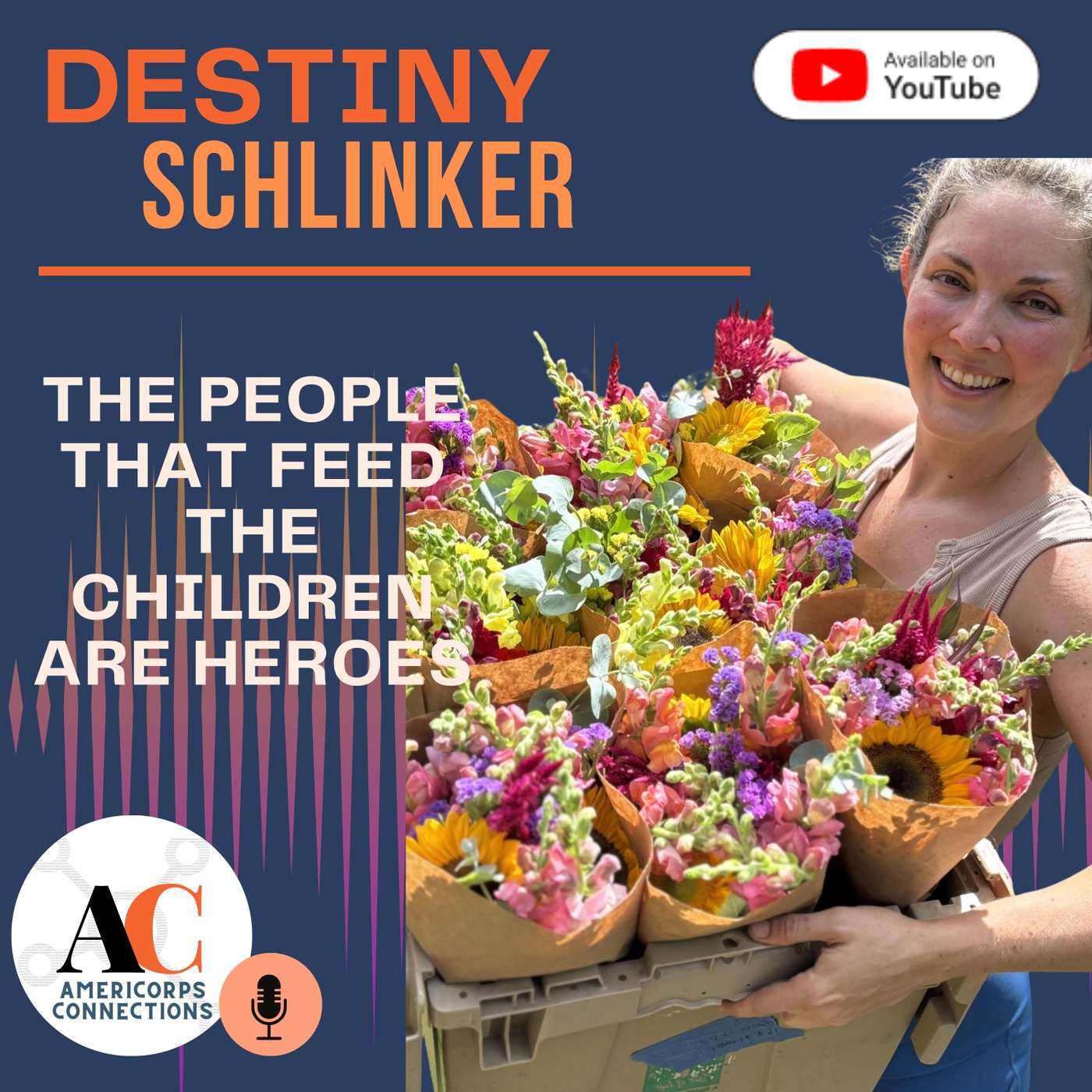
🎙️ AmeriCorps Connections tells the stories of alumni who were changed by national service. Subscribe and share so these stories keep reaching people. What if your leftover Segal Education Award could make you a better teacher in six weeks? Destiny Schlinker served as a FoodCorps AmeriCorps member in Springdale, Arkansas, from 2013 to 2015. She led garden and cooking lessons in the state's largest school district, where her students raised 12 chickens in a purple coop they built together and bottle-fed two baby goats in the middle of the city. Today she's Senior Manager of Leadership Pipelines at FoodCorps and co-owns Blue Mountain Vegetable Farm in a town of about 80 people. Destiny tells Nicki how garden lessons bring second-grade adjectives and fifth-grade haikus to life, and what it meant when a former student stopped her at a college career fair to say he still remembered those energy balls. She also talks about how FoodCorps rebuilt after losing its federal funding, going from 200 AmeriCorps positions in 19 states to 50 in nine, and the new ways it's investing in leaders. Use this a code where folks can say they heard through AmeriCorps Connections Podcast! Visit website at www.foodcorps.org email at [email protected] 🍎 FoodCorps programs featured in this episode FoodE: Food Education in the Classroom Micro-Credential With Teachers College, Columbia University • Six weeks, online and asynchronous, with optional live office hours • Built for educators teaching kids in a classroom, garden, or nonprofit setting (most useful for K-5) • Earns a certificate, a badge, and continuing education credits in many states • $295, and eligible for your Segal Education Award • Upcoming cohorts: November 2, January 4, March 1, April 26 👉 FoodCorps Member Position • Full-time, 11-month contract role (August 3 to July 11), renewable for a second or third year • Two tracks: Food Education (classroom and garden) and School Nutrition (district child nutrition teams) • About $40,000 for the term, plus PTO and health, dental, and vision insurance • Open in Mississippi, Arkansas, Kentucky, Texas, Maine, New Jersey, Oregon, New Mexico, and California • No teaching degree required. Summer camp or Boys & Girls Club experience counts! 👉 Kindred Fellowship for School Nutrition Leaders • Free, nine-month fellowship (October to June) for 30 district school food leaders • In-person kickoff in Philadelphia, about 10 virtual sessions, and a closing Hill Day in DC • Applications open in May and close in August 👉 FoodCorps Leadership Network Everyone from all three programs joins the alumni network on Slack, with mentors, job boards, training, and policy opportunities. 📬 Connect with Destiny: [email protected] She's happy to send details on using your Segal Award. Check out our featured partner Idealist for social-impact jobs, volunteer opportunities, and ways to give back right where you are. Link 👉 USE THIS LINK Look for our my guest blog for the Idealist Career...
_Destiny Schlinker Nicki Fiocco: [00:00:00] To it, I have to shout out our friends at Idealist. If you're listening to this podcast, you already get it. Service matters, community matters, doing good matters, and Idealist is where over 40 million people have gone to turn that feeling into something real. Jobs, volunteer opportunities, ways to give back right where you are. Don't wait. Go check out the link in the show notes right now. Explore the possibilities, Destiny Schlinker: and then of course, come back for this incredible service story. Let's go. All right, everyone, Nicki Fiocco: welcome back to another AmeriCorps Connections podcast. I'm looking forward to having this conversation with Destiny Schlinker, particularly because we're gonna be talking about what Destiny did during her service year, but the opportunities for service [00:01:00] members after you serve, which may or may not include micro-credentialing. It may or may not have something to do with, I don't know, food, because of the logo in your background. This is a pertinent conversation and timely conversation right now, just because everything that's going on s- specifically, like, with our food system and local farmers, and just different ways that we can find opportunities to, to get food and, and educate ourselves on food services. So Destiny, why don't you start off with telling us a little bit about yourself, and we'd love to learn a little bit about your service year, but most of all, I'm excited to learn about what you're up to now. Destiny Schlinker: Yeah. Perfect. Uh, well, hi, everyone. Thanks for letting me be here. My name is Destiny Schlinker. I am the Senior Manager of Leadership Pipelines at FoodCorps. Um, we are a national nonprofit that is really focused on a future where every kid has access to food education [00:02:00] and free nourishing school meals. Um, so in my role, I get to do a lot of recruitment and connect people with leadership opportunities. Excited to share more about those with you all. Um, I was a FoodCorps member in 2013 to 2015 in Springdale, Arkansas. I did lots of food education during that time, so lots of gardening and cooking with kids. We had goats in the classroom. It was chaotic and amazing. Um, and I am also a co-owner of a small farm in Arkansas called Blue Mountain Vegetable Farm. So I live in a town of 80-ish people Wait. Nicki Fiocco: Okay, wait. You live in a town with 80-ish people. This has nothing to do with AmeriCorps, but, uh, 80 people, how big's your farm? Destiny Schlinker: Um, it's 34 acres, but we operate on between one to two acres a year. Nicki Fiocco: Okay. Um, and so do you, like, [00:03:00] supply food to y- your community? Destiny Schlinker: We do. We, we primarily grow specialty cut flowers. We do hot sauces as well. Um, and then we grow vegetables for one CSA, which is, like, a community supported agriculture subscription. Yeah, sorry, I told you we were going on tangents. That's- Fun little side hustle, but it's related Yeah. So I was supposed to be an English teacher, and then one summer I randomly worked on a ranch in Arkansas, and we were teaching kids outside. So I fell in love with it, and I knew, like, this is it. This is the career path for me. Um, so when I found FoodCorps, that was such an easy decision. Uh, I didn't know jobs like that existed. So during that two years, I was leading garden and nutrition classes in an [00:04:00] elementary school in Springdale. So the kids were building garden beds. Uh, we had chickens, so we- chickens, so we were raising about 12 chickens. We built the coop together. Um, we had two goats. This was in the middle of the city. This is the largest school district in Arkansas at the time. Um, and the kids were cooking meals, um, um, at least once a week. I also got to do some local procurement and support some cafeteria initiatives, so it was a really hands-on position. It was the first year that they had a FoodCorps program in Springdale, um, so we were definitely figuring out what it was to look like there. The program is really place-based, so it looks different everywhere. Um, but just tons of activities with the kids and, and really getting them excited about food and where- food and where it comes from. And we also explore culture a lot through food, too, so that was a really [00:05:00] fun way to learn about each other and, and where everyone came from and what they eat at home. Nicki Fiocco: I wanna know what the, um, how the kids' responses were, uh, with the chickens. Um, I've just, I've seen Instagram reels where, you know, kids are picking up chickens and... What was that like for, for the kids to recognize that their food comes from these animals and the ground? Destiny Schlinker: It was so special. Um, we planned the coop together. My supervisor was a teacher named Courtney Erickson. I hope she sees this. She's a superstar. She built the coop. We painted it purple. The kids were really involved from the very start. They got to name the chickens. They took turns feeding them every day. So that was a very fulfilling process. I think they felt a lot of ownership and, and leadership in that, and being able to work on a hands-on project together, it just builds such a team. Like, it brings the [00:06:00] students together very closely. Um, so they were pumped about the eggs, very kind and gentle with the chickens, and it was just a great thing for us to focus on. Same with the little baby goats. We did a lot of bottle feeding. Nicki Fiocco: I love that. It's so, I mean, it's just so important to d- to create that bond with the animals. And also, I can imagine the kids, y- you maybe didn't use this terminology, but were making their home so they can go to sleep at night in a nice warm place, and you like your warm blanket, and the chickens need their warm blankets. Destiny Schlinker: Yeah. You know, I think at its face value, people are like, "Oh, it's great for the kids to learn about food." And it is. That is so critical, especially at a young age. But it is unbelievable how many connections that you can make to curriculum that they're already required to learn in the outdoor classroom. So be it the chickens or the life cycle of the soil, um, the [00:07:00] water cycle, there were so many different ways that we could connect to the science or the English or the reading lessons that they were required to study, but this just gave them a way to bring it to life. I love that. I love seeing that click for the kids. Nicki Fiocco: Can you tell, give us a, a few examples of what that looked like or sounded like to the kids? Destiny Schlinker: Yeah. So we would do, um, maybe say with, like, second grade classroom, they're learning about adjectives and storytelling. So we're gonna go to the garden, maybe you have an egg carton that has, like, 12 adjectives in it, and so you have to go into the garden and find an item that describes that adjective or that that adjective describes. So they might go find something that's prickly, something that's soft, and so it's really helping them to contextualize these things that they're learning in their class. Or maybe they have to, they're learning how to write a haiku in fifth [00:08:00] grade, so they go to the garden and they write a haiku of what they're observing in the garden. Um, another thing that we did was the plant cycle. And so they're planting a seed in their classroom window of something we'll transplant later, maybe like a snap pea. But they have journals where they're observing every day the progress of this seed, and that's something that they would learn in the book, but this is just, like, giving them an example of what it looks like in real life. They're really getting to be a part of the process. And so there might be terms or concepts, um, in their science lesson or their English lesson that wouldn't click for them just in the book, depending on their learning style, but because they're getting to actually experience it, it, it really brings that full picture, you know? Nicki Fiocco: I 100% understand because I'm comparing myself to a second grader. When, when I- ... when I dis- [00:09:00] I went back to school later in my 30s and I was like, "Well j- I just want a bachelor's degree. I don't care what it's in, so I'll just do teaching." But I went on the campus at UMBC and they had an environmental studies program. Destiny Schlinker: Yeah. Nicki Fiocco: And I was like, "Environmental what? What?" And I sat down and I talked to the department chair, and he told me all of the things I'd be studying. Well, I grew up on a couple acres with a, a stepdad that was off the boat Sicilian, so we grew our own fruit. And if, if there, if, if there wasn't food in, like a lot of food in the refrigerator, I could go to the ar- uh, the avocado grove and grab an avocado, and something else, and a tomato, whatever. There were peaches, there were kumquats, if anybody knows what those are. Um, so we were constant- we had sheep. You know, we didn't, he didn't mow the lawn, he just grazed the sheep. And so I, I intuitively understood the relationship to our food and to the, the land. And then when I learned it at [00:10:00] university, it became extre- like, just embodied in myself. And it's just so funny, I always have coffee grounds out on the counter. I always have shells that I dry out, and then I put in the coffee grounds, and then I put in the compost. And I'm like, "Oh, well that's probably too acidic, so now we need a little bit of leafy green, l- you know, greens to put in there." Um, so I love... So I'm just thinking about how through my studies with a university and my experience in childhood where I was like, "Oh, this makes so much sense," and now I don't feel like I grew up in a wacky place, I just kind of grew up in this place where we were actually a little bit more connected to the land and the, the area around us. And just one funny thing too, my, my stepdad would shear the sheep, and he would bring it to the egg person down the street to get us eggs. And I just remember ho- being horrified as a kid. I'm like, "Can we [00:11:00] just go to the grocery store and get the eggs?" But then now I go to the local farmers market and get eggs from, you know, people down the street. So , just you, Pop. Destiny Schlinker: It says so much that you remember that later in life. Um, like when I bump in, I was at a career fair a few months ago, and I bumped into one of my students, which did indeed make me feel old, um, because he's in college now, but he recognized me. And I was only his teacher for a year, and he said like, "I remember going to the garden. I remember cooking. I loved those energy balls." And I was like, "Wow, this, this is a thing that stuck with you through your adulthood." And I feel like when you are exposed to those things at a young age, it just forms habits. Um, and, and it looks different everywhere too. That's something I really appreciate about FoodCorps, like the things that we're growing in Arkansas are not the things that we're gonna grow in rural Maine. The things that we're [00:12:00] helping to get on menus in Mississippi are not gonna be the same as Oregon. Um, so we really approach it in a way that the kids feel fully a part of it. Like, it's culturally responsive, so they're, they're growing things that they are gonna eat at home, exploring menus and recipes that are familiar. And there's not just, like, one definition of healthy, um, or, or one way that a program has to look. So I feel like there's place for every kid in the programming, and they're just pumped about it, and, and that's a great way to feel at school Nicki Fiocco: Yeah. Well, I think that's a really great jumping off point because FoodCorps, like you said, is place-based. Mm-hmm. Um, and I think from my notes you have, you're in, uh, about eight states, uh, right now? Destiny Schlinker: Nine right now. Nicki Fiocco: And before we hit record, you were talking about how excited you were [00:13:00] because the, uh, y- our new friends are joining, and you're learning about who they are and, and what they're gonna be doing. So if you wanna talk about your transition from being a member into your position with FoodCorps, if that was like how you went, or if you just wanna jump into FoodCorps and, and what you all are doing right now, um, either way is great for me. Destiny Schlinker: Yeah. I would love to- Or Nicki Fiocco: great for the listeners, I should say Destiny Schlinker: I would love to. Um, after my time with FoodCorps, I did go work several other places and doing the same work, teaching kids outdoors, um, participating in programming, and even got to continue working with Springdale Schools. Um, in 2018, I returned to FoodCorps, and now I support our recruitment for all of our leadership opportunities. So the reason that I initially reached out to Nicki to join today was because we have a new offering called FoodE, and it is a food education [00:14:00] micro-credential with the Teachers College at Columbia. And I thought that that could be a fun thing for AmeriCorps alumni to learn about, about because it can be covered by the Segal Education Award. So we have a few opportunities that could be great for you, but this one I'm especially excited to share about. Um, I'm gonna participate in it in the spring, and I cannot wait to put my teacher hat back on. But I, I would love to nerd out with you for a minute and share more if you're interested. How do you feel? I Nicki Fiocco: love nerding out. Nerding out's my favorite thing, and if we're talking about food, then absolutely, 'cause I was that weirdo mom where we had sliced peppers and carrots, and we always had at least three different options of fruit and three different options of vegetables on the counter every day, all day. And I did do a really good job of growing a couple figs and blackberries were, like, pretty cool in one of my yards on the East Coast. But yeah, please nerd out on [00:15:00] us. Tell us all about this program, and if you wanna share your screen or anything, just let me know. Destiny Schlinker: What if microwave popcorn didn't have to be full of chemicals, plastics, and mystery ingredients? Nicki Fiocco: Conventional microwave popcorn bags are lined with toxic chemicals, artificial flavors, and trans fats. You deserve better. Meet PopZup Popcorn, a family-made chemical-free microwave popper from Somersworth, New Hampshire. Just pop in non-GMO kernels, pop it in the microwave, and watch it pop up. No plastic, no silicone, no junk. One box pops 120 cups of delicious air-popped popcorn. Then season it your way. Vermont maple, buttermilk ranch, sweet sriracha, and more, all made with real ingredients. Get your popcorn and seasoning today by heading over to PopZup, that's P-O-P-Z-U-P.com, [00:16:00] and at checkout enter code Nicki10 for 10% off your order. That's Nicki, Nicki10, N-I-C-K-I-1-0 for 10% off your order. Snack clean, snack smart. PopZup Popcorn, the better way to pop Destiny Schlinker: Well, I'm jealous because it's very hard to grow fruit in Arkansas. We have a lot of pest pressure. Um, but FoodE is a six-week online micro-credential, and it is for folks who are educating children in a garden or a food-based environment. So that could be the formal classroom or it could be like a nonprofit setting. And it is offered with the Teachers College of Columbia University in partnership with FoodCorps. We have been organizational friends for a very long time. Um, our goal [00:17:00] with this program is to train educators to be able to provide engaging evidence-based food education, um, that is really rooted in nutrition science and experiential learning. So it covers connecting that food ed to disciplines like biology and ecology and environmental science and history, kind of like I was talking about earlier, um, so that teachers feel confident adapting food-based lessons to meet those national and state curriculum standards and in, in a way that really can engage all the different learning types, uh, which is the best classroom management of all, engaging your students. Uh, what I love about this program when I think back to my time directly in schools is that it's really practical. There is no one busier than a teacher. So this is not about putting on another hat, adding another role, adding another subject [00:18:00] to your plate. It is helping you to weave food education into what you're already teaching. So by the end of this course, someone would have a lot of ideas of how they can actually implement this in their classroom or their program, and they also get continuing education credits depending on what state they're in, which is like gold when you're a teacher, um, and a certificate and a badge and, and a lot of cool perks. Um, but the course is geared towards busy folks, so it is online and over that six weeks. It's asynchronous, so you're kind of watching when it is convenient to you. We have some very cool like spotlights and luminaries, so you can hear from different experts in the field and, and kind of see it brought to life, and you get to observe folks actually teaching in classrooms and, and some recordings. And then we have a few live office hours for connection too, but those are optional. Um, and, and as far as [00:19:00] curriculum goes, we do get into like the student view of the food system. That's how we kick it off, kind of just framing it in our own context, our personal context. But then week two we really dive into the food literacy framework. Uh, weeks three we practice like- the practical skills and classroom management for promoting food literacy. Week four, we talk about how that can be extended to the classroom or even the home. Like, how can we connect with our students even outside of the class on this? And week five, we talk about really integrating the food ed into lessons, and week six is all about planning for after the course and, and making it like a portfolio of, of how you're gonna continue that on. So it's a really exciting time. We've had great feedback from the first two groups, and we have four more groups this year. One starts November 2nd, one starts January 4th, so you can start your [00:20:00] new year right. Uh, one March 1st, and one April 26th. Uh, so if you do wanna learn more about that, you can visit our website, uh, at www.foodcorps.org, or you can just email me at [email protected] and we can chat. I would be happy to send details for how to utilize your Segal Award too. The course is $295, so if you are someone who hasn't been sure how to spend that money, I definitely left some unspent. Or you just have a little bit left, like you did something really cool, but you've got $500 left, this could be a great opportunity for you, um, to develop your skills further and, and make sure you're utilizing that benefit of your service year Nicki Fiocco: That sounds amazing. It was just having a conversation about all the different ways of utilizing the education award. So it's not a large fee, and the education award, depending on how long your service year, could be up to [00:21:00] almost $8,000. So it could just be a little notch in your belt for a certificate and learning. If you're not in the education field, could you still participate? You definitely could. It's Destiny Schlinker: obviously most useful for folks working with kindergarten through fifth grade students, but if it's of interest to you or something that you could see yourself doing in the future, um, I encourage you to join and, and just take what you can get from it. Nicki Fiocco: Yeah. That's so great. And I'll make sure that all of the show notes are i- or, or all of the links are in the show notes. Mm-hmm. Easy for people to link up and with your contact information as, as well. You also mentioned a few other professional development opportunities for AmeriCorps alums. Do you wanna talk about some of those as well? Destiny Schlinker: I, I wanna talk next about the actual FoodCorps member position. Nicki Fiocco: Ooh, let's do that. Destiny Schlinker: Similar to what I talked about earlier, my experience, um, but it is no longer an [00:22:00] AmeriCorps role, so it's actually a, a contracted position for an 11-month period. Um, so this could be a great opportunity for someone who has worked with children or wants to work with food systems or in school food, um, and is looking for next steps after their service year. And so if you're an alumni, maybe you even had time since you served, and you really love that school setting. You're passionate about education or school food. This could be a great next career step for you. So th- the FoodCorps member position, as I mentioned, it's full time, uh, we have opportunities in nine states, I'll share those in a bit for sure, um, and it is focused on growing healthy school food environments. It's an 11-month position. You can reapply for a second or third year, and it is always from early August to early July. So this year it's August [00:23:00] 3rd to July 11th. It is very hands-on, very relationship based, and we have two different position types. So one is the food education role, which is kind of like the experience I described for myself. You're leading hands-on food education lessons in the classroom, in the garden. You are maybe leading garden clubs or helping students build excitement around food. The other position type, which I haven't talked about, is our school nutrition member. These folks work closely with the child nutrition team at the district level. So if you're someone who's interested in food systems or systems level change, school food, this is great for you. These folks support student feedback to get more student voice on the menu. They focus on the district's level goals around things like local procurement, culturally responsive [00:24:00] meals, or increasing scratch cooking. So it does look different from district to district, but we always communicate that throughout the interview process. Um, both of the positions are very focused on supporting schools and their food and nutrition goal. Um, but one just works really closely with kids every day and one is more food, school food focused, cafeteria focused And I do just wanna be honest here. We are not looking for experts for the role, um, or someone that already knows how to do things and do everything. This could be a really good growth experience for someone, uh, who just wants to work with kids long term or work in cafeterias long term. Uh, it's a learning experience. FoodCorps invests a ton in professional development. You learn so many great skills during your year, and even as an alumni, that, that learning continues. Um, so you get a lot of coaching [00:25:00] throughout the year where you do need development, a lot of observation and feedback, and training. So if there are skills that you are still developing, we're all still developing all of our skills. Um, we're looking for folks who are open and curious and adaptable and excited to learn alongside us. So maybe you don't have a formal teaching degree, um, but you've worked at a lot of summer camps, or you've worked at the Boys & Girls Club, and you love teaching children. This could be a great career step for you. And right now, our positions are in Mississippi, Arkansas, so come on over to Arkansas, Kentucky, Texas, Maine, New Jersey, Oregon, New Mexico, and California. So we have a great variety across several regions, um, and both rural and urban settings. And as far as, like, benefits go, that's, [00:26:00] you know, everyone's gotta know what they're getting into. Sure. FoodCorps members receive about $40,000 over the 11-month term if they do their full-time position. They are expected to work 38 hours a week in person, and we also have a great PTO package, or paid time off, as well as health, dental, and vision insurance, with some company matching, too. So, it is, um, definitely a higher pay point than the AmeriCorps program, and could be a good transition to folks as they're, like, continuing to build their resume and make networking connections in the field they wanna be in. Nicki Fiocco: I was thinking that exact same thing, and when you mentioned, "I wanna be honest, we're not looking for experts," I was literally thinking this could be a great opportunity for somebody who might be looking to pivot their career or just try something different. They are working with youth, and they want [00:27:00] to do something different. What a great opportunity. And do you use a cohort model in the States, or how are they connected- Destiny Schlinker: Oh, Nicki Fiocco: yeah ... how many members in each state and what does that look like? What does a member experience look like? Destiny Schlinker: We- Nicki Fiocco: I'm sorry, they're not members. They are fellows? Destiny Schlinker: Yeah, they're FoodCorps members. Um- Nicki Fiocco: Okay, FoodCorps members Destiny Schlinker: we have 50 total, and the number does vary from state to state, but most districts have between two to five members. So you usually have a good peer system within your district, and you do trainings on a state level and a national level. So you have a lot of camaraderie in- on all levels. You get to know the people at your site really well. Like, you definitely feel like a part of your school, um, but you build strong relationships with your FoodCorps fellow friends, you know, too. Um, the, the members do trainings at the [00:28:00] state level, and they get to travel for those and be together. Um- Mm-hmm ... but they also have virtual training opportunities, and they travel one to two times a year for national training opportunities too. So there's a great balance of, like, that virtual learning that we all kind of got used to during COVID, but also getting to enjoy time together. In Nicki Fiocco: person, yeah. Destiny Schlinker: Peer learning too, and, and really be, like, very hands-on in, in those opportunities. This sounds like a great opportunity for folks. And Nicki Fiocco: bummer it's not an AmeriCorps opportunity, but also awesome that the FoodCorps was able to pivot and say... I don't know if it was similar to the program that you were doing, but to be able to offer these opportunities for folks. And again, it seems like anybody at any stage of their n- not, I wouldn't even say Destiny Schlinker: career, but curiosity. That, that was a huge transition moment for us, too. We've always been an AmeriCorps program. We, like many [00:29:00] programs, we lost our federal funding, um, about a year and a half ago, I think. Um, so this is our first time operating independently. And, and we did shift from 200 positions in 19 states to 50 in nine. Um- Mm ... but we also were encouraged to open up these other opportunities like Food Education Micro-Credential and the Kindred Fellowship, which I'll, I'll share a little bit about, um, that allow us to still invest in leaders. We really want to invest in the growth of school nutrition leaders. So our FoodCorps members get so much training on technical skills and adaptive skills. I've never been invested in like that before, um, by an employer. These are skills I use in every job, but also in my personal life. Um, but we invest in our alumni like that, too. So we, we really are excited to support people in their professional journeys- Mm-hmm ... where [00:30:00] they're n- they're supporting child wellbe- being during their time with us, but then that's what they're doing long-term, too. 91% of our alumni continue on in a similar field of nutrition and public- Wow ... health or education or non-profit management or school food, policy or ag. So they are taking these skills into other settings and continuing to make such a huge difference, and, um, getting to invest in that growth is, is so special. Nicki Fiocco: I had the opportunity to be the director of a statewide AmeriCorps program, and it was so fulfilling to see, and we kinda talked about this before we hit recording, where you're bringing in all these new fellows or members, and they're green and they're cutting their teeth on things, and they're just learning and learning. And by the end of their service year or their fellowship or their time with the program, they're professionals in their field. And one of the things we used to always do is have, um, at the beginning of the service year, we [00:31:00] would have them stand up and talk about what they're doing at their site, and they'd be like, "Blah, blah, blah, blah, blah, blah." And then at the end of the year, we'd have them stand up and talk, and they were like, "This is the graph, and this is what we're doing, and I did this," and, and they are just... It's, I mean, there's n- there's nothing like it to see people really grow into their best potential. Yeah. And whether they stay there forever and ever, it doesn't matter. It's just fun to see people grow and do things that are outside of their comfort zone, and figure out that, "I'm not gonna die if I try something that I don't know how to do." Destiny Schlinker: Yeah, 100%. And, um, I love that you mentioned the, the difference from the beginning of the term to the end of the term. That's why I always encourage a second or third year if someone has had a good experience, because that, it, it makes a world of difference. Being able to start the year already knowing your position and your people, and having your flow, you can make so [00:32:00] much impact in that second year. Nicki Fiocco: Totally. That's why I was excited when I got hired by my site after my service year, 'cause I was like, "I'm not done yet." I didn't do another AmeriCorps year 'cause they didn't have another position, but I was able to continue some of the projects. So you had mentioned some of the other programming that, uh, you wanted to talk about, so I wanna give you ma- uh, make sure we have enough time to open up the floor for those. So go for it. Destiny Schlinker: So our, our last opportunity that we currently offer is a, it's called the Kindred Fellowship for School Nutrition Leaders. Well, this is a little bit more niche. Um, school food professionals, so think like the folks that make school cafeterias thrive. These are... They have a lot of places where they can learn technical skills, like knife skills, bidding structure. This fellowship is different because it is to support their growth as change makers. They oversee the most important part of the day, which is when kids get fed. [00:33:00] Um, so we, we want them to have the skills that they need to bring their visions to life and to advocate for what they need. So this is a, a investment in their growth. It's a 30-person fellowship that really invests in folks who are leading the district-wide nutrition, um, so that they feel confident leading change and advocating. Um, it's a nine-month program. We have a very fun in-person kickoff weekend where we do some team building. It's in Philadelphia this year. Um, and then we have, like, around 10 virtual sessions, they're an hour and a half each, over that nine months, where we focus on skills like systems-level change, policy and advocacy, storytelling, and how to utilize data to advocate for your needs. And then at the very end, they come together in DC for a Hill day where they're meeting with leaders from [00:34:00] their state to advocate for more infrastructure for cafeterias, more funding, free school meals, and to really share the stories from the field of what's happening, 'cause people don't know. Um- Yeah and no one can speak to it like they can. They're, they're heroes. These people are heroes. The people that feed the children are heroes. They're so Underappreciated, and I hope everyone can better understand just how amazing they are. So this fellowship is for them. It's from October to June. Applications open in May and close in August of every year. Um, and it is just a great team of people who learn so much from each other and teach each other so much, and it is- they create such a strong little network together. Nicki Fiocco: See, this is exactly what I'm talking about. If this conversation is activating something in you, don't just let that feeling sit there. Go check out Idealist. They've connected over 40 [00:35:00] million people with opportunities to serve, give back, and do good. Whether, whatever that looks like for you, um, you know, go, go explore, and the link will be in the show notes. And now back to the episode. Destiny Schlinker: Um, so if you're someone who is working in school food, maybe you're a chef at a district or doing farm to school or supporting breakfast or lunch, this would be a great opportunity for you. And the best, the best part is it's free. There aren't a lot of free professional development, and most districts don't have professional development funds readily available. So this is a great thing. We've had really good feedback from our post- first cohort, um, and, and we just welcomed our second cohort, and they are equally as amazing, so it's just a great group of people. And participants from all three of these programs, the Food-E Microcredential, the Kindred Fellowship, [00:36:00] and the FoodCorps members like myself, they all join our alumni network. And this is, this is why I came back to FoodCorps, because when I left They stayed in touch, and that really stands out to me. Yeah. Normally, when you leave a place, when your employment is done, your relationship is done. Yep. I mean, you have friends there, but they don't continue to care for you as an organization. But FoodCorps did. They had grant opportunities. They shared job opportunities. They-- I got to go advocate for Arkansas in DC, um, and they taught me how to do that, and that was a once in a lifetime opportunity, and they do that for all of their alumni. So they have this very cool platform called the FoodCorps Leadership Network. It's on Slack, and it's a place where you can connect with mentors who are doing similar work. There are tons of training opportunities. Um, you can raise up questions to the [00:37:00] group, and we have job boards, policy opportunities, and, and if you're someone who's passionate about school food and want to keep doing that work long term of food education or feeding children, it is an incredible network of people who are also doing that work who understand you and are excited to support you. So maybe you're, like, filling out a USDA grant for the first time. You're like, "Hey, group, has anyone done this?" Someone has done it, and they're gonna give you tips. Or maybe you're just, like, having a hard time in your classroom. There's someone who also teaches third grade and leads Garden Club who can give you tips, and, and that kind of rapport or camaraderie is so special. So I think the programs are amazing, but it really is that, like, longer term relationship that excites me when I think about, like, what sets FoodCorps apart, and I would be so excited for some of the AmeriCorps alumni to also become FoodCorps [00:38:00] alumni and, and join us in this leadership development. Nicki Fiocco: Yeah. This falls underneath, what is it? Healthy, Healthy Futures. So if an AmeriCorps member was serving underneath Healthy Futures, this could be a natural cycle into another opportunity. But if you're working in, if you did something with Healthy Futures or did something with environmental that you were focusing on, I think, I feel like this is just a, an easy spinoff and, and a, um, extension of a service year. Um, I almost... I had this image of, I know it's FoodCorps, but I was like, um, I was like Space Force. I was kind of like Food Force, you know? Like, I feel like y'all need- Right. Destiny Schlinker: You never know. Might have our way back. Nicki Fiocco: Yeah. Y'all need, like, special uniforms. Like, we're taking on the food. We're- Destiny Schlinker: He also just turned 15, which is why I have this background. So- Nicki Fiocco: Nice ... Destiny Schlinker: we're about to start driving. We're entering [00:39:00] a very exciting era in life. Um, but I do wanna say, if you're an alumni listening, and any part of this stood out to you as something that feels in alignment with your interest, with your career trajectory or, or with the impact that you wanna see in the world, let's just chat. A, a little chat will not hurt. We can hop- Yeah ... on a phone or we can email. Um, so you can connect with me at [email protected]. FoodCorps is F-O-O-D, food, C-O-R-P-S. And we can go from there and, and see where we can best support you in your Nicki Fiocco: growth journey. That's perfect. That's so great. And I, again, I'll have all the links in the show notes, and this has been such a great conversation. I always enjoy all the conversations that I have, but it's always fun to listen to a member who did a service year and then came back to their organization, and then is such an advocate- Yeah ... for the [00:40:00] organization that they served in because they just know it like the back of their hand. They're like, "Yep, I have a freckle here, and FoodCorps does this." You know? Yeah. It's, and, and we're growing in this way, and it's, um, yeah, this was, this was such a great conversation. Destiny Schlinker: Oh, thank you so much. I, I truly believe you. When you are working with kids, there are no bad days, 'cause they are just the most joyful, most pure, wonderful humans on the face of the earth. And in whatever is happening in your life, it just stays behind, at the door. So it's easy to get excited about it when you have experienced it firsthand, you know? Right. You know the impact that these wonderful humans can have. So- Nicki Fiocco: Yeah ... Destiny Schlinker: we wanna recruit the best people to support all of the wonderful kids that we get to work with, and, and just get the Nicki Fiocco: word out there. That's so good. Is there anything that you wanna leave, either alums or somebody that might be thinking about... I know we're talking [00:41:00] about FoodCorps, but what about somebody that might be like, "Well, I don't know if I really wanna do FoodCorps," but I'm saying that, what did you say, 40,000? 40,000? Like- Yeah that's not a bad, that's not a bad start. But we're grounded in AmeriCorps since it's the AmeriCorps Connections podcast. But tell us, what would you say to somebody that might be considering a national service or service opportunity in, in any, in any sort of sphere? Destiny Schlinker: Yeah. Well, I think that you just really have to think about your motivations. Um, is this something you wanna do longer term? Does it align with your career interest? Is it something that you are passionate about that's gonna make you excited to show up every day? Um, and, and what is the impact that you wanna have? So I feel like if you can find a position that, uh, just really clicks for you, and there are so [00:42:00] many different types of AmeriCorps roles or, or programming out there, then you should go for it. It's a great learning opportunity, a great career advancer. Um, and, you know, in our, in our scenario, we're looking for folks who wanna work with kids or with school food, but there are programs out there for all sorts of different interest types. So you just have to look around for what makes the most sense for you, you know? What, what was your service? Nicki Fiocco: Oh, mine personally? Destiny Schlinker: Yeah. I can't remember. Nicki Fiocco: What did you do? Yeah, so I did state and national. So for the folks that are listening to, they're like, "I don't know what that means." So state and national allows the AmeriCorps member to do a l- uh, like a 20% direct service, maybe a little bit more, but I also did capacity building, which is different from VISTA, which is all capacity building. It's all different. I served in a regional park as a volunteer coordinator, and what I learned during my service year [00:43:00] and with Volunteer Maryland is I learned the skill of volunteer coordination, which is basically project management, management, program management, people skills, you know? Like supervision. Service. Yeah. Event management. And so I, I'll go into a slight tangent, but when you're talking about your service year, even though you're position description says one thing, that I was a volunteer coordinator, yeah, I did all those things. I did event planning, I did coordination, I did all those things. It was so much fun because I really enjoyed and learned is one of my skills, and that's how the podcast evolved into the AmeriCorps Connections, is my ability to make the connections, right? It was natural for me to meet somebody and then figure out where the opportunity was for them at either that regional park or somewhere else for them to volunteer and feel like their [00:44:00] skills were being utilized and recognized and valued. And then I've, I, I feel like I've just kinda continued that on in, uh, pretty much everything I do. If you're in my sphere, and if anybody's watching this, I, I bet you're laughing because I always reach out and I'm like, "Hey, I have an opportunity. Would you be willing to do this thing?" You know? And, and just continuing for that connection. So that was super helpful for me. But, um, yeah. So I was a, I was a volunteer coordinator at a regional park and did all kinds of different things throughout the park. We did not make a lot of gardens. I would put my foot down at that because people would wanna come in and make... And, and it's probably a little bit similar when you're working with food gardens, where they, "We're gonna make a community garden." It's like, who's gonna water these tomatoes in, on August 2nd when there's no water source and it's 90,000 million, a trillion degrees, you know? I'm like, "No, we're not putting in a flower garden." Just [00:45:00] Destiny Schlinker: thinking. Um, I do wanna... I, you asked, like, what would be one piece of advice I would give for folks, and I kind of focused on- Yeah the career journey. But I, I wanna give advice that I wish someone had told me prior to my service year, and I think it's applicable to, like, anyone going into programming. Um, really encourage folks to just approach it with a community-driven lens. And so there is this concept that exists across many cultures and groups called Nothing For Us Without Us, and that really means that all the participants of that program are a part of the planning or helping to vision what it looks like, and really kind of building it and informing it. I think that is so important for buy-in, for the experience of participants, and for program sustainability. [00:46:00] And a lot of times when you're joining these programs, you're super passionate, so when you get there you're like, "Let's go!" You've got solutions. You're, you're just ready to do it. Um, but it is important to slow down and do the relationship building and, and some really deep listening first, and make sure that the folks are at the table, and that the programs are aligned with what the people actually want. So when I think about, like, going into a new program, I feel like that is some solid advice. Nicki Fiocco: 1,000%. Is there anything that you wanna share that I did not ask you that you just need to share with the audience before we land the plane? Destiny Schlinker: No. No lingering thoughts. I'm just really grateful for this time together and, and for folks giving this a listen, and, um, hope that if anyone is curious, they'll reach out. It would be great to connect. Nicki Fiocco: Thank you so much for joining us for another AmeriCorps [00:47:00] Connections podcast, and we have a few things. I have a few things working up here. Um, trying to launch a special alumni chapter series where we can learn where alumni are across the US, and opportunities for AmeriCorps alums to connect with those chapters and continue to be involved and make those connections. So stay tuned for some of those things. Destiny, thank you so much for your time, and I learned so much about FoodCorps that I already have five organizations in my head that I wanna share connections with. So I hope other people are inspired and make the connections, and thank you so much for your time. Destiny Schlinker: Thank you for having me. I hope everyone has a good rest of their day. All right, see ya. Nicki Fiocco: See ya. So for everybody, thank you so much for joining the AmeriCorps Connections podcast. If you haven't done it already, please hit subscribe. It really makes a difference in the podcast algorithms, so if you like this content and you want it to continue, [00:48:00] I just need you to hit subscribe and share it. So for everybody-