
Alt Marketing School · Fab Giovanetti
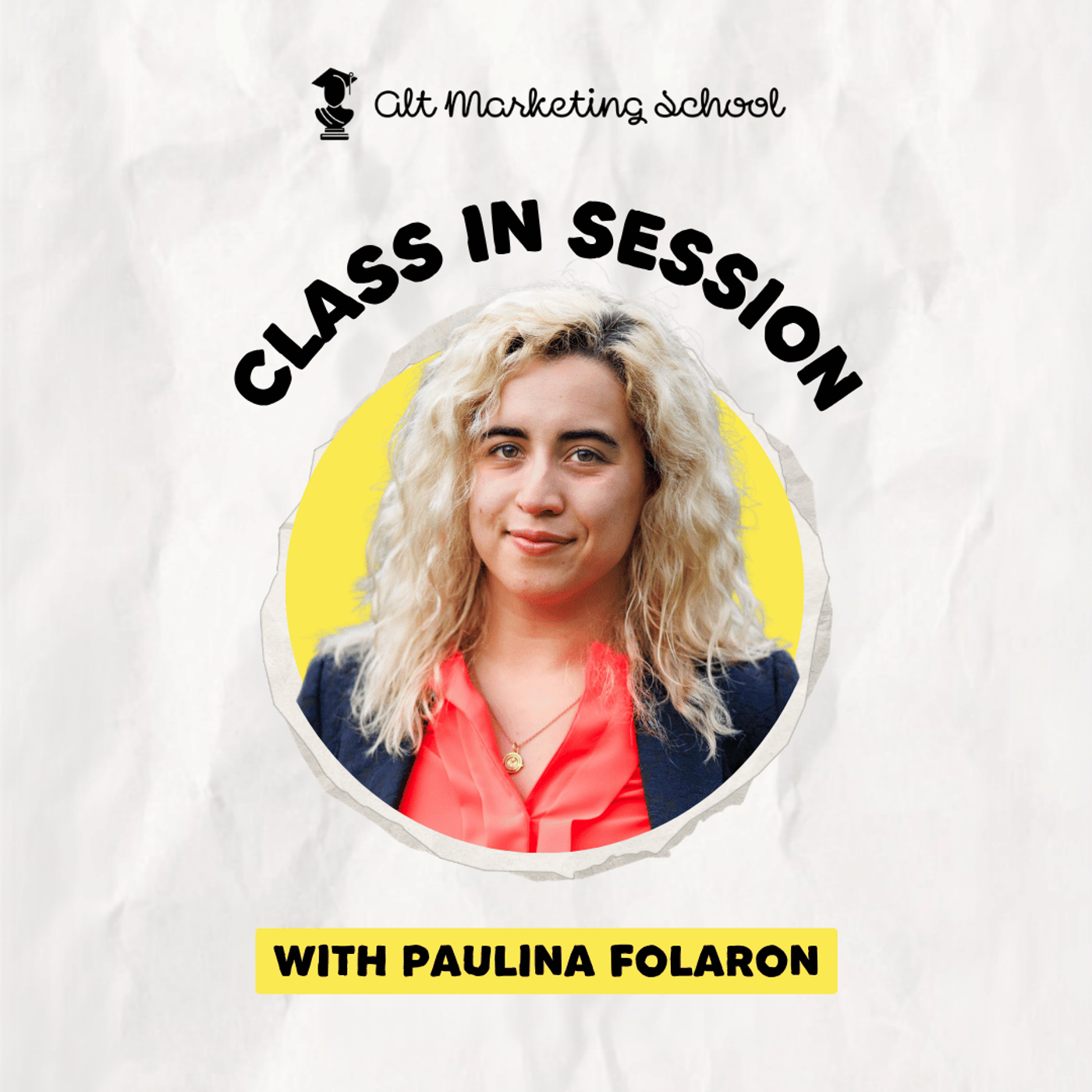
Our first-ever Visibility Challenge: three weeks, three prompts, running through September. Join in and share yours via All-Access Pass Rust out is coming for marketers next, burnout's sneakier, quieter cousin, and it's just as damaging. In this episode, Fab is joined again by AMS coach Paulina Folaron, aka the Solutions Sorceress Supreme, to unpack the anti-hustle trend taking over Gen Z's corner of TikTok: bare minimum Mondays, lazy girl jobs, and rust out. They get into why the old hustle-harder playbook stopped working, what sustainable performance actually looks like for marketers, and one genuinely practical way to start tracking your own impact. ABOUT YOUR TEACHER Paulina Folaron is an operations and digital marketing strategist, self-styled "Solutions Sorceress Supreme," who brings a bit of witchy, a bit of whimsy, and a lot of anti-hustle energy to everything she does. She's a coach at Alt Marketing School, helping people scale their businesses and build sustainable, analytics-driven marketing without the burnout. Website: paulinafsolutions.com LinkedIn: Paulina Folaron BECOME A SMARTER MARKETER 👇 Get weekly lessons in your inbox for £0: Signup for the newsletter CONNECT WITH AMS 🤝 Our course library Our certification OUR SPONSORS 🪩 Collect and showcase testimonials effortlessly with Senja Stay ahead on everything social media with Annie-Mai's newsletter The Social Tea by Girl Power Marketing Grab 3 months of Canva Pro free with code ALTMARKETING3: click here View all sponsors and offers SUPPORT 🫶 Leave a review on Apple Podcasts Leave a rating on Spotify
Paulina: So rust out. you end up in a similar space as to when you are burnt out, but it's technically sort of the opposite. So you're not being overworked or like hustling too hard and just trying to do too much into a little time, not looking after yourself. It's sort of the opposite. You're being underutilized and it's leaving you feeling again, sort of listless, a bit useless, a bit like no one cares that I've got these abilities, these skills, no one's developing me. Fab: Hello Rebels and welcome back to All Marketing School. We keep up with marketing so you don't have to. That's the whole idea for us is to make marketing better for marketers. My name is Fab. I'm the founder, headteacher, and your host. And today I'm joined yet again by our coach, Paulina. And we're here because she's all about anti-hassel ways of working, helping people scale their business and build sustainable marketing without the burnout. And since we're gonna be talking about lazy girl jobs and more. and the anti-hustle trends that are happening on TikTok when it comes to Gen Z. I thought I'll bring it back in. So Paulina, hi, how are we doing today? Paulina: Hi, all good, thank you. I'm so delighted to be back. Shall I say a sentence or two about myself because I'm not as famous as I'd like to be yet. So for those who don't yet know Fab: Ha ha Paulina: me, why don't you yet know me? No, I'm Paulina. I'm an operations and digital marketing strategist, also known as Solutions Sorceress Supreme. Thank you very much. Bring a bit of witchy and a bit of whimsy to everything I do. But ultimately my whole vibe is anti-hustle, anti-burnout. anti bullshit. So I'm here to see how we can do ops and marketing in a way that doesn't strip joy out of your life and business. And I'd love to hear what you're bringing to the table. This anti, you mean anti like burnout is actually something we're talking about fab like out in the Gen Z world. Tell me. Fab: Yeah, yeah, and it's kind of interesting because there were some stats, which I'm gonna throw a couple because stats that were also coming out, but I think it was obviously ops people together, ops and marketing people together. But also there was again as I said, a bit of a trend, which usually leads into like a language basically that came from TikTok. But this the hard stats themselves they go back into looking at a bit of a lens of the Gen Z that is in the workforce or just about coming into the workforce, which is where this interesting lens came from. They say that 36% of Gen Z say they're very engaged at work. But as a result of that, 91% of them, I repeat, 91% of them have experienced burnout or a mental health challenge at some point in what I would say for some of them a relatively shortish career experience. You know, we're not talking about 20 years of of work and careers. So already maybe entering into the workforce, it's already been a bit of a challenge for them. And now as a colour of correlation to that or as an interesting serendipitous coincidence. we have seen on TikTok it was where the surfaced this trend of language that talked about things like bare minimum Mondays, lazy girl jobs. But also on top of that, which I found really interesting, there has been even on Instagram, which is mainly where I live to be frank, more Paulina: Mm-hmm. Fab: conversations and content and behind the scenes of people that actually are From many different generational outputs coming out of busy life and actually celebrating and almost recounting and journaling in a way in a video form, their new kind of slow living and slow life. So it's kind of see interesting to see that this is very Gen Z driven. However, it's not just that. And I think it's just interesting that we don't want history to repeat itself, but obviously, because it's a generation that is very much about documenting their life. on top of on top of being aware of it, they also created content around it. So I was kind of wondering when it comes to how you work with people and some of the experience that you had yourself, what do we, what can we do to actually start thinking about where we are sitting in this sort of burnout, taking on more, more is more mentality when it comes to our work. Paulina: you flatter me. Are you asking me because I can pass for a Gen Z? Is that what we're doing? Thank you very much. Thank you. Ever so flattered. Fab: us millennials of course. Paulina: Us millennials, are so, so long on this trolley of, you know, anti-hustle. We've, we've, think, definitely widespread with our generation-ish. And I don't want to create too big a generational divide. Obviously, I'm not for that. But I think it's interesting to see what each bigger sort of age group and generation experiences and how it drives their behavior, also as consumers and as creators, because it's super interesting to see the differences. And it's, yeah, so in terms of my experience personally, as I've said already what I stand for in my business, I jumped on that, you know, anti-hustle a while back. Hustle for me just stinks of... I had money from daddy and I'm going to give you advice and charge you for it. So that's sort of what I see every time someone's just like, yeah, you just, if you just work a bit harder, you'll go, no, no, no, you won't. That's not how economics works. Trickle down economics, never trickle down. Meritocracy is a lie. I'm not being a cynic here. These things have now been proven through data and studies and experts coming out and saying, yeah, trickle economics, trickle down economics failed. that never worked, that money did not go down to the working class that needed it. Or if you work harder, for an example, if you've got a physical job and you are working 50, 60 hours a week, I don't see how you're actually having a better life than someone who works three hours a week, but they're, I don't know, a pop star or, you I'm just trying to work out someone who might be working like less hours, but ultimately sort of maybe less physical effort or something else. These things are so hard to compare because simply we don't live on the same linear kind of structure. And if only, if you could work harder, you gain more. You don't. That's not how capitalism is structured. That's not how this economy that we have, I'll speak for like the Western and Central Western civilization is built. So no wonder as we have become, we the millennials then became, you we got our degrees, you know, more than any other previous generation. We got our jobs and then we became very quickly disillusioned and unhappy. because we were like, I've worked so hard and I'm struggling to get promotion. I'm struggling to get, you know, more money. I'm struggling to save for a house. if only I stopped eating my avocado toast, that will buy me a house. We know all of that. And now if we take it back down to like back down the generational ladder to Gen Z's and we go, okay, they are now in a situation where they've seen what happened to us that studying harder, working harder, following the rules of stay at this job like our parents did and that will reward you. no longer work because you statistically speaking don't have the same benefits when you have a job. don't get, I live in the UK so I'll speak for that, you don't get dental with a job unless you have a really great job but it's not standard. You don't get all these extra benefits that used to be sort of more standard with our parents generation when you had a full-time job you were more looked after and tied into that job for your well-being. That's no longer the case. So structurally speaking that has really affected how we then move through jobs. And then Gen Zs have looked at that and they've gone, okay, so the economy is more unstable. There's less jobs on the market. Our elder siblings or young parents, depending on the age gap here between me and them, have tried this and they've tried it really hard and it's not worked for them. So why should we try this hard? What exactly is my motivation to be selling my soul to this company when... Like, what is it? And they want the company to actually tell them. They don't want to look for that answer, present it, sort of, I suppose like maybe we did before, we would say, I've done the research for you, so you don't, you know, don't want to interrupt. I'm sorry, sorry, super quick. So is this why I'm trying this hard? you just quick yes or no, please? You know, that was very much the like the hustle attitude of please just, you know, let me keep this because this would be key to me having a better life. I don't know, a house or whatever. stable family situation. And I think the Gen Zs are very much over that people pleasing being worried about a job going because the jobs are already unstable so they just go whatever you tell me why I should try harder. Fab: One of the things that I found interesting, like as as you're talking as well, is then not only as you say, that realization, but also owning and trying to actually showcase what sustainable performance can look like. And in an ideal world, it would also show the people above them or the people around them, you know, whether it's managers, sometimes even clients, you know, we don't we're not gonna get into those stats, but the number of even like people that get into work and are starting as freelancers, basically only not only being their own boss and even having less benefits, like fewer benefits tied to their name. But on top of that, they also have to look at managing more than one or two stakeholders, which means like stakeholders can be clients, can be managers, can be people in this case or customers. In this case it's basically they have to manage the clients. Sometimes they have to manage collaborators and multiple people at the same time. And I think, you know, It's interesting to see how terms like I'll give you the example of one of them was the bare minimum Mondays, was actually something that is not necessarily new. So actually it went viral at first in 2023. So a startup founder called Marisa Yumayas in in the US did this. And so basically kind of created this bare minimum Mondays as a way to go against the Sunday scaries, which is something that has millennials. I'm gonna put my hand up. I've seen far too much content and far too many conversations around that, you know, how to what it is and how to go and make sure that you don't feel that pressure and that front loading on the Mondays. So I think it's interesting that this is not completely new, some of these kind of terms, but they're coming back. And it's almost like knowing that one of the options can be to just literally feel overwhelmed. And so reclaiming a bit of that, which I appreciate when it's done with content, when it's done with sharing and documenting, and thinking about what the sustainable performance looks like. I think, and you know, I want to hear your opinion here because you've kind of hinted it at it already, especially as a marketer, we are inherently already adding to, and this is gonna be my little soapbox moment, everybody, get ready for a mini tech talk. We already have as marketers to inherently think about How to justify the fact that we exist, which when you think about it, is absolutely ridiculous. Plus, Paulina told you, just as a refresher, she's also a hops queen, just like myself, is is something that I didn't realize was one of my strengths, but it is. So we're systems and processes people. So we don't just bring the relationship building, we also make it so that it doesn't drive us insane. And when I think about the fact that as humans on a personal life, most of us, including myself, can barely keep track of WhatsApp groups or conversations. Marketing is that a scale, right? Because the best way for you to build super fans in a community and trust with your customers or clients, whichever, is really to nurture these relationships. And it's taxing, and so much falls under our shoulders. So that's to say that in itself is not easy. On top of that, we constantly have to justify that it's not just sales, because it can lead to conversions, but it's not just sales. So I think it's refreshing. I think. It's good that it sparks a conversation about what sustainable performance looks like. And I kind of think, and I want to hear your opinion here, to round this up, that as marketers, we also need to ask ourselves this question and see if we will be able to explain or answer it. We shouldn't, by the way. We shouldn't have to do that. That's my opinion. We shouldn't have to be the ones that justify our existence. But it can be hard sometimes to be faced with that and be like, I don't know if people understand how much work I'm doing. And so you feel I have to do more to show that things are happening. Whereas a lot of the time, at least I know because I know Paulina really well, is also how we explain things, is how we learn how to communicate and and explain our value that is not tied to how many hours, how many tasks we close and stuff like that. So that's my final thinking. I wanted to see if there's something that you can also reflect upon when it comes to this to give people something tangible out of. Something that we hoped that we didn't have to constantly talk about again, like being the anti-hustle, as you say, waivers of the flag, but we still do. So I think as marketers, there's this layer, and I I generally think that we can learn how to do better and not just us be more efficient, because it's not about efficiency. I think a lot of the time it's about communicating and explaining actually the value of the shitloads amount of work, pardon my French, that we put in every single day. Final thoughts on that. Paulina: Just on that, nothing more. Fab: What? Paulina: There's so many thoughts, Fab, and frankly, I would love nothing more than to do another episode, like a deep dive on this subject, because I think it's so fascinating. And because both of us as ops people, sit in this space of efficiency and productivity, but also trying to find the wellbeing balance and the sustainability of it. And we sit in this... sort of crazy overlaid Venn diagram of it. I think it's never just, it's never so straightforward, is it? It's never just like, here's the simple answer. Here's the one thing you can do to improve your efficiency. We're not going to send you away with anything like that because that would be oversimplifying it. But if I were to say something that is sort of simple enough sounding, that sums up quite a bit of what I believe in around productivity, efficiency, sustainability, and sort of not burning out. whether you're employed or not, but ultimately in whatever you do for the majority of your week, I would say, don't forget that as a human, first of all, that you are a human in this age of, you know, AI and things being so streamlined and made more optimized and all of those fancy, fancy words, we can sometimes forget about the human factor, but you are an animal, you are a human, you need to see the impact of your work and often burnout will happen because you're either being worked or working yourself. I'll let you decide it's probably a crossover. Too hard with too little an impact that is visible, easily visible to you. And that is one of the biggest things that makes you then feel like, why do I bother? What am I doing here? This is too hard. I'm making no change, no difference. You know, that's, that's huge. So I would say, remember that what you do, does have an impact, but you need to see that impact. So if you're not seeing it right now, maybe that is a good moment to just question, okay, can I adjust anything? Can I speak to my manager? Can I change the way I'm behaving or tracking or logging things in my business? Can I change the way I'm showing up? Small tweak. Impact matters. If I can throw in one extra thing though, Fab, because I wanted to add, seeing as we're talking about burnout, I wanted to ask you, have you heard about Rust out? So super quick on that front, this is a super new thing that I just read about very recently, which is very much a Gen Z related thing. We've just got a new phrase for something that I think obviously has been, mean, know, anti-hustle has been around for a long, long, long time. It's just good to see that it is being brought to the forefront again. And like the next generation has got the, you know, it was waving the flag, as you said, and then sort of taking up that mantle. So rust out. is sort of, it ends up, you end up in a similar space as to when you are burnt out, but it's technically sort of the opposite. So you're not being overworked or like hustling too hard and just trying to do too much into a little time, not looking after yourself. It's sort of the opposite. You're being underutilized and it's leaving you feeling again, sort of listless, a bit useless, a bit like no one cares that I've got these abilities, these skills, no one's developing me. So. Right now, apparently, and I'll link back to the AI and I say apparently, just because I've read a few articles, I've not experienced this myself, but I'm fully willing to believe this is what's happening in the workplaces right now is through the adoption of so many automations, quite indiscriminate. adoption of all these automations, which is a whole other problem in my opinion. A lot of the staff, a lot of workers are being left feeling like they are not actually being asked to use their skills to do their job. Instead, they're having to just put into a system, take it out and take the brunt of presentation or following through on the actions. So they're actually feeling a bit like. you know, well, who cares? Like, who cares if I, they sort of under stimulated, which is the opposite of how I function. Whoops. And they're being left, yeah, just sort of feeling like, well, yeah, I can be here, but it's almost like they're just coasting. So there's no, again, there's no impact or satisfaction. So either way, lack of impact and lack of satisfaction, as we know, has huge, huge impact, ironically. it results in so much detriment to our wellbeing in a lot of ways and also to our tangible career progression. Because I don't want anyone listening to think, I'm banging on about wellbeing. Yeah, we get it. We'll sleep more and we'll feel a bit better. No, I think. wellbeing is so big, you can look at it holistically, it's how you feel in your body and you know, how you feed yourself how much you sleep, but it's also where's your career going? How your finances stable and making you feel safe and secure? Have you got you know, time to be away from all of these things matter. So yeah, when you're sort of in a job in a, especially now economically unstable moment where your job hugging as they call it, so you're sticking with a job. because there isn't a better alternative, so you may as well stick to what you know. And then they're underutilizing you. That leaves you with that other side to burnout, which is just like meh as a job approach. And apparently that's something that a lot of Gen Zs are experiencing. And frankly, I think it's as bad as burnout. But it's, yeah, it's called rust out. So they just get rusty because they're not actually being used to the full capacity. Fab: I like the idea also of the meh. You like the the two ways of defining Rust out and meh. My final thoughts on I got two folds of thoughts, and one of them looks like it almost looks like I've been doing this for a while, right? I'm gonna bring it back to one of the things you said earlier. but there's two there's two thoughts here. The first thought is a bit about us as a school, I guess. But one of the things that I was really conscious about is that We we get you in with the hard skills as well. Like you can learn about SEO, funnels, etc. We also get you in with the community. And one of the things that we always do, again, Pauline is one of our coaches, so I know is really try to push you to be curious or to ask questions. We ask you questions back so that you can think. And I think that kind of c critical and lateral thinking helps so much. If you really are reclaiming some space with the automations, how can you then showcase and make time for that creative thinking and actually pitch wilder ideas and and sketch it out and you know and use it as a way to make space. But as you say, it's it's not as easy. So I've got one practical thing that we can think about for that. But before that, I just wanted to say, which is why at the school every single assignment that we have for each and every course, I updated them all, so I know that's the case. from September onwards, I made sure that there were snapshots that really help you put into practice ideas and thoughts, for example, for a funnel. or ideas and thought for our UGC campaign brief. I really want us to have more time to do that. And then you know that you can come to us as coaches. We will review that work, ask you questions, and help you optimizing it so that you have that as your assignment to really think and come up with great ideas yourself. It's not GPT driven, it's not agent driven. It's just a simple snapshot and you fill the gaps. And I think the more we can do that and the more the employers allow us to do that and give us the space to do that, The more we can strengthen all the human and the creative inside of us. The other point to finish off was that going back to Paulina, you talk about it yesterday. So I'm gonna say if you want a physical way to actually look at your impact, because yesterday we have a demo recording. So this week past, we had our networking session, and then we just went on physical ways of look at progress, like Gold Star you mentioned and stickers. So you can even do that when it comes to your achievements and wins. not just because we want you to buy stickers, but going back to what Paulina was saying in our network Working with the members. It's just about seeing things and sometimes the physical help. So that could be another way to start looking at your impact, even if you do it in your own home office, even if you work for somebody else. I have a folder that has screenshots that say, like, I'm awesome, and then it's got all the little things that students say about us. Whatever that might be, that could be a starting point for you. It doesn't replace talking to your employers and finding other tangible ways. round it up today, what's been happening at the school this week has been a bit busy. We had the networking session that I just mentioned. We have kicked off our first visibility challenge. Yet another way, in my opinion, to show your impact as a marketer and work on that. So I'm really excited to see all the posts coming through and tagging us. And we also have our monthly Slack AMA, which is gonna be with Margaret Ward, one of the business of marketing speakers. And so what I'm gonna leave you with before we come and say goodbye is a little voice extra from Margaret's AMA, which happened on Thursday the 17th. And if you want more of this kind of thing, like the networking sessions, the AMAs, the challenges, our courses, the assignments, come and hang out with me, Paulina, and the rest of the gang at any time inside the classroom with the all access pass. You can find the link in the show notes as always. But before we go, Paulina, why can people come and say hi to you after this and chat more about rusting out and burning out? Or not. Paulina: and how to prevent them, yeah? How to stay curious. Fab: Yes. Paulina: How can I burn out even harder? Well, right, where you can find me if you want a bit of anti-hustle and anti-burnout, but still seeing your impact and staying curious and just retaining joy in what you're doing. Definitely hop onto my website. It's PaulinaFSolutions.com, where you can then find all of my links, my services, but also subscribe to my newsletter, which I would really recommend because I'm a long form queen and I love sharing a lot of value and a lot of insights and bit of tongue in cheek stuff in my emails. which is called Solutions Sorcery, the email. I also have Solutions Sorcery, the podcast, which I've just kicked off. So I'll probably do like an episode a month or so, slow burn, stick around. Or Instagram, probably quite quick to get me on there. It's pulinaf underscore solutions. Fab: Thank you so much for being here today. As always, today, even more so, don't forget to be kind to yourself and others. Yes, no burnout, no rest out. You're amazing. And as always, never stop learning because practice makes progress. And until next time, class is dismissed.