
AI Post Transformers · mcgrof
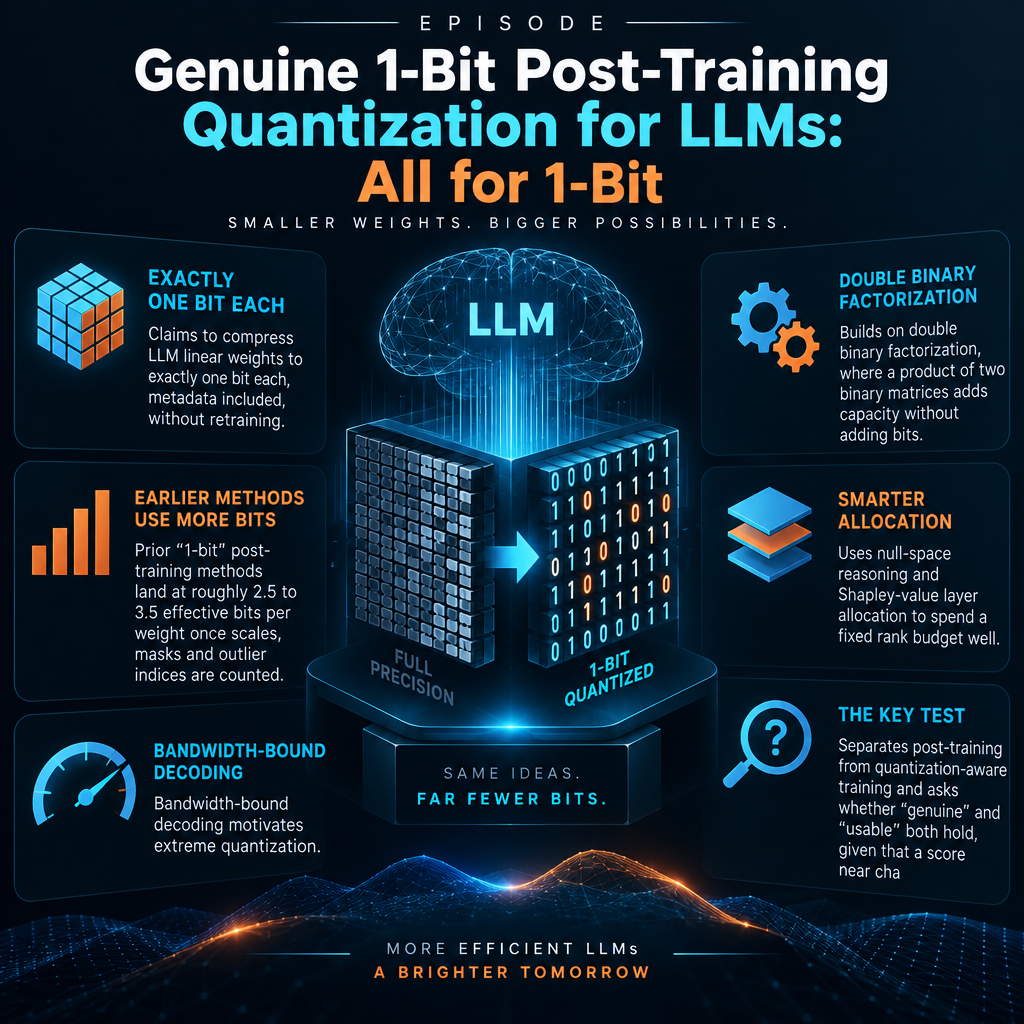
This episode examines "All for 1-Bit," a paper claiming to compress LLM linear weights to exactly one bit each, metadata included, without retraining. It builds on double binary factorization and challenges earlier "1-bit" post-training methods, which land at roughly 2.5 to 3.5 effective bits per weight once scales, masks and outlier indices are counted. The discussion covers why bandwidth-bound decoding motivates extreme quantization, how a product of two binary matrices adds capacity without adding bits, and how null-space reasoning and Shapley-value layer allocation are meant to spend a fixed rank budget well. Along the way it separates post-training from quantization-aware training and sets up the key skeptical test: whether "genuine" and "usable" both hold, given that a score near chance (about 25 on the zero-shot scale) means a broken model. Listeners get a clear explanation of what "bits per weight" really measures and a framework for judging low-bit quantization claims. Sources: 1. All for 1-Bit: Towards Genuine 1-Bit Post-Training Quantization for LLMs — Zhixiong Zhao, Zukang Xu, Guangyu Sun, Lifeng Liu, Dawei Yang, 2026 http://arxiv.org/abs/2609.06161 2. BiLLM: Pushing the Limit of Post-Training Quantization for LLMs — Wei Huang, Yangdong Liu, Haotong Qin, Ying Li, Shiming Zhang, Xianglong Liu, Michele Magno, Xiaojuan Qi, 2024 https://scholar.google.com/scholar?q=BiLLM%3A+Pushing+the+Limit+of+Post-Training+Quantization+for+LLMs 3. ARB-LLM: Alternating Refined Binarizations for Large Language Models — Zhiteng Li, Xianglong Yan, Tianao Zhang, Haotong Qin, Dong Xie, Jiang Tian, Zhongchao Shi, Linghe Kong, Yulun Zhang, Xiaokang Yang, 2024 https://scholar.google.com/scholar?q=ARB-LLM%3A+Alternating+Refined+Binarizations+for+Large+Language+Models 4. OneBit: Towards Extremely Low-bit Large Language Models — Yuzhuang Xu, Xu Han, Zonghan Yang, Shuo Wang, Qingfu Zhu, Zhiyuan Liu, Weidong Liu, Wanxiang Che, 2024 https://scholar.google.com/scholar?q=OneBit%3A+Towards+Extremely+Low-bit+Large+Language+Models 5. BitNet: Scaling 1-bit Transformers for Large Language Models / The Era of 1-bit LLMs: All Large Language Models are in 1.58 Bits — Hongyu Wang, Shuming Ma, Li Dong, Shaohan Huang, Huaijie Wang, Lingxiao Ma, Fan Yang, Ruiping Wang, Yi Wu, Furu Wei (BitNet); Shuming Ma et al. (b1.58), 2023 / 2024 https://scholar.google.com/scholar?q=BitNet%3A+Scaling+1-bit+Transformers+for+Large+Language+Models+%2F+The+Era+of+1-bit+LLMs%3A+All+Large+Language+Models+are+in+1.58+Bits 6. GPTQ: Accurate Post-Training Quantization for Generative Pre-trained Transformers — Elias Frantar, Saleh Ashkboos, Torsten Hoefler, Dan Alistarh, 2022 https://scholar.google.com/scholar?q=GPTQ%3A+Accurate+Post-Training+Quantization+for+Generative+Pre-trained+Transformers 7. SVD-LLM: Truncation-aware Singular Value Decomposition for Large Language Model Compression — Xin Wang, Yu Zheng, Zhongwei Wan, Mi Zhang,...
0:01[Hal Turing] Alrighty! Thanks for tuning in! Hello AI world! I am your host, Hal Turing, and my co-host is Dr. Ada Shannon.
0:07[Hal Turing] Today's paper is "All for 1-Bit: Towards Genuine 1-Bit Post-Training Quantization for LLMs," by Zhixiong Zhao, Zukang Xu, and colleagues at Houmo AI and the School of Integrated Circuits at Peking University. It was posted to arXiv in September 2026. It builds on "Addition is almost all you need: Compressing neural networks with double binary factorization," by Vladimír Boža and Vladimír Macko, arXiv 2025. We'll call that one DBF. The question is whether you can compress an LLM's linear weights to exactly one bit each, with no retraining, and still have something useful.
0:51[Dr. Ada Shannon] The claim is that earlier methods called "1-bit" aren't. Once you count everything they store, they land between about 2.5 and 3.5 bits per weight. This paper says it hits exactly 1.0, metadata included. So we should test two words in that claim: "genuine" and "usable."
1:08[Hal Turing] Start with why anyone wants this. Why chase one bit?
1:11[Dr. Ada Shannon] The paper's framing is memory traffic. A 400-billion-parameter-class model is roughly 800 gigabytes in BF16. Decoding one token at a time is mostly bandwidth-bound, because the GPU spends its time streaming weights. Fewer bits per weight means less to stream. That's the authors' argument, and it's a standard one.
1:31[Hal Turing] And binarization means each weight becomes plus one or minus one?
1:34[Dr. Ada Shannon] Times a scale. W is approximately alpha times B, where B is a sign matrix. The matmul turns into additions and subtractions. The trouble is that one sign matrix has very little capacity. Real weights have varied magnitudes and outlier channels. So methods like BiLLM from 2024, ARB-LLM, STBLLM and HBLLM add rescue machinery: extra scales, masks marking salient weights, residual passes, group assignments.
2:03[Hal Turing] And that machinery costs storage.
2:05[Dr. Ada Shannon] Yes. Effective bits per weight is total storage bits divided by weight count, including scales, masks, group parameters and outlier indices. Table 1 puts BiLLM at 2.88, ARB-LLM at 2.51, HBLLM at 3.25 and STBLLM at 3.50. AF1 claims exactly 1.0, but only for target linear weights. Embeddings, the output head and norms aren't part of that claim.
2:31[Hal Turing] Is there a way to get a true one bit by training instead?
2:34[Dr. Ada Shannon] That's the other route. Post-training quantization, PTQ, takes a finished model, uses a small calibration set, and never retrains it. Quantization-aware training, QAT, puts the low-bit constraint in the loop. OneBit and LittleBit are QAT, and they get real one-bit storage. The cost is hundreds to over a thousand GPU-hours. BitNet b1.58, by Ma and colleagues at Microsoft Research in 2024, goes further and trains ternary models from scratch. That's context, not a competitor here. AF1 wants QAT-style storage at PTQ cost.
3:14[Hal Turing] So how do you widen a single sign matrix's capacity without adding bits?
3:19[Dr. Ada Shannon] DBF's answer is to write the matrix as a product of two binary matrices. Each has its own full-precision scaling vectors around it. The inner dimension, the rank, sets the storage budget. A product of two sign matrices can take many more distinct values than one sign matrix, so the factorization buys expressiveness without extra bits per entry. Inference still needs only additions, sign flips and cheap vector scalings.
3:45[Hal Turing] Then the paper needs two more ideas. First one?
3:47[Dr. Ada Shannon] The null space. Say you approximate A times B, and B has a direction it maps to zero. An error in A that lies in that direction gets multiplied by B and vanishes from the output. So it's free to leave uncorrected. Spend your limited binary capacity on the errors that survive the product. We'll see shortly how AF1 uses this.