
AI Post Transformers · mcgrof
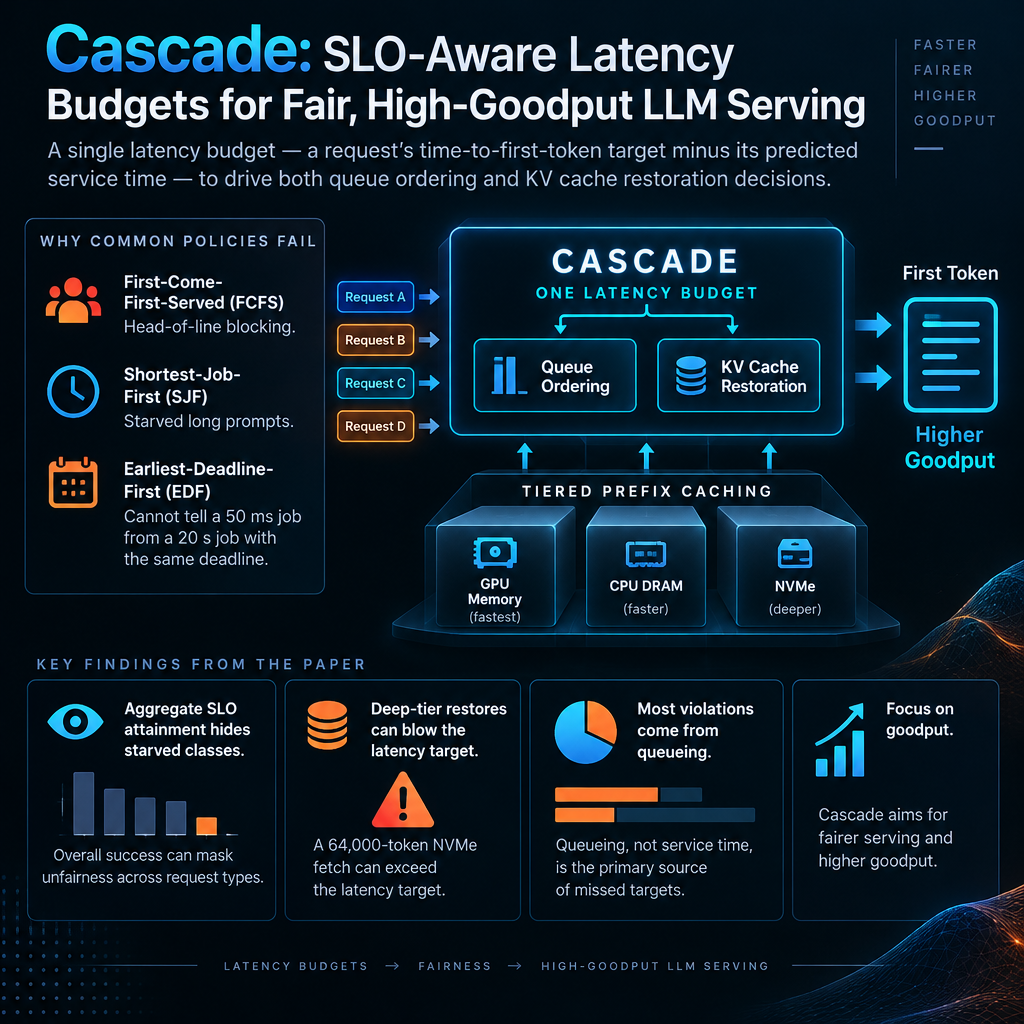
This episode examines Cascade, a serving system that uses a single "latency budget" (a request's time-to-first-token target minus its predicted service time) to drive both queue ordering and KV cache restoration decisions. It explains why first-come-first-served, shortest-job-first and earliest-deadline-first each fail. The failures are head-of-line blocking, starved long prompts, and an inability to tell a 50 ms job from a 20 s job with the same deadline. The discussion covers goodput, tiered prefix caching across GPU memory, CPU DRAM and NVMe, and chunked prefill. It also covers the paper's motivating findings: aggregate SLO attainment hides starved classes, deep-tier restores such as a 64,000-token NVMe fetch can blow the latency target, and most violations come from queueing rather than a lack of budget. Listeners get a clear walkthrough of the scheduling vocabulary, Jain's fairness index and the budget estimator. They also get a caveat that the headline cluster results come from an extended simulator fed with GB200 NVL72 data-movement profiles rather than a real deployment. Sources: 1. Cascade: Exploiting SLO-Aware latency budget for fair and high goodput LLM inference serving — Muhammad Adnan, Rohan Mahapatra, Prashant J. Nair, Daniel Berger, Pantea Zardoshti, Rodrigo Fonseca, Esha Choukse, 2026 http://arxiv.org/abs/2608.06557 2. Orca: A Distributed Serving System for Transformer-Based Generative Models — Gyeong-In Yu, Joo Seong Jeong, Geon-Woo Kim, Soojeong Kim, Byung-Gon Chun, 2022 https://scholar.google.com/scholar?q=Orca%3A+A+Distributed+Serving+System+for+Transformer-Based+Generative+Models 3. Taming Throughput-Latency Tradeoff in LLM Inference with Sarathi-Serve — Amey Agrawal, Nitin Kedia, Ashish Panwar, Jayashree Mohan, Nipun Kwatra, Bhargav Gulavani, Alexey Tumanov, Ramachandran Ramjee, 2024 https://scholar.google.com/scholar?q=Taming+Throughput-Latency+Tradeoff+in+LLM+Inference+with+Sarathi-Serve 4. Fast Distributed Inference Serving for Large Language Models (FastServe) — Bingyang Wu, Yinmin Zhong, Zili Zhang, Shengyu Liu, Fangyue Liu, Yuanhang Sun, Gang Huang, Xuanzhe Liu, Xin Jin, 2023 https://scholar.google.com/scholar?q=Fast+Distributed+Inference+Serving+for+Large+Language+Models+%28FastServe%29 5. Efficient LLM Scheduling by Learning to Rank — Yichao Fu, Siqi Zhu, Runlong Su, Aurick Qiao, Ion Stoica, Hao Zhang, 2024 https://scholar.google.com/scholar?q=Efficient+LLM+Scheduling+by+Learning+to+Rank 6. DistServe: Disaggregating Prefill and Decoding for Goodput-optimized Large Language Model Serving — Yinmin Zhong, Shengyu Liu, Junda Chen, Jianbo Hu, Yibo Zhu, Xuanzhe Liu, Xin Jin, Hao Zhang, 2024 https://scholar.google.com/scholar?q=DistServe%3A+Disaggregating+Prefill+and+Decoding+for+Goodput-optimized+Large+Language+Model+Serving 7. Fairness in Serving Large Language Models — Ying Sheng, Shiyi Cao, Dacheng Li, Banghua Zhu, Zhuohan Li, Danyang Zhuo, Joseph E. Gonzalez, Ion Stoica,...
0:01[Hal Turing] Alrighty! Thanks for tuning in! Hello AI world! I am your host, Hal Turing, and my co-host is Dr. Ada Shannon.
0:09[Hal Turing] Today's paper is "Cascade: Exploiting SLO-Aware Latency Budget for Fair and High Goodput LLM Inference Serving," by Muhammad Adnan and colleagues. Adnan did the work as an intern at Microsoft Azure Research, and the affiliations are the University of British Columbia, Microsoft Azure Research and NVIDIA. It appeared on arXiv in August 2026. The question: if you subtract a request's predicted service time from its latency target, can that one leftover budget drive both the order of the queue and the decisions about restoring KV cache, without starving long prompts?
0:50[Dr. Ada Shannon] Same latency target, very different urgency. That's the problem. One cluster now serves chat, tool and agent calls, coding and reasoning. Inside a single class, prompts and outputs can differ by orders of magnitude, and so can how much cache is already warm. A scheduler that treats them as equals wastes capacity.
1:11[Hal Turing] Let's set the vocabulary. Start with the two phases of inference.
1:15[Dr. Ada Shannon] Prefill reads the whole prompt in one compute-heavy pass and builds the KV cache, the per-token attention state. Decode then emits tokens one at a time and is limited by memory bandwidth. Each phase gets its own latency target. Time to first token, TTFT, covers prefill. Time per output token, TPOT, covers decode. Lower is better for both.
1:38[Hal Turing] And goodput?
1:39[Dr. Ada Shannon] Throughput counts every token served. Goodput counts output tokens per second only from requests that meet both the TTFT and TPOT targets. A server can look busy and still deliver little goodput if most answers arrive late. DistServe, from Zhong and colleagues in 2024, popularized that framing for LLM serving.
2:01[Hal Turing] Now the scheduling failures. Take one 20,000-token prompt sitting ahead of many short chats.
2:06[Dr. Ada Shannon] First-come-first-served, FCFS, is the vLLM default. It never starves anyone, but that big prefill blocks everything behind it. That's head-of-line blocking. Shortest-job-first fixes it by serving short work first, which helps most requests, but long coding or reasoning requests keep getting bumped. Earliest-deadline-first, from Liu and Layland's 1973 real-time work, has a different blind spot. Two requests with the same deadline look identical, even if one needs fifty milliseconds of work and the other needs twenty seconds.
2:38[Hal Turing] So the missing quantity is slack. Deadline minus the work still to do.
2:42[Dr. Ada Shannon] Right, that's close to least-laxity-first from real-time systems. Cascade calls it the latency budget: the class TTFT target minus an estimated TTFT for that request. Queueing, contention, preemption and KV transfer all spend from it, and it shrinks as the request waits.
3:00[Hal Turing] One more piece of mechanism. Why does the cache matter for scheduling at all?
3:04[Dr. Ada Shannon] Prefix caching. If a new request shares a prefix with earlier work, like a system prompt, a previous chat turn or a code repository, you reuse that state and skip prefill compute. But the cache is tiered. GPU memory, HBM, is fastest. CPU DRAM is the warm tier, reached over NVLink-C2C on GB200. NVMe is the deep tier, reached through GPU-Direct Storage. A deep-tier hit saves compute but costs transfer time.
3:35[Hal Turing] Does the transfer time actually hurt?
3:37[Dr. Ada Shannon] The paper's Figure 4 says yes. A 64,000-token prefix fetched from NVMe on Qwen-2.5-72B blows the TTFT target, even with LMCache's batched prefetch. Existing caches decide what to keep by capacity, reuse probability and transfer cost. They don't ask whether the requesting user can afford the wait.