
Afterlives of Ancient Egypt with Kara Cooney · Kara Cooney
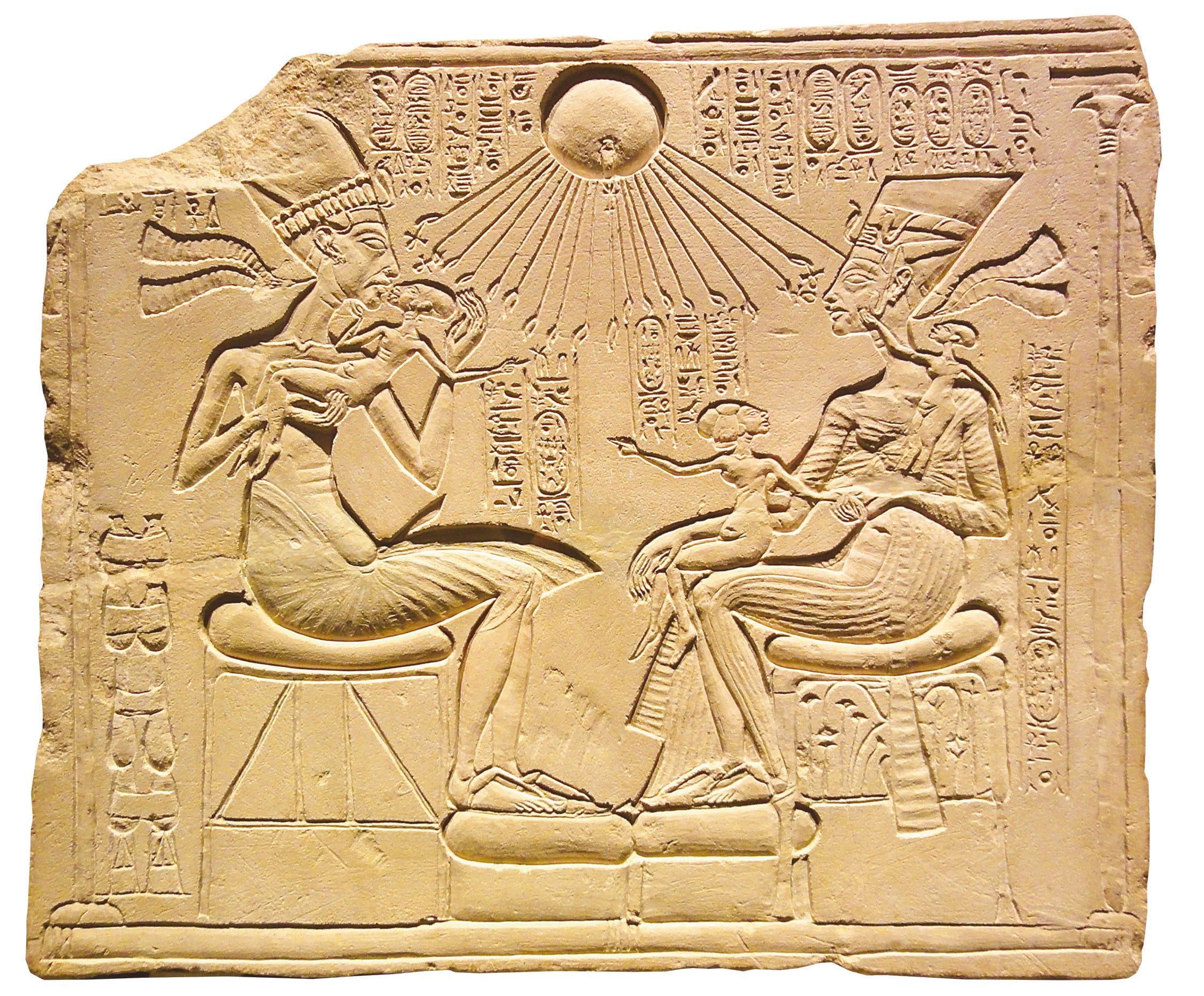
CW: This episode includes discussion of sexual themes, including incest and child sexual abuse. Listener discretion advised. In this episode, Kara and Amber take on one of Amarna’s most famous images—the so-called “house altar” showing Akhenaten, Nefertiti, and their three daughters beneath the Aten (Ägyptisches Museum/Neues Museum, Staatliche Museen zu Berlin, Inv. no ÄM 14145). At a glance, this relief seems to show a sweet private scene of domesticity and familial affection, but taking the time to do some close-looking reveals how the scene might covey so much more. Kara unpacks how—to initiated elite eyes, at least—the piece encodes theology, court politics, sexual and reproductive power. What might Nefertiti’s unique blue crown signal about containment of solar power? Why are the girls’ bodies shown the way they are, like tiny women but with the heads of infants? And how might a palace loyalist use such an altar to telegraph succession hopes—and anxieties—without writing a word? It’s all here, encoded in the stone. Along the way Kara and Amber also explore ancient Egyptian ideas of divine conception, the harem as a political machine, why Amarna “realism” isn’t exactly realism, but an idealized magical end goal, and how royal bodies carried the burden of sustaining royal legitimacy and succession. Show notes Object entry on Google Arts & Culture For more on the commodification of women’s and girl’s bodies, see: Episode #69 - Bodies and Power in the Ancient World Cooney, Kathlyn M. 2025. Body power in the ancient world: patriarchal power and the commodification of women. In Thompson, Shane M. and Jessica Tomkins (eds), Understanding power in ancient Egypt and the Near East, volume I: Approaches, 104-135. Leiden; Boston: Brill. DOI: 10.1163/9789004712485_006. For more on harems in ancient Egypt, see: Episode #41 - Power and Politics in the Egyptian Harem Cooney, Kathlyn M., Chloe Landis, and Turandot Shayegan 2023. The body of Egypt: how harem women connected a king with his elites. In Candelora, Danielle, Nadia Ben-Marzouk, and Kathlyn M. Cooney (eds),Ancient Egyptian society: challenging assumptions, exploring approaches, 336-348. London; New York: Routledge. DOI: 10.4324/9781003003403-31. For the Amenhotep III conception scene discussed in the episode, see: Krauss, Rolf. “Die Amarnazeitliche Familienstele Berlin 14145 Unter Besonderer Berücksichtigung von Maßordnung Und Komposition.” Jahrbuch Der Berliner Museen 33 (1991): 7–36. https://doi.org/10.2307/4125873. Get full access to Ancient/Now at ancientnow.substack.com/subscribe
0:03SPEAKER_02Welcome to Afterlives of Ancient Egypt,
0:06SPEAKER_02in which we discuss ancient history and relevant current events.
0:09SPEAKER_02I'm Kara Cooney,
0:10and I love to take deep dives into history that are not always
0:13possible in academic
0:15SPEAKER_02formats.
0:16SPEAKER_02So let's get started.
0:21SPEAKER_02Hello, everyone.
0:22SPEAKER_02Welcome to another episode of Afterlives of Ancient Egypt.
0:25SPEAKER_02I am your host,
0:27SPEAKER_02Cara Cooney,
0:28SPEAKER_02and I'm joined by Amber Myers-Wells,
0:30SPEAKER_02and we are going to be doing a deep dive into an object.
0:34SPEAKER_02How do you feel about that, Amber?
0:37SPEAKER_00Oh, I'm looking forward to it.
More Afterlives of Ancient Egypt with Kara Cooney episodes →