
Afterlives of Ancient Egypt with Kara Cooney · Kara Cooney
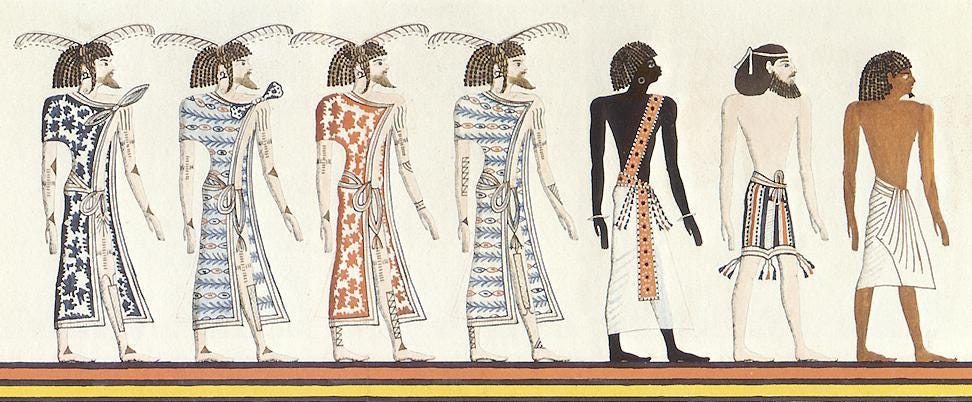
In this episode of Afterlives of Ancient Egypt, Kara, Jordan, and guest Jason Silvestri delve into the enigmatic history of the Libyans during Egypt’s Third Intermediate Period. Jason shares his academic journey into Egyptology, discusses the discovery of ancient Libyan words in the Qeheq papyrus, and highlights his exciting archeological work at El Hibeh. About our Guest: Jason Silvestri Jason Silvestri (BA ’19, Univ. of Toronto; MA ’21 UC Berkeley) is the Lady Wallis Budge Junior Research Fellow at Christ’s College, Cambridge and PhD Candidate in Egyptian Archaeology at UC Berkeley’s Dept. of Middle Eastern Languages and Cultures (MELC), where he is writing a dissertation on the social and political history of the Libyan Period (Dyns. XXI-XXIV). He has also worked extensively on Libyan-Egyptian interconnections, and has published the earliest known evidence of an Ancient Libyan language, the Qeheq Papyrus. In addition to his textual work, he is also an archaeologist, and has worked for several projects in Italy, Greece, and Egypt. Academia https://elhibehproject.org/ Show Notes * Check out Jason’s article on oldest extant text that possibly preserve the Berber language * Third Intermediate Period * Libyan Period * Egyptian glyph rendering of the term “Libyans”- 𓍿𓅓𓎛𓌙𓀀 or 𓍿𓎛𓈖𓏌𓇋𓇋𓅱 * Candelora, Danielle 2019. The eastern Delta as a middle ground for Hyksos identity negotiation. Mitteilungen des Deutschen Archäologischen Instituts, Abteilung Kairo 75, 77-94. * Hubschmann, C., (2010) “Who Inhabited Dakhleh Oasis? Searching for an Oasis Identity in Pharaonic Egypt”, Papers from the Institute of Archaeology 20(1), 51-66. doi: https://doi.org/10.5334/pia.341 * Code Shifting * Use of the term “tribe” within anthropological studies * Banishment Stela * The Amazigh Language Family * Afroasiatic Language Family * Cooper, Julien Charles 2021. Beja and Cushitic languages in Middle Egyptian texts: the etymologies of queen Aashayet and her retainers. Lingua Aegyptia 29, 13-36. DOI: 10.37011/lingaeg.29.02. * Cooper, J. (2020). Egyptian Among Neighboring African Languages. UCLA Encyclopedia of Egyptology, 1(1). Retrieved from https://escholarship.org/uc/item/2fb8t2pz * El Hibeh Want to learn more about the Libyan Period? Suggested Readings: * Ritner, R. K. (2009) The Libyan anarchy : inscriptions from Egypt’s Third Intermediate Period / translated with an introduction and notes by Robert K. Ritner ; edited by Edward Wente. Atlanta: Society of Biblical Literature. * Moreno García, J. C. (2014) Invaders or just herders? Libyans in Egypt in the third and second millennia bce. World archaeology. [Online] 46 (4), 610–623. * Broekman, G. (2011) Theban Priestly and Governmental Offices and Titles in the Libyan Period. Zeitschrift für ägyptische sprache und altertumskunde. [Online] 138 (2), 93–115. Ancient/Now is a reader-supported publication. To receive new posts and support my work, consider becoming a free or paid subscriber. Get full access to Ancient/Now at...
0:03SPEAKER_02Welcome to Afterlives of Ancient Egypt,
0:06SPEAKER_02in which we discuss ancient history and relevant current events.
0:09SPEAKER_02I'm Cara Cooney,
0:10and I love to take deep dives into history that are not always
0:13possible in academic
0:15SPEAKER_02formats.
0:16SPEAKER_02So let's get started.
0:21SPEAKER_01Hello, hello.
0:22SPEAKER_01Hey there.
0:24SPEAKER_02How are you doing?
0:26SPEAKER_02Good, good.
0:27SPEAKER_02We were just talking about the end of the world, which...
0:31SPEAKER_02Fiscally,
0:32SPEAKER_02the end of the world at UCLA,
0:34which I think allows us to introduce our guests because it's
More Afterlives of Ancient Egypt with Kara Cooney episodes →