
Afterlives of Ancient Egypt with Kara Cooney · Kara Cooney
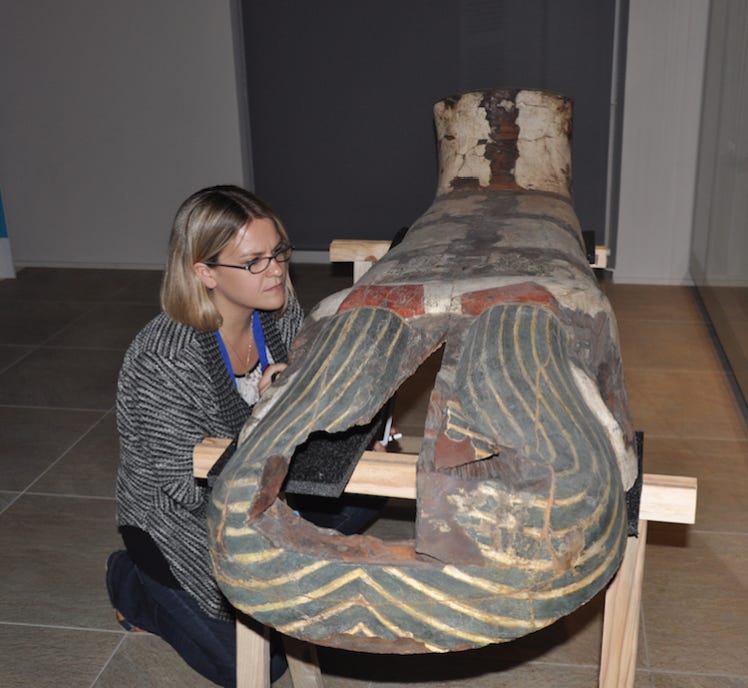
In todays episode, we welcome wood-and-coffin specialist Carrie Arbuckle McLeod for a deep dive into why ancient Egyptian coffins are basically time capsules: tiny wood samples reveal trade and value, tool marks preserve the hands-on actions of carpenters, and joints can map changing technology and belief. You’ll hear why cedar (often linked to Osiris) was a luxury imported “king of woods,” how local sycamore fig became the womb of Nut, and why coffins and boats share the same journey-to-the-afterlife logic—plus the surprising “magic” of red-painted and even inscribed joints. We also unpack the messy afterlife of coffins in modern times: early excavators burning plain coffins for warmth, collectors mixing bodies and boxes, and over-conservation that can repaint or plasticize the past. About Carrie Caroline Arbuckle MacLeod is Assistant Professor of Classical and Near Eastern Archaeology at St Thomas More College at the University of Saskatchewan. She specializes in the archaeology of wood and woodworking, focusing on the history of ancient Egyptian wooden coffin production. She has recently published Archaeological Wood and Woodworking, in the Cambridge University Press Elements series, and has won awards for her experiential approaches to teaching. She is part of the Turin-Leiden excavation team at Saqqara, and is currently working on a volume on the coffins from Assiut housed in the Museo Egizio, Turin. Academia Page Cambridge Elements: Archaeological Wood and Woodworking Show Notes Haida Woodworking Medjehu Project Trees of Egypt Tamarisk Acacia Sycomore Fig Zizithus (aka Christ Thorn) Cedar (cedrus lebani) Egyptian words for cedar: ash 𓂝𓈙𓇫 and meru 𓌸𓂋𓅱𓇫𓆱 Tale of Wenamun Year 5, fourth month of summer, day 16, the day of departure of Wenamun, the Elder of the Portal of the Temple of Amun, Lord of Thrones-of-the-Two-Lands, to fetch timber for the great noble bark of Amen-Re, King of Gods, which is upon the river and [is called] Amen-user-he. Bunbury, Judith and Reim Rowe 2021. The Nile: mobility and management. Cambridge Elements: Elements in Ancient Egypt in Context. Cambridge: Cambridge University Press. DOI: 10.1017/9781108919913. Box Coffin with Rope from the Old Kingdom (MET), made of Tamarisk Death of Osiris Typhon (Seth), having secretly measured Osiris's body and having made ready a beautiful chest of corresponding size artistically ornamented, caused it to be brought into the room where the festivity was in progress. The company was much pleased at the sight of it and admired it greatly, whereupon Typhon jestingly promised to present it to the man who should find the chest to be exactly his length when he lay down in it. They all tried it in turn, but no one fitted it; then Osiris got into it and lay down, and those who were in the plot ran to it and slammed down the lid, which they fastened by nails from the outside and also by using molten lead. Then they carried the chest to the river and sent it on its way to the sea through the...
0:03SPEAKER_02Welcome to Afterlives of Ancient Egypt,
0:06SPEAKER_02in which we discuss ancient history and relevant current events.
0:09SPEAKER_02I'm Cara Cooney,
0:10SPEAKER_02and I love to take deep dives into history that are not always possible
0:14SPEAKER_02in academic formats.
0:16SPEAKER_02So let's get started.
0:21SPEAKER_00Howdy, howdy.
0:23SPEAKER_00Hello, how are you?
0:24SPEAKER_00I'm doing all right.
0:26SPEAKER_00We're in our May greys, so it's a gloomy morning.
0:29SPEAKER_00I kind
0:30SPEAKER_02of like May grey.
0:31SPEAKER_02It's good.
0:32SPEAKER_00Well, I was going to say,
0:33SPEAKER_00the voice lurking in the background, who do we have as our special guest today?
More Afterlives of Ancient Egypt with Kara Cooney episodes →