
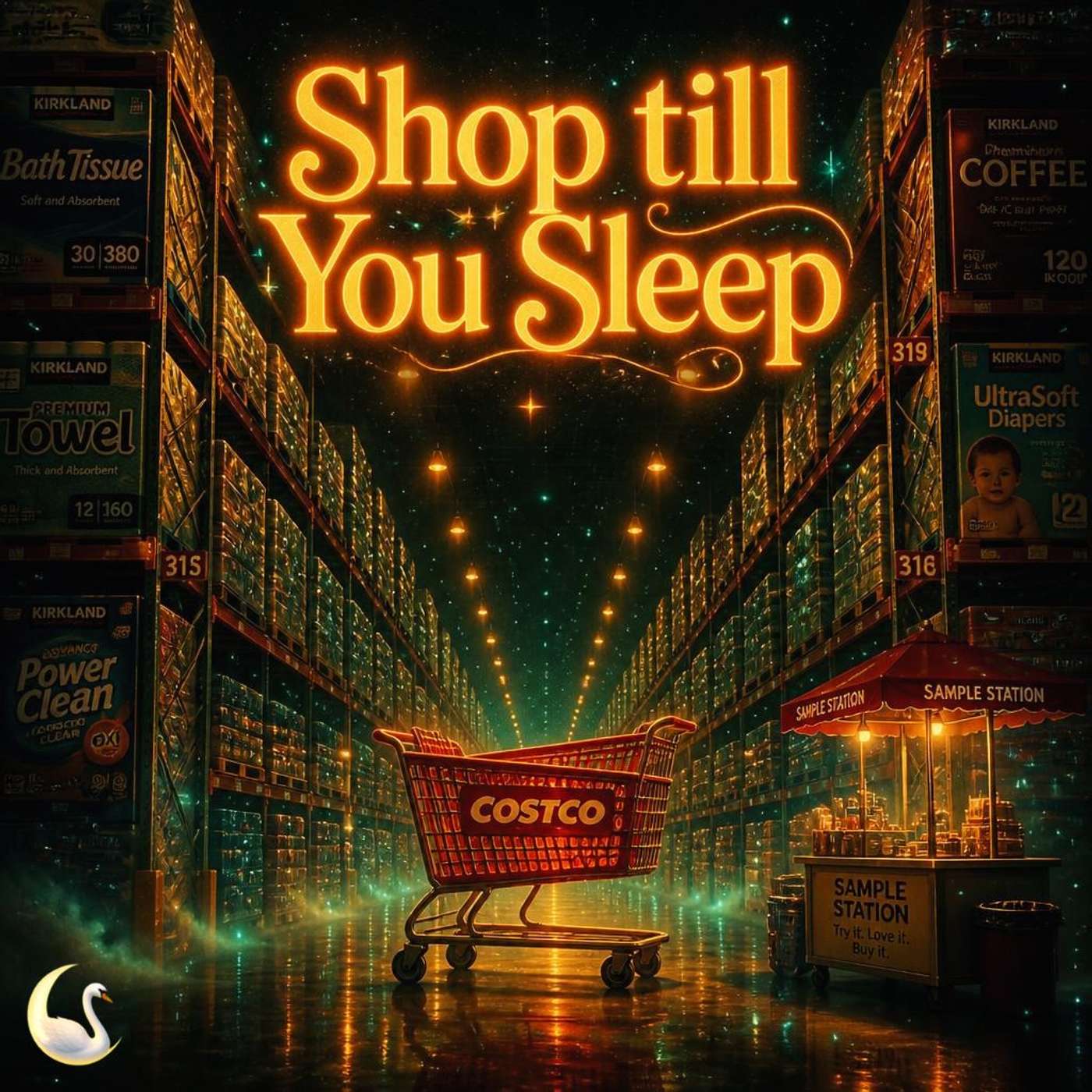
Adventures in Dreamland 🌙 Sleep Stories · Beth Hagendorf
You'll walk into a Costco that never ends, where membership expires never and shoppers have been pushing carts for decades. This Dream Spoofs story tickles your funny bone, helping you laugh your way into a light, giggly sleep. 🔭 Explore all of our series — ✨ DreamScapes, 🏡 Dream Grounding, 🧠 Dream Priming, 🐜 Dream Wonders, 📚 Dream Studies, and 🎭 Dream Spoofs — on YouTube 💤 @SleepDreamland
"The Costco That Never Ends" is episode X and resides inside our Dream Spoofs playlist, where we appreciate the silly side of life— softly. — One— The Membership Card— You're standing in a parking lot the size of a small nation. Rows of cars stretch toward a horizon you can't quite see. Shopping carts— massive, industrial, built for hauling— roll past in herds, pushed by people who look both determined and slightly dazed. The air smells like gasoline, ambition, and something roasting inside. Before you rises a building so large it creates its own weather system. The walls are gray. The letters are red. The word is simple: COSTCO. You don't remember driving here. You don't remember deciding to come. But in your hand, warm and faintly glowing, is a membership card. You flip it over. Your photo stares back— not your best angle, taken under fluorescent lighting during what was apparently a difficult year. Next to it, text: MEMBER SINCE: ALWAYS. EXPIRES: NEVER. WELCOME BACK. You didn't know membership cards could welcome you back. This one does. This one seems to mean it. Either you're about to buy groceries— or you've joined a wholesale cult that requires a photo ID and a flatbed cart. Both feel equally possible. You walk toward the entrance. The automatic doors part— not hesitantly, like at the DMV, but confidently. Eagerly. These doors want you inside. A greeter stands just past the threshold. She's wearing a red vest and a name tag that says DOLORES. She's seen everyone who's ever entered this building. She will see everyone who ever will. "Card, please," Dolores says. You hand it over. She scans it. The machine beeps— once, approvingly. "Welcome back," Dolores says, handing it back. "Carts are to your left." You nod. You take the card. You step inside. The warehouse opens before you, vast and humming, fluorescent lights stretching into infinity. You're in. — Two— The Cart— The carts are not carts. They're vehicles. Small, flat, rectangular vehicles with four wheels and a handle and enough square footage to transport a family of four plus their belongings plus possibly a small refrigerator. You grab one from the corral. It's heavier than expected— solid steel, built to last, designed by someone who understood that people would fill these with things they didn't come for and haul them across concrete floors for hours. One wheel is already pulling to the left. They all do. It's part of the experience. The child seat is built into the front— a fold-down contraption with leg holes that could comfortably fit a teenager. A dad walks past with a kid in one, the child's legs dangling, eating a churro the size of his arm. Neither of them seems to think this is unusual. You push forward. The wheels rattle— that specific Costco rattle, the sound of commerce in motion. You came for "just a few things." Paper towels. Maybe some chicken. Possibly eggs. The cart doesn't believe you. The cart has heard this before. The cart knows how this ends. The entrance gauntlet begins immediately. First: the electronics. Always the electronics. Televisions line the walls— 65-inch, 75-inch, 85-inch— each one playing nature documentaries on loop. Eagles soaring. Whales breaching. Slow-motion footage of a cheetah running that makes you feel things you didn't expect to feel at 11 a.m. on a Saturday. A man stands frozen in front of an 85-inch QLED display, watching the cheetah. His cart is empty. His eyes are full. He's been here a while. He might live here now. No one is checking. You push past. The cart rattles. The warehouse hums. You're just getting started. — Three— The Free Samples— You smell it before you see it. Something warm. Something fried. Something deeply, fundamentally free. You turn a corner— past a pallet of canned tomatoes stacked six feet high, past a tower of paper towels wrapped in plastic like a monument to absorption— and there they are. The sample stations. They dot the warehouse floor like tiny shrines, each one staffed by a person in a hairnet, an apron, and the quiet patience of someone who has handed out seventeen thousand one-ounce portions of frozen orange chicken and will hand out seventeen thousand more. People cluster around each station. Adults. Professionals. People in business casual who probably have retirement accounts and opinions about wine. All of them crowding forward like they haven't eaten in weeks, reaching for tiny paper cups and toothpicks and cubes of things they didn't know existed until right now. You approach the nearest station. A woman behind the counter is frying something in a tiny skillet. The sizzle is hypnotic. "Spinach artichoke dip," she announces. "Just heated. Try it with the pita chip." She hands you a cup. Inside: a smear of something green and creamy, one triangular chip wedged beside it. You eat it in one bite. It's good. It's actually really good. The ratio of spinach to artichoke is perfect. The chip provides crunch. For one glorious second, you understand why people buy the 48-ounce tub. "This is amazing," you say. "There's a coupon this month," the woman replies. "Three dollars off." You consider it. You actually consider it. You live alone. You don't need 48 ounces of spinach artichoke dip. But here, in this moment, math doesn't exist. Only flavor. Only value. You move on— but not before circling back for a second sample. She doesn't say anything. She's seen it before. The next station has mini quiches. The one after that, some kind of protein bar cut into cubes. A man in a polo shirt is eating his fourth cube without shame. His wife is pretending not to know him. A station near the freezer section offers tiny cups of smoothie— mango, maybe, or some tropical blend that tastes like vacation. "This is incredible," someone says. "I might get some." They will not get some. They will circle back in fifteen minutes for another sample. That's the system. That's the covenant. You grab one more sample— a piece of ravioli that a woman is boiling in an electric kettle, which feels illegal but isn't— and push on. Your cart is still empty. But your soul is full. — Four— The Oversized Everything— And then you reach the main floor, and the scale of things hits you like a revelation. Everything is big. Not regular big. Not "oh, that's a lot" big. Big in a way that makes you question whether you've been living wrong your entire life. Big in a way that suggests whoever designed this place has never heard the word "moderation" and wouldn't use it if they had. You pass a jar of pickles that could double as a fire hydrant. The label says 1.5 GALLONS. The jar has a handle. The jar needs a handle because otherwise you'd need two hands and a plan. You pass a bag of tortilla chips so large it could insulate a small attic. NET WEIGHT: 42 OUNCES. Nearly three pounds of tortilla chips in a single bag. Someone will buy this. Someone will finish this. Someone is ready for a commitment you can barely imagine. You pass the toilet paper aisle— and it's not an aisle, it's a corridor. A canyon. Packages stacked floor to ceiling, each one containing 30 rolls, 36 rolls, 48 rolls. Quantities that suggest you're not shopping for a household. You're shopping for a bunker. You're preparing for something. A woman stands in front of the 48-roll pack, calculating. You can see her doing the math. Price per sheet. Months of supply. Whether her hall closet can physically accommodate this much toilet paper. The answer is unclear. She grabs it anyway. You reach the olive oil section. The bottles have handles. Plural handles. Two of them, on opposite sides, because the bottle is so large it requires a grip strategy. The cheese section stops you cold. A 5-pound bag of shredded mozzarella. A 3-pound block of cheddar. A wheel of brie the size of a hubcap, just sitting there, wrapped in plastic, waiting for someone to make a decision they can't take back. You live alone. You grab the 5-pound shredded cheese anyway. What are you going to do with 5 pounds of cheese? You don't know. You'll find out. That's the Costco promise. Buy in bulk. Figure out the rest later. You pass a display of muffins— 48 count, assorted flavors, packed in a plastic clamshell so large it has its own weather system inside. Three people are reaching for them. One of them has two packs already in her cart. Who needs 48 muffins? Everyone, apparently. Everyone needs 48 muffins and they need them right now. Your cart is no longer empty. The 5-pound cheese sits in the corner like a golden brick of future decisions. The muffins beckon. The pickles whisper. You push on. You came for paper towels. You're going to leave with so much more. — Five— The $1.50 Hot Dog— You smell it before you see the sign. Meat. Warm bread. The faint sweetness of onions that have been sitting in a condiment trough since the doors opened. It's not gourmet. It's not trying to be. It's something better. It's the food court. The line snakes from a counter in the corner— and it's always snaking, always moving, always full of people who've decided that now, in the middle of a shopping trip that has already cost them their afternoon and possibly their dignity, they need sustenance. The menu hangs above, simple and unchanging. White letters on a red background. No seasonal specials. No limited-time offers. No innovation. This menu doesn't need innovation. This menu achieved perfection decades ago and refused to move on. HOT DOG + SODA: $1.50 You read it again. $1.50. This price has survived recessions. It has survived inflation. It has survived supply chain crises and economic downturns and at least four different presidents who had opinions about the economy. The CEO of Costco once said— and this is true, you've read the article— that if anyone tried to raise the price of the hot dog, he would kill them. He didn't say "fire." He said kill. That's how seriously they take this. $1.50. Forever. The one constant in an uncertain world. You order. The hot dog arrives. It's enormous— at least a quarter pound of processed meat stuffed into a bun that's soft in the middle and slightly crispy on the edges. The soda cup is 20 ounces. Refills are free. Forever. For the rest of your natural life, as long as you're inside this building, you can refill this cup. You load the hot dog with mustard from a pump dispenser. Ketchup from another pump. Onions from a crank machine that deposits them in wet, tangled piles. Relish, if you're feeling chaotic. You find a seat. The tables are metal. The chairs are metal. Everything is designed to be hosed down at the end of the day, which is both practical and vaguely unsettling. Around you, strangers sit in silence, eating their $1.50 hot dogs with the focus of people performing a sacred ritual. A man in a suit. A woman with two kids, both of whom have their own hot dogs. An elderly couple splitting a slice of pizza the size of a small continent. No one speaks. Everyone understands. You take a bite. It's perfect. Not objectively— if you described this hot dog to a food critic, they would have questions. But subjectively, spiritually, in this moment, sitting in a metal chair in a warehouse that smells like bulk and ambition, this is the greatest hot dog you've ever eaten. You finish it. You refill your soda. You consider getting another one, because it's $1.50, because you could, because the universe is offering you a gift and who are you to refuse. You get another one. No one judges you. Judgment doesn't exist here. Only value. — Six— The Things You Didn't Come For— You return to your cart. It's fuller than you remember. You came for paper towels. You came for chicken. You came for— what was it? Eggs, maybe. Something simple. Something reasonable. You look at your cart. The paper towels are there. A 12-pack, industrial strength, wrapped in plastic so tight it could survive a small explosion. Fine. Expected. But beside the paper towels: A patio furniture set. Three chairs and a table, nested together, strapped with bungee cords you don't remember picking up. You don't have a patio. You have a small balcony that barely fits a plant. But the set was $199, marked down from $299, and the display made it look so inviting— the fake family sitting in the fake sun, laughing about their fake weekend plans. A 3-pack of jeans. Bootcut. Your size, somehow, even though you never tried them on. There's no dressing room at Costco. You just trust. You buy three pairs and you trust. A kayak. You stop. You stare at it. A kayak is in your cart. An actual kayak. Bright yellow, 10 feet long, wedged diagonally across the flatbed like it belongs there. You don't kayak. You've never kayaked. You live in a city where the nearest body of water is a decorative fountain outside a bank. But it was right there. On display. Discounted. A little sign that said GREAT FOR SUMMER, even though it's not summer, even though you don't know when summer is anymore because you've been in this warehouse for what feels like years. You keep looking. A bucket of pretzels— a literal bucket, plastic, with a handle, containing what must be 3 pounds of tiny twisted knots. An air fryer. Your third. You already have two air fryers at home. One works. One you've never opened. This one was $39.99 and came with a recipe book. Something called a "wellness bundle." You pick up the box and read it: a 90-day supply of multivitamins, a foam roller, a resistance band, and a pamphlet titled "Your Healthiest Self Starts Now." It's shrink-wrapped together like a promise you're not sure you can keep. A 64-ounce bottle of maple syrup. Pure. Grade A. Imported from Canada. You don't eat pancakes that often. You might start. You don't remember putting half of this in your cart. The cart remembers. The cart knows what you need before you need it. You push forward. The wheels rattle. The kayak shifts. This is fine. This is Costco. — Seven— The Checkout— The line for checkout stretches down the aisle and curves around a pallet of bottled water. It's long. It's impossibly long. It's the kind of line that, in any other store, would make you abandon your cart and leave. But this is Costco. The rules are different here. You wait. The line moves. And it moves fast. That's the thing about Costco. The lines look terrifying, but they flow. The cashiers scan with supernatural speed— beep beep beep beep— a rhythm so constant it becomes music. No small talk. No hesitation. Just scanning. Just motion. Just progress. A cashier waves you forward. Her name tag says CHRISTINE. Christine has seen a thousand carts. Christine has seen kayaks, and air fryers, and 5-pound bags of shredded cheese. Christine is beyond surprise. She scans the paper towels. Beep. The muffins. Beep. The wellness bundle. Beep. The jeans, the maple syrup, the bucket of pretzels. Beep beep beep. She gets to the kayak. Pauses. Scans it. Beep. Her face betrays nothing. "Found everything okay?" Christine asks. "Too much," you say. She nods. She knows. She's heard it before. She's heard it every day since she started working here, which might have been last week or might have been thirty years ago— time works differently under these fluorescent lights. The total appears on the screen. It's a number. A large number. More than you expected, even though you knew. Even though you saw the cart. Even though you made choices at every turn that led you here. You pay. The card goes through. The receipt prints— a scroll so long the machine spits it out in waves, itemizing every decision, every weakness, every moment of surrender. Christine hands it to you. "Have a good one," she says. You will. You think. You hope. — Eight— The Exit— The final checkpoint awaits. A man stands at the exit door with a highlighter and a purpose. His name tag says FRANK. Frank is the last line of defense. Frank will look at your cart. Frank will look at your receipt. Frank will make sure the numbers match, that you haven't accidentally walked out with something you didn't pay for, that the covenant has been honored. You hand over your receipt. Frank scans the cart. His eyes move quickly— counting, calculating, confirming. The kayak. The air fryer. The bucket of pretzels. The 5-pound cheese, slightly warm now, starting its slow journey toward a decision you'll make tomorrow. Frank draws a line across the receipt with his highlighter. You're free. The automatic doors part— eagerly, graciously— and you step outside. The sun is setting. Orange and pink streak across a sky you'd forgotten existed. You've been inside for hours. Maybe days. Maybe a small eternity. The parking lot stretches before you, endless and familiar, shopping carts rolling toward cars like pilgrims heading home. Your car waits where you left it— or where you think you left it. They all look the same out here. But there it is. Yours. Ready. You open the trunk. The kayak doesn't fit. Of course it doesn't. You knew it wouldn't. But you play Tetris anyway— shifting the muffins, angling the patio furniture, wedging the bucket of pretzels into the passenger seat because there's no other option. The kayak goes on the roof. You tie it down with bungee cords you bought— when? Just now? An hour ago? It doesn't matter. You have them. They work. The kayak is secure. You drive home. The membership card sits on the seat beside you, glowing faintly in the fading light. MEMBER SINCE: ALWAYS. EXPIRES: NEVER. At home, you unload. Trip after trip. Paper towels and pretzels and an air fryer you'll unbox next month. The wellness bundle goes on a shelf. The jeans go in a drawer. The maple syrup goes in a cabinet next to two other bottles of maple syrup you forgot you had. The kayak leans against the wall in your living room. You'll figure it out. You collapse into bed. Your body is tired. Your cart is empty. Your home is full of things you didn't know you needed until you saw them stacked on pallets under fluorescent lights. Somewhere, in the distance— or maybe just in your memory— you hear the beep of a scanner. The rattle of a cart. The sizzle of a sample station heating something small and free and perfect. You close your eyes. The warehouse hums softly in your dreams. The aisles stretch forever. The hot dogs are always $1.50. The samples are always warm. You'll go back. You always go back. Sweet dreams. Good night.