
8158 Podcast: Stories of Sacrifice · 8158 Podcast
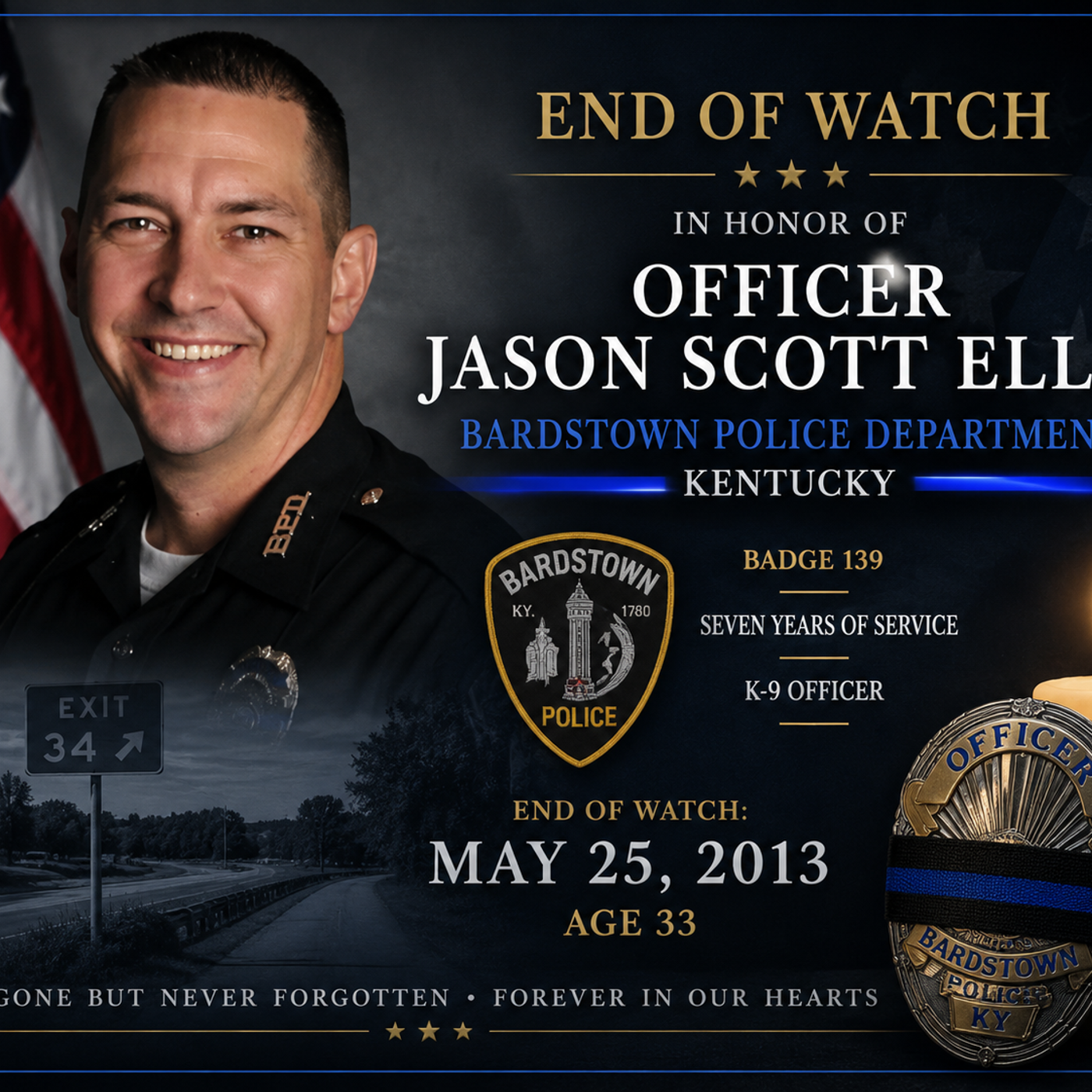
In this episode of 8158: Stories of Sacrifice, we honor the life and legacy of Bardstown Police Officer Jason Scott Ellis — Badge 139, whose End of Watch came on May 25, 2013. Jason was so much more than the circumstances surrounding his death. He was a husband to Amy, a father to Hunter and Parker, a son, brother, friend, youth baseball coach, former professional baseball player, award-winning police officer, and K-9 partner to Figo. Before Badge 139, he was Number 5. Jason built an incredible baseball career at the University of the Cumberlands before playing professionally in the Cincinnati Reds organization. After baseball, he found another calling in law enforcement, joining the Bardstown Police Department in 2006. In the early morning hours of May 25, 2013, Jason finished his shift and began his drive home. At Exit 34 of Kentucky's Bluegrass Parkway, he encountered branches deliberately blocking the roadway. Jason stopped to clear the obstruction so other motorists wouldn't be endangered. Investigators believe it was a planned ambush. Jason was shot and killed. He was just 33 years old. More than thirteen years later, his murder remains unsolved. In this Fallen Hero episode, we go beyond the End of Watch to remember the man behind the badge—from Jason's baseball dreams and love story with Amy to fatherhood, Figo, his law-enforcement career, his final shift, the investigation that followed, and the family and community that continue to keep his memory alive. 💙 Someone knows something. The FBI continues to seek information regarding Jason's murder and offers a reward of up to $50,000 for information leading to the identification, arrest and conviction of those responsible. Anyone with legitimate information can contact the FBI at 1-800-CALL-FBI (1-800-225-5324). Officer Jason Scott Ellis Bardstown Police Department Badge 139 End of Watch: May 25, 2013 Age: 33 Gone, but never forgotten. 🌐 8158: Stories of Sacrifice: 8158Podcast.com 🛍️ Support the show / Shop: 8158 Podcast Shop 🎙️ Want to share your story? Be a Guest on 8158 💙 Support 8158: Donate Please share this episode. Not for the download—for the possibility that Jason's story reaches the person who knows the missing piece. 💙🖤
Rico: Welcome back to another episode of eighty one fifty eight Stories of Sacrifice. Today's episode is a Fallen Heroes episode. And today's Fallen Hero we honor Officer Jason Scott Ellis Bardstown Police Department, State of Kentucky. Badge number one thirty nine. End of watch may twenty fifth, twenty thirteen. The unsolved ambush on exit thirty four. There are certain roads you drive so many times that eventually you stop thinking about them. The turns become automatic, the landmarks become familiar, you know where to slow down, you know which exits is yours. And when you're almost home, there's usually a point where you mentally transition from work to family. The shift is over. You're going home. In the early morning hours of may twenty fifth, twenty thirteen, Bardstown police officer Jason Ellis was making one of those drives. His shift was over. His paperwork was finished. His wife was home. His two sons were home. His canine partner was home. Jason had traveled this road many times before, but this time he was When he reached exit thirty four of Kentucky's Bluegrass Parkway, something was different. Branches were blocking the road. This is not abnormal for Kentucky, as many branches do fall in the roadways, especially during high winds. Jason Ellis stopped his cruiser. He turned on his emergency lights. And because he was the kind of police officer who didn't simply drive around the danger. and leave it for somebody else. He got out. He began clearing the roadway. He never made it home. Someone was waiting, and more than thirteen years later, we still don't know who. This is the story of Officer Jason Scott Ellis. But it's not going to begin with his murder, because Jason Ellis was more than just what happened to him on Exit thirty four long before he became badge number one thirty nine. He was number five. He was a baseball player, a son, a brother, a teammate, a husband, a dad, a coach, a friend, and eventually a police officer and canine handler. Today we're going to remember him. And we're going to tell you about a case that as of twenty twenty-six is still waiting for the one thing Jason's family has never received. An answer. And I am Rico, and this is eighty one fifty-eight Stories of Sacrifice. Jason Scott Illis was born september twenty second, nineteen seventy nine in Cincinnati, Ohio. His father was Charles Ellis. His mother was Pamela. Jason grew up with two sisters, Kelly and Lacey. Before law enforcement became part of his identity, another passion occupied a huge part of Jason's life. And that was baseball. Not casually, Not just Little League followed by a few seasons in high school. Jason could play. He attended Glen Estee High School near Cincinnati, graduating in nineteen ninety-eight. During his senior year, Jason was named First Team All City and Player of the Year in the Queen City Conference. This position was catcher. And when you think about it, catchers almost seem appropriate for the person Jason would eventually become. A catcher spent the game watching everything. He sees the field differently. From almost everyone else. The action is in front of him. He has to communicate, he has to lead, he has to make decisions quickly, he has to know his teammates, and sometimes he has to put his body directly in the path of something coming at him. Jason excelled there. Baseball provided structure, competition, teamwork, responsibility, and a dream. After graduating Glenn Este, the dream took Jason south into Kentucky. He enrolled at Cumberland College in Williamsburg, Kentucky. The school now known as the University of Cumberlands and Jason didn't simply make the baseball team, he became one of the best players in the program's history. Statistics don't tell us everything about a person, but Jason's college statistics tell us something about how seriously he took the baseball. Over one hundred and eighty six games with the Patriots, Jason compiled a number that would eventually put him in the university's Athletic Hall of Fame, A career batting average of three hundred eighty nine, two hundred and forty six hits, sixty doubles, thirty-four home runs, and one hundred and eighty-three runs batting in. At one point, those numbers represented school career records across multiple categories. During one season alone, Jason recorded 93 hits and 30 doubles. But one of the most meaningful descriptions of Jason didn't involve a single number. His college coach, Brad Shelton, remembered a leader. Jason was described as someone who led through example. And behind a plate, he could change a game defensively. Now that matters, because almost every chapter of Jason's life seems to contain the same theme. He could perform, he could achieve. But the people around him tended to remember his character and Jason's baseball talent eventually carried him beyond college. He got the opportunities so many young baseball players spent their childhood dreaming about. Professional baseball. Jason entered the Cincinnati Reds organization and played in the minor leagues, including with the Billings Mustangs in Montana, which I am very familiar with Billings Mustangs, as I had lived in Billings for many years. The kid who grew up around Cincinnati was now a part of an organization whose logo he had grown up seeing. He had done it. Not all the way to Great American Ballpark. Not to the major leagues. But he had crossed the incredible line between playing baseball and being paid to play baseball. And if Jason's story ended there, it would already be a story worth telling. But baseball was only one chapter. Because somewhere in the middle of chasing that dream, Jason met the person with whom he wanted to build the rest of his life with. And her name was Amy. Jason's collegiate career records and later number five, Jersey retirement are documented by the University of Cumberlands. Jason and Amy met on Valentine's Day in two thousand one. There is a story from the beginning, their relationship has survived because it's such a wonderful, simple glimpse into Jason's personality. Jason and Amy were going to their first date. There was just one little complication Amy's mother happened to be visiting. Jason could have decided to make it awkward. He could have rescheduled. He could have showed up and hoped for the best. Instead, he arrived with flowers, two bouquets, one for Amy, One for her mother. That's the kind of story that an official line of duty record can't capture. You won't find it under rank, or a badge number, or cause of death. Because it's part of the reason we're telling Jason's story this way. Because before the community mourned Officer Ellis, there was a young woman falling in love with Jason. Their relationship grew, and Jason talked about the future. He wanted a family. Professionally, he could see two possible roads ahead. Baseball or law enforcement. At that moment nobody could know just how deeply both eventually became part of his legacy. Around Christmas in two thousand two, Jason had another surprise for Amy. He took her out to her family's barn. Amy apparently believes she might finally be getting something she'd been wanting A puppy. Jason had something considerably smaller in his possession and considerably more expensive, a diamond ring. Jason got down on one knee and asked Amy to marry him. She said yes. In October of 2004, Jason and Amy were married. And Amy later remembered one image from that day especially clearly. As the door opened, As she prepared to walk toward him, she saw Jason waiting and smiling. In photographs and newspaper stories about the fallen officer, it's easy to see everything through the end. But Jason and Amy weren't living in the end. They were at the beginning. They were newly weds. They were building a home. They had plans, and soon their family would grow. The WCPO's Exit thirty four project reconstructed Jason and Amy's relationship through extensive interviews with Amy and people close to Jason. About a month after their wedding, Jason and Amy learned that they were expecting their first child. Their son Hunter arrived in July of two thousand five. Hunter was born with Down syndrome, and Jason became dad. Two years later, another little boy joined the Ellis family, Parker. Now there were four: Jason, Amy, Hunter, and Parker. and the man who had spent years competing on baseball diamonds started experiencing the game from an entirely different angle. He became involved in new sports in Nelson County. He coached. He shared baseball with children. He shared it with his sons. There is something beautiful about this transition. When Jason was younger, baseball was about achievement. Hits, doubles, home runs, winning, advancing. Professional baseball. Now baseball could be about dirt on little uniforms. Teaching someone how to hold a bat. A kid running towards the wrong base. Parents cheering from the bleachers. A father watching his son play. Jason's obituary would eventually specifically mention his involvement coaching young sports in Nelson County. That detail probably seems small compared with what later happened. It isn't. Those were lives Jason touched. Those were kids who knew him as coach. Parents who saw him at games. His sons who had memories of their dad connected to baseball. And according to Amy's recollections, Jason's family hasn't simply parked. And according to Amy's recollections, Jason's family wasn't simply part of his life. They were the center of it. His family was his life. Jason's obituary identifies Amy, Hunter, and Parker as his surviving wife and sons, and notes his active role coaching youth sports in Nelson County. Professional baseball didn't last forever. For very few players it does. but Jason had already talked about the other career that interested him, and that was law enforcement. In 2006, Jason joined the Bargetown Police Department. For anyone unfamiliar with Bargetown, Kentucky, it sits in Nelson County, southeast of Louisville. It's known around the world for bourbon. It's historic, picturesque. The kind of community tourists visit for beautiful streets, distilleries, festivals, and Kentucky's history. It would also become the community Jason was sworn to protect. Law enforcement seemed to fit him. The discipline, the teamwork, the willingness to take responsibility, and the ability to communicate. The expectation that when something happened, he reacted. Just as Jason had succeeded in baseball, distinguishing himself. in policing. He received the Governor's Award for Impaired Driving Enforcement in 2007. He received it again in 2008. And in two thousand eight, Jason was named Officer of the Year. He served on the Department's special response team. He was associated with the Fraternal Order of Police, he became Bardstown's canine officer. And in fact, Bardstown's current memorial to Jason identifies him as the department's only canine officer at the time. His partner was a German shepherd named Figo. Jason had found his second career, and once again, he was all in. The city of Barstown says Jason joined the police department in two thousand six and served seven years, including service as its only canine officer. His obituary also records his K9 special response team and FOP affiliations. There is a bond between a canine officer and a police dog. That is difficult to understand unless you've seen the partnership first hand. A police dog isn't simply riding around in the back of a cruiser. Officer and dog train together. Work together. Depend on each other, They learn each other's movements, they learn each other's signals, they operate as a team. Jason's partner was Figo, a German shepherd trained for police work. Together, Jason and Figo worked narcotics enforcement. And according to those who knew Jason, He took pride in getting drugs off of Archtown streets. At home, the relationship didn't suddenly disappear. He was Jason's partner, and Figo would eventually become one of the most recognizable parts of Jason's story. But not because of an arrest, not because of a drug seizure, not because of something that happened while Jason and Figo were working together. Because of what happened on a night when Figo wasn't there. In May twenty thirteen, Jason's normal K9 vehicle wasn't being used by him. Jason was driving another Bargetown police cruiser, and Figo wasn't riding with him. That seemingly ordinary circumstance would become haunting in hindsight, because Jason was about to encounter something for which his partner might normally have been standing beside him. By twenty eleven, Jason was barely into his thirties. But the University of the Cumberlands had already decided his baseball career deserved permanent recognition. Jason was inducted into the university's Athletic Hall of Fame. He had become the kind of former player whose statistics younger players could see on records in the books. He could look back and say he played professional baseball. He could look back at his home and see a wife and two sons. He could go to work knowing he was an award winning police officer. And he was only thirty one when he entered the Hall of Fame. There should have been decades of milestones still ahead. Hunter graduating, Parker graduating, wedding anniversaries, baseball games, birthdays. Maybe someday grandchildren. Maybe retirement. Jason had already accomplished a remarkable amount, but nobody who loved him would have described his life as finished. It was still being built. Then came Friday, may twenty fourth, twenty thirteen. One of the reasons we know so much about Jason's last day is because WCPO investigative journalist Jessica Knoll undertook an extensive reconstruction of his final hour. She spoke with Jason's family, coworkers, investigators, and other witnesses reviewed police materials and reconstructed a timeline. When you look at the timeline, the thing that strikes you is how normal everything was. Nothing said this is the last day. Amy was working as a substitute teacher. The boys had school, Jason had worked late and was sleeping. Amy got Hunter and Parker ready. At one point after leaving, she realized she had forgotten to kiss Jason goodbye. That thought would become painfully important later. But at the time There was no reason for to be She would see him again. Jason woke. He got ready for work. The same uniform, the same duty gear, the same routine. Later that afternoon, Amy and the boys were heading home while Jason was heading toward work. They crossed paths. The boys recognized him. Daddy. The family stopped along enough for Jason and Amy to talk. There were plans for later. Parker had a T ball game. Jason intended to be there. Before they separated, Jason and Amy told each other they loved one another. Then Jason went to work. That's it. No dramatic final speech. No sense that something terrible was coming. A husband going to work, a wife taking care of their kids, a baseball game later, tomorrow waiting on the other side. WCPO's details reconstruction of Jason's final watch was based on interviews, reports, records and police radio communications. Jason didn't make it to Parker's game. For a little while the police officer became dad and a coach again. It seemed appropriate that one of Jason's final evenings included a baseball field. The game that had defined so much of his younger life now belonged to his sons, but Jason was still on duty. And police work has a way of interrupting plans. A domestic call came over the radio. Jason had to leave. So he left the field and returned to work. Amy wanted more time with him that evening. At one point she even wanted to ride along. She called him. Some of her calls weren't answered, but again, why would that feel ominous? Jason was working. Police officers don't always answer phones when family calls. They may be driving, they may be on a call. They may be dealing with something nobody waiting at home knows anything about. There would be another conversation. There'd be tomorrow. Except there wouldn't. The shift continued into the night. Police work is strange that way. An officer can go from sitting in a cruiser doing paperwork to dealing with an emergency in seconds. During Jason's final hours, there were calls and arrests. His best friend and fellow officer Andrew Riley was also part of the night. At approximately one twenty in the morning, Jason had a person in custody at Flaggett Memorial Hospital. Once the individual was medically cleared, Jason transported him toward the jail. The radio traffic from the night survived. Jason's voice survived. Routine transmissions, Officer one hundred thirty nine communicating with dispatch. Nothing in the tones of those communications gives any indication that history is about to divide his family's life into before and after. Jason completed what he needed to complete. He prepared to head home. Around two AM Amy was still awake at home. Hunter and Parker had fallen asleep. She moved Parker to bed, she looked at her phone. She considered calling Jason again. Then decided not to. He would be home soon. That moment might be one of the hardest in the entire story. Not because Amy made the wrong decision, she didn't. Because every one of us has done the same thing. I'll tell him later. I'll call tomorrow. I'll see him when he gets home. We live in our lives assuming there will be another opportunity. Almost every time there is. Jason's family had absolutely no reason to think this night would be any different. WCPO's reconstruction places Jason at Flaggett Memorial Hospital around 120 AM and Amy awake at home shortly after two AM, expecting him home soon. Jason finished his shift, he signed off the radio, then he did what he'd done hundreds of times. He drove home. From Bargetown to Jason took Route one hundred fifty towards the Bluegrass Parkway. Then he turned east. His route would take him roughly thirteen miles along the parkway to exit thirty four. From there, he was only minutes from home. Amy, Hunter, Parker, Figo, Bed. And whatever Saturday was supposed to bring, it was Memorial Day weekend. Families across Kentucky were preparing for cookouts, travel, and time together. Jason was simply trying to get home after work. Then his headlights illuminated something in the road. Tree branches, placed across the Nexit ramp. Jason slowed. He activated his cruiser lights. He would position his police vehicle in a way that would alert and protect other drivers approaching the obstruction. And he got out. That decision tells you something about Jason. Typically his shift was done. He could have called someone, he could have driven around it, he could have made it someone else's problem. But there was an obstruction in the road. Someone could hit it. Someone could be injured. So a police officer who supposed to be going home stopped to make the road safer. The FBI's current account states Jason encountered branches blocking Exit thirty four, got out to clear them for public safety, and was attacked while doing so. Exit thirty four is where Jason Ellis' story changes forever. Investigators would come to believe the branches weren't there accidentally. They had been placed carefully, methodically, a roadblock designed to make someone stop. and authorities would eventually describe what happened next as a planned ambush. Jason walked towards the obstruction. Somewhere nearby was another person, maybe more than one. Someone who had arrived before Jason. Someone who had put those branches there or knew why they were there. Someone with a shotgun. Jason began clearing the roadway. Then gunfire shattered quiet. Jason was shot multiple times. The FBI says he died shortly after. The gunman or gunmen disappeared. No immediate arrests No traffic stops nearby that suddenly provide the answers. No suspect waiting at the scene, just Jason, his cruiser, the branches, and the darkness surrounding Exit thirty four. Jason Illis was thirty three years old. Federal investigators continue to describe his killing as occurring after he stopped to clear deliberately obstructing branches. The FBI's original 2013 reward announcement called the crime an apparent carefully planned ambush. Jason wasn't discovered immediately by another police officer. A passing motorist came upon the scene. His name was Chad Munro. Monroe had just finished work at Heavens Hill Distillery and was heading home. As he approached exit thirty four, he encountered something that didn't make sense, a police cruiser, lights flashing, nobody apparently standing beside it. The road obstructed. He approached cautiously. Eventually he saw the officer, Jason, Blood. Something was wrong. Another person at the scene got to Jason's cruiser and used the radio to call for help. The first transmission was confused. Officer down, Dispatch needed a location. The caller struggled. to describe exactly where they were. Eventually, Dispatch determined the scene was around Exit thirty four. Monroe checked Jason. Picked up a radio, dispatched asked whether the officer was breathing. He wasn't. Quiet exit rap exploded into emergency response. Units began heading towards the scene. And the Bar Sound Police Department was about to discover that one of their own had been murdered. WCPO reconstructed this portion of the recordings and interviews with motorist Chad Monroe and dispatch personnel. Among the people connected to Jason that night was his close friend and fellow officer Andrew Riley. When information about Officer Down at Exit 34 began circulating, there was an immediate horrifying connection. That was Jason's route. That was the way Jason went home. Eventually, there was no ambiguity left. Officer Jason Ellis had been shot and killed. Riley later described an emotional impact of learning what had happened and then having to become part of the response. There is a particular kind of grief inside law enforcement when the person killed isn't a stranger whose name appears in an email. It's the person whose locker is nearby, the person you joke with, the person you ate with, the person you complained about a shift with, The persons whose radio number you recognize before dispatch ever says the name. Now Jason's friends were being summoned to a crime scene, and Jason was the victim. Riley would eventually be tasked with helping notify other officers. Sometimes they didn't answer their phones, so he went to their homes, knocked on doors, delivered the kind of news nobody wants to give. Jason was gone. WCPO's reporting describes Riley learning that Jason had been killed and later helping notify other Bargetown police officers. Meanwhile, Amy was home. Remember where we left her? Her husband was supposed to be coming through the door. The boys were sleeping. Life was normal until it wasn't. Her mother lived next door. Members of Amy's family began gathering around her. One of her brothers was himself a Barstown police officer, and Amy waiting. She cried, she screamed, she waited. Hunter and Parker were still sleeping. For a little while longer, two little boys lived in a world where their dad was simply at work. Soon they would wake up in a completely different world. The family hadn't simply lost Officer Ellis. Amy lost the man who showed up. Two bouquets, the man who proposed in a barn, the man waiting at the end of the aisle, the man she expected to come home that morning. Hunter and Parker lost dad. A mother lost a son, two sisters lost a brother, the community lost an officer, and Thigo lost his partner. This is the part of an end of watch that a date on a memorial page can never completely convey. an officer's end of watch is not only when an officer's service stops. It's when dozens of other lives suddenly change direction. WCPO documented Amy's family gathering around her while Hunter and Parker were still sleeping. Once investigators began examining Exit thirty four, the responsibility that Jason had simply encountered naturally fallen branches quickly gave way to something more sinister. The debris appeared to be deliberately placed. This wasn't a tree coming down during a storm. It was a roadblock, a trap. Investigators publicly criticized Jason's killing as a targeted ambush. That conclusion created enormous questions. Who knew Jason traveled that way? Did someone know his schedule? Was Jason specifically targeted? Did the killer expect an officer to stop? Was the person responsible familiar with police procedure? Was Jason killed because of something connected to one of his cases? Was the murderer alone? Where did they go afterwards? and where was the shotgun? The questions multiplied. The answers did not. Kentucky State Police became the lead investigative agency. Investigators reconstructed the crime scene. They examined cases Jason had worked on. They interviewed hundreds of people. They chased thousands of tips and leads. Police officers and deputies in Barstown and Nelson County were themselves interviewed. At one point divers searched a pond near X thirty four looking for the shotgun used to kill Jason. They didn't find it. That's worth emphasizing. This was not a case where nobody looked. This became a massive investigation, and still no arrest came. Contemporary investigative reporting documented hundreds of interviews, thousands of leads, and Crime scene reconstruction, scrutiny of Jason's cases, and upon search for the shot. Any unsolved murder of a police officer in a small community produces even more. Over the years, Jason's murder has been discussed alongside of other crimes in and around Bardstown. People online have suggested connections. There have been documentaries, podcasts, message boards, social media discussions, claims, suspicions, rumors. We are initially not going to spend this episode accusing people of Who have never been charged with murdering Jason Ellis. There is a reason for that. Jason's story is real. Amy's grief is real. His sons are real. And the investigation is real. Speculation may be interesting, but it's not evidence. The responsible thing to do is separate what investigators have established from what people on the internet believe. What investigators have established publicly is enough. Jason was heading home. Branches were blocking exit thirty four. He stopped to remove them. He was shot multiple times. Investigators believed the obstruction was deliberately created. Law enforcement had described his killing as a planned ambush. The crime remains unsolved, and the FBI is still asking the public. for information. Anything beyond that should be treated as theory unless investigators say otherwise. May thirtieth, twenty thirteen, five days after Jason was killed, Barstown said goodbye. His funeral was held at Parkway Baptist Church. Jason's flag draped casket sat before the congregation filled with family, friends, residents, and law enforcement officers. More than a thousand officers from Kentucky and beyond reportedly came to honor him. People lined streets along the procession route. Flags waved. Police vehicles stretched through the community. Inside the church, people talked about Jason. And importantly, they didn't talk about how he died, they remembered how he lived. Police Chief Rick McCubbin remembered Jason's humor. He told the story about Jason dressing like an elf at a community Christmas event. Think about that image, because that's Jason too. Not the crime scene photograph, Not the badge draped in mourning. Not the officer whose murder appears on the FBI page. A grown man willing to dress like an elf because the community was having a Christmas celebration. McCubbin also remembered how proud Jason was of his police work and the drugs he and his canine partner helped remove from the streets. The officer killed on Exit thirty four was buried at High View Cemetery in Chaplin, Kentucky. While his funeral service and burial are documented in his obituary, while contemporary coverage described officers arriving from Kentucky, Indiana, Ohio, and elsewhere in And Figo's goodbye. And then came one photograph. Have you ever seen Jason Ellis' story before? There is a good chance you've seen this image. Jason's canine partner, Figo, was brought to the funeral. His handler was gone. The person he trained with worked besides, ridden beside, trusted Figo approached Jason's flag draped casket and placed his paw on it. A photographer captured the moment. The image spread across the country. It is one of those paragraphs that almost seemed too perfectly symbolic to be real. But it was a police dog, a flag draped casket, a paw resting against his partner. Figo didn't return to service. The Bar Sound Police Department retired him. And then something fitting happened. Figo went home to Amy, Hunter, and Parker. Jason couldn't come home, but his partner did. Figo began following the boys around the house. officers who remained close to the family talked about Figo becoming protective of them. At night he stayed close. He was no longer searching cars or working police calls. His new job seemed simpler. Stay with Jason's family, watch the boys, and perhaps in some small way, keep some remaining pieces of Jason's daily life inside their home. WCPO documented Figo placing his paw on Jason's casket, and Wave later reported that the retired canine lived with Amy, Hunter, and Parker, and became increasingly protective of the family. Several months after Jason's death, baseball honored him again. In october twenty thirteen, the University of Cumberlands held a special ceremony. Jason's family attended. Former teammates were there, players, coaches, fans, and the university retired Jason's jersey, number five. No future Patriot baseball player would ever wear it. Jason had already been inducted into the Athletic Hall of Fame two years earlier. Now number five became permanently associated with him. The baseball program also established an annual award in Jason's memory. There is something about those two numbers that stays with me. Number five, and badge number 139. Two very different uniforms, two very different chapters, but one man. Before police officers knew him as 139, teammates knew him as five. Both numbers now represent someone who isn't here anymore. But neither disappeared. The University of Cumberlands retired Jason's number five jersey in October of twenty thirteen and established an annual award in his memory. Jason was laid to rest His grave marker doesn't only say that a police officer died, Its design tells pieces of his life. His son's handprints are incorporated onto it. There is Cincinnati red imagery. There is an image representing Jason and his family together. There is an American flag and the thin blue line. Even there, the whole man is represented baseball, family, service, the things Jason loved. If someone walked through the cemetery knowing nothing about him, stopped along enough to study the marker. They could begin to understand. This was a man with a story, a family, a life. A life considerably bigger than one violent morning on an exit ramp. WCPO's reporting describes Jason's monument as incorporating the handprints of his sons, Red's imagery, family's imagery, the American flag, and the thin blue line symbolism. Kentucky also put Jason's name somewhere thousands of people would encounter it. A section of the Bluegrass Parkway became Officer Jason Ellis Memorial Highway. There is something bittersweet about attaching Jason's name to the road so closely connected to his death. But it also takes ownership of that place away from his killers. Exit thirty four might be where Jason died, but the highway carries Jason's name. The person responsible doesn't get that honor. Jason does. A driver can pass that sign today and wonder who was Officer Jason Ellis? Hopefully now some of you know. He was a character. Number five, a husband, a dad, a coach, a canine handler, and badge one thirty nine. A man who saw an obstruction in the roadway After his shift was finished, and still stopped because somebody else might get hurt. More than thirteen years have passed since May 25th, 2013. But Jason hasn't disappeared from Bargetown. The city of Barstown maintains an official memorial page for him, And the police department continues to hold an annual memorial service around the anniversary of his death. Think about what that means. People have joined the department since Jason died who never worked with him. Children who were little in 2013 have grown up. People have moved to Barnstown who weren't there when the road filled with police cars. Businesses have opened, businesses have closed. Chiefs change. Officers retired. Life moves. But once a year the department still stops. Jason's family stops, the community stops, and his name is spoken again. That is what remembrance is supposed to do. It doesn't pretend the person never died, it refuses to behave as though they never lived. Barstown's current city website states that its police department and Jason's family remain committed to his remembrance and that an annual memorial is normally held during the week of May twenty fifth. thirteen years it's easy to say, harder to understand. Think about your own life thirteen years ago. Where were you? Who were you? What job did you have? How old were your children? Who hadn't been born yet? Who was still alive? What did you think your life would look like? Hunter and Parker were little boys when Jason died. They aren't little anymore. Their dad didn't get to grow older alongside them. He didn't get to see all the birthdays, all the school years. All the moments that happen quietly between the milestones. And Amy has lived every one of those years knowing that someone took Jason from their family. An unsolved murder creates a particular kind of grief. Death already leaves questions we're never capable of answering. Why now? Why them? Why us? But murder adds another. Who And when nobody is arrested, the question stays, who did this? And why? Who knew? Who helped? Who kept quiet? Was there one person? More than one person? Has the killer driven past the memorial highway? Has that person watched anniversary coverage? Has anyone heard the truth? And convince themselves it wasn't their responsibility to say anything? Somewhere there is an answer. This is where Jason's episode is different from many fallen hero episodes we tell. We're not only remembering history, there is still something you can do. As of this episode in twenty twenty six, the FBI continues to list Jason Ellis under its seeking information cases. The reward currently offering by the FBI is up to fifty thousand dollars for information leading to the identification, arrest, and conviction of persons or persons responsible. That means this case has not simply been placed in a history book. Investigators still want information. And here's the thing about old cases. Sometimes they don't break because somebody suddenly discovers a magical piece of forensic evidence. Sometimes they break because relationships change. People get older, loyalties change, friendships end, marriages end, fear changes. Someone decides they've carried another person's secret long enough. Someone remembers a detail differently. Someone finally realizes that the conversation they heard years ago mattered. If you know something about the murder of Jason Ellis, you do not have to solve the case yourself. You shouldn't try. You don't need to confront anyone, you don't need to investigate, you don't need to post a name on Facebook or You don't need to tell investigators what you know. The FBI nationwide tip hotline is one eight hundred call FBI. That is one-eight hundred-two two five five three two four. Information can also be submitted to the FBI through its official TIP system. Let investigators determine whether your information matters. A tiny piece of may fit somewhere in the puzzle you cannot see. the FBI's current Jason Ellis listing continues to offer up to $50,000 for information leading to the identification, arrest, and conviction of those responsible. Before we close Jason's story, we want to recognize that this episode comes during the Labor Day season. For a lot of people, Labor Day is the unofficial end of summer. It's a three-day weekend, cookouts, lake trips, camping, family, football getting started again. one more chance to enjoy summer before schedules get busy and the weather begins to change. And there is absolutely nothing wrong with enjoying that. We hope you do. but while many of us are sleeping late, are standing around a grill, there's another group of people watching the clock because their shift starts soon. Police officers are still working, firefighters are still at the station, Paramedics and EMTs are still climbing into ambulances. Nine one one dispatch still puts on the headset. Correct officers still walk through secure doors. Emergency room nurses and doctors still report to duty. Military members still stand watch. Utility crews still respond when something goes down. Tow operators still leave their families and stand inches away from highway traffic. Public work crews still answer emergencies, and families still watch the people they love walk out the door. Emergencies don't recognize federal holidays. A house doesn't wait until Tuesday to catch fire. A drunk driver doesn't take Labor Day off. A heart attack doesn't care that the family barbecue just started. A domestic violence call still comes in. Someone still dials nine. Somebody still has to answer. Jason's story is a powerful reminder of why we should never treat another person's return home as guaranteed. On May 24, 2013, Jason Ellis went to work. He saw his wife. He saw his children. He went to his son's baseball game. He finished his shift. He headed home. and his family had every reasonable expectation that a few minutes later they would hear the door open. But they didn't. So this Labor Day from everyone at 8158 Stories of Sacrifice, we want to say thank you to the officers working while we're grilling. Thank you to the firefighters eating a holiday meal at the station because the tones could drop at any second. Thank you to EMTs and paramedics spending twelve to twenty four hours away from their own families. Thank you to dispatchers who remain calm during someone else's worst moments. Thank you to corrections officers who work happens largely out of public sight. Thank you to nurses, emergency room staff, and medical personnel. Thank you to our active duty military members. And thank you to our veterans, whose years of labor include service of something larger than themselves. Thank you. We also want to recognize the families, the husbands, wives, parents, the children, the people who know what it feels like to hear. I've got to go. I'll see you when I get home. The people who sleep differently when their loved one is on shift. The people who understand why a late text sometimes creates a knot in the stomach. We see you too. So enjoy Labor Day. Spend time with the people you love. Eat food, laugh, make memories, and if you happen to pass an ambulance, a patrol car, a fire station, a dispatch heading to work. or somebody wearing a uniform while you're enjoying your day off, remember that their labor day looks different from yours. And if you get the chance, say thank you. Sometimes two words matter more than we realize. If we ended this episode with the crime scene, then Jason's murder would occupy the final chapter of Jason's story. I'm not willing to give that person that much space. So instead, let's go back. Back from Exit 34, back before may twenty fifth, back before Badge 139, There's a kid with a catcher's mask, a young man standing behind home plate. A college athlete swinging a bat in Williamsburg. Number five. There are teammates nearby, there are coaches watching. There is a kid from Cincinnati putting together one of the best baseball careers his university has ever seen. Then there's professional baseball uniforms. Billings, Montana, my home. A dream most kids never reach. Then Valentine's Day. A young woman named Amy Two bouquets of flowers, a first date, a barn, a diamond ring, a wedding. Doors opening, Jason standing at the other end, smiling, then Hunter, then Parker. The professional baseball player becomes dad. The Hall of Fame athlete becomes a youth coach, then another uniform. This one comes with a badge. Bardstown Police Department is two thousand six Officer Illis, then Officer of the Year, then canine officer, then Figo, a cruiser, two partners working together, then baseball again, a little boy playing T ball. Jason standing there, not as a former professional player, but as dad. That is Jason's story. Exit thirty four is part of it, but Exit thirty four does not own it. There is one port we cannot close, which is the investigation. Somebody killed Jason Ellis. That is not speculation. Somebody placed those branches. Someone waited. Someone fired the shots, and somebody left a thirty three year old husband and father dying on an exit ramp. Thirteen years later, there has been no conviction of Jason's murder. That means this story still has a missing chapter. And maybe somebody listening knows something about this. Maybe you lived in Nelson County in 2013. Maybe somebody told you something strange. Maybe you remember someone acting different after Jason's murder. Maybe you've carried information because you were scared. Maybe you assumed somebody else already told police. Maybe you decided it couldn't possibly matter. Maybe you haven't even thought about it in years. If there is something in your memory right now making you wonder, then call. Don't put it in your comments. Don't send us a name of somebody you think did it. Don't start confronting people. Call law enforcement. Call the FBI at one eight hundred call FBI one eight hundred two two five five three two four. Because someone knows, and Jason's family has waited long enough. Before we end today's episode, we have one final roll call. Officer Jason Scott Illis, born september twenty second, nineteen seventy nine. Cincinnati, Ohio, graduate of Glenistay High School. First team All City Baseball Player, Queen City Conference Player of the Year, University of the Cumberlands Baseball Standout, Professional Minor League Baseball Player, University of Cumberland's Athletic Hall of Fame number five, husband to Amy, father to Hunter and Parker, youth baseball coach, Member of the Barstown Police Department beginning in two thousand six. Seven years of service, governor's awards for impaired driving enforcement recipient. Officer of the Year, Special response team member, canine officer, partner to Figo, Badge one hundred and thirty nine, end of watch, may twenty fifth, twenty thirteen, age thirty three years old. killed while stopping to clear a dangerous obstruction from the road after completing his shift and heading home. His death was the result of a deliberate planned ambush. His murder remains unsolved. Officer Jason Scott Illis. Your baseball number has been retired. Your highway bears your name, your police department still gathers in your memory. Your community remembers you, your teammates remember you. Your brothers and sisters behind the badge remember you. Your family remembers you. And today, so do we. Rest easy, Officer Illis. We'll take it from here. So, in closing, you've been listening to the 8158 podcast Stories of Sacrifice. And I'm your host, Rico. Normally, at this point, I'd ask you to follow the podcast, share the episode, and help us continue telling the stories of first responders, veterans, and families who stand behind them. And yes, Please do those things. But today I want you to share this episode for another reason. Jason Ellis' murder is still unsolved. Maybe the person who needs to hear this story isn't already listening to a law enforcement podcast. Maybe they're a friend of yours. Maybe they're from Bardstown, Nelson County, Bloomfield, Louisville, Cincinnati. Maybe they lived in Kentucky in twenty thirteen and don't anymore. Maybe this episode crosses their screen because somebody shared it. And maybe hearing Jason's name triggered a memory. That's how information moves. So share the episode. Share Jason's photograph. Share the FBI information. Share his name. Officer Jason Scott Ellis. Not because we're looking for downloads, because we're looking for reach. And somewhere potentially reaching someone with information. Information becomes evidence. Evidence becomes an arrest. And maybe someday an arrest becomes an answer for the family that has waited since May 25th, 2013. If you have legitimate information concerning Jason's murder, contact the FBI at 1 800 call FBI. That's 1-800-225-5324. The FBI currently offers a reward of up to $50,000 for information leading to the identification, arrest, and conviction of whoever was responsible for Jason's murder. And please remember. Don't use social media to accuse people. Don't interfere with the investigation. Do not confront anyone. Take legitimate information directly to law enforcement. Before you leave today, call someone you love. Check on your people. Tell them love them. If somebody you love works behind the badge, in a firehouse, on an ambulance, inside a dispatch center, inside a correctional facility, in our military or anywhere else where going to work carries risks most people don't have to think about. Tell them you appreciate them. Especially this Labor Day. Because somewhere around two o'clock in the morning on May twenty-fifth, twenty thirteen, Amy Illis looked at her phone and considered calling Jason one more time. Then she decided she'd see him soon. It was the most normal assumption in the world. Her husband was coming home. Except he didn't. So don't take the ordinary moments for granted. The goodbye at the door, the phone call, the kiss before work, the kids yelling, Daddy. The baseball games, the ride home. Those ordinary moments are the things a family would give anything to have back. For Amy, for Hunter, for Parker, for Figo, for every officer who worked beside Jason, for the Barstown community, and most importantly, for Jason. Officer Jason Scott Illis. Badge number 139. End of watch. May 25th, 2013. Gone, but never forgotten. Until next time, take care of yourselves. Take care of each other. And remember, every badge has a person behind it. Every uniform has a family waiting at home. Every end of watch has a lifetime that came before it. Those are the stories we will continue to tell. This is 8158 Stories of Sacrifice, and we will see you next time.