
8158 Podcast: Stories of Sacrifice · 8158 Podcast
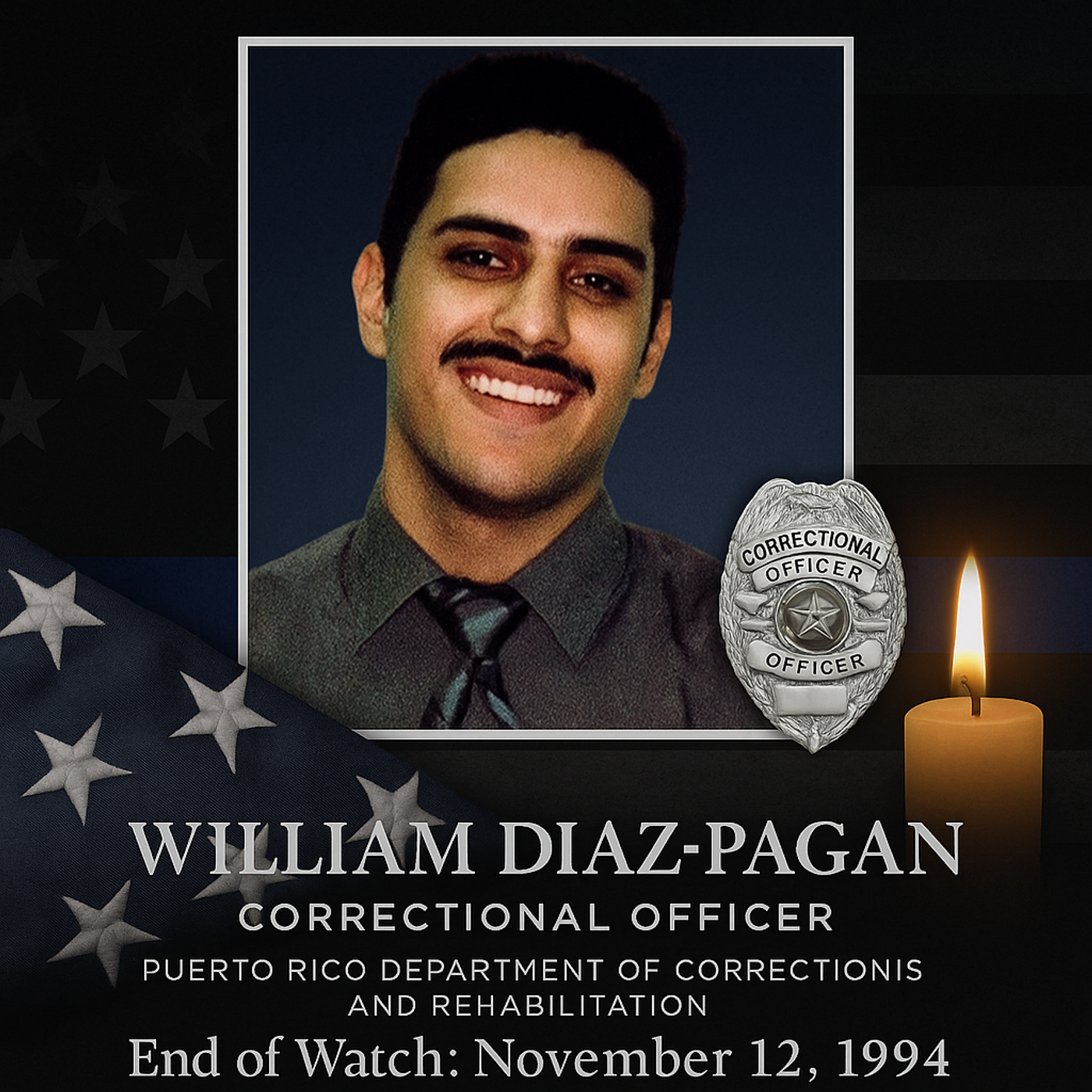
In this episode of 8158: Stories of Sacrifice, we honor the life, service, and sacrifice of Correctional Officer William Diaz-Pagan of the Puerto Rico Department of Corrections and Rehabilitation. On November 12, 1994, Officer Diaz-Pagan was driving an unmarked department vehicle when he was ambushed and fatally shot. Those responsible fled the scene, leaving behind a family, a department, and a community mourning the loss of one of their own. His name is forever recorded among America's fallen law-enforcement professionals, but his story also represents a group of first responders whose service is too often overlooked: correctional officers. Behind prison walls, corrections professionals walk into an environment most of us will never experience. They maintain order, protect lives, respond to emergencies, and carry the responsibility of returning home safely after every shift—knowing there are no guarantees. William Diaz-Pagan's watch ended more than three decades ago, but time does not erase sacrifice. Today, we speak his name. We remember the officer behind the badge. And we make sure Correctional Officer William Diaz-Pagan is never forgotten. 💙 End of Watch: November 12, 1994 Puerto Rico Department of Corrections and Rehabilitation 🎙️ 8158: Stories of Sacrifice Stories of service. Stories of courage. Stories that deserve to be remembered. 🌐 https://www.8158podcast.com 💙 https://www.8158podcast.com/donate 🎧 https://podcasts.apple.com/us/podcast/8158-podcast-stories-of-sacrifice/id1786888538 #8158Podcast #StoriesOfSacrifice #NeverForget #ThinGrayLine #HonorTheFallen #CorrectionalOfficer
Rico: Welcome back to another episode of eighty one fifty eight podcast Stories the Sacrifice. Before we begin today's episode, I just want to take a moment to share something that's been on my heart. Here at 8158 Stories of Sacrifice, we've had an incredible privilege of sitting down with first responders, veterans, and families who carry stories of courage, resilience, and sacrifice. Those conversations will always be the foundation of this podcast. But there are also stories that may never have the chance to be told by the people who have lived them. Stories of heroes whose voices were silenced far too soon. That's why moving forward, we're introducing a new recurring series called Fallen Heroes. In these episodes, we'll take time to honor the lives of law enforcement officers, firefighters, corrections officers, dispatchers, EMS, paramedics, military service members, and other public servants who made the ultimate sacrifice in service to others. Our mission isn't to investigate cases or speculate about unanswered questions. Our mission is much simpler than that. It's to remember the person behind the badge. We'll share what has been publicly documented, recognized their service, and whenever possible, highlight the legacy they left behind. Because every one of these men and women was more than just circumstances surrounding their death. They were sons and daughters, husbands and wives, mothers and fathers, friends, mentors, co workers, and members of the communities that still fill their absence If you're a surviving family member listening to one of these episodes, we want you to know that we approach every story with humility, compassion, and respect. We know we can never capture the entirety of a person's life in a single episode, but it is our sincere hope that each story honors their memory in a meaningful way. Our promise is simple we will tell these stories with dignity. We will stick to the facts, and above all we will remember. Because as long as someone's story continues to be told, their sacrifice is never forgotten. Now, let's honor today's hero. Every badge has a story. Every uniform represents a life dedicated to serving others. And every name etched onto a memorial belongs to someone who was much more than a police officer, firefighter, corrections officer, dispatcher, medic, or public servant. They were someone's son, someone's daughter, someone's husband or wife, a parent, a friend, a co worker, a neighbor, a person with dreams, goals, a future. They were working towards. Sometimes when we hear the phrase end of watch, it's easy to focus on the day a hero died. But here at 8158, it's never been our goal. Our goal is to remember how they lived. Because every one of those heroes deserves more than a single paragraph in a database or a name carved in a stone. They deserve to be remembered as people. Today's story is one of those stories. It's also one that carries more questions than answers. Correctional Officer William Diaz Pegan served with the Puerto Rico Department of Corrections and Rehabilitation. On november twelfth, nineteen ninety-four, William was ambushed while driving an unmarked government vehicle in San Juan, Puerto Rico. He was shot and killed. His murder remains unsolved. According to the Officer Down Memorial page, investigators believe that the attack was connected to his work with the multi-agency gang and narcotics task force. That's the official record. But as we researched William's story, we discovered something else. There isn't much information available. In fact, compared to many of the heroes that we've honored on this podcast, William's story is remarkably difficult to piece together. Some official records contain inconsistencies. Some details are missing altogether. And much of what happened after his death remains unknown to the public. Out of respect for William, his family, and the truth, today's episode is based only on information that has been publicly documented through official records, court documents, and recognized law enforcement memorials. Where questions remain, we'll simply acknowledge them. We're not here to speculate, we're here to remember. One of the things I've learned while creating these fallen hero episodes is that not every sacrifice receives the attention it deserves. Some names become known across the country. Others quietly fade into history. Not because of their sacrifice mattered any less, but because time moved on. New headlines appeared, new tragedies unfolded, and before long only families, friends, and a handful of co workers still spoke their names. That's one of the reasons this series exists. Because no hero should ever be forgotten. Whether thousands attended their funeral or only a few. Whether their story is told on national television or barely documented at all. Their service mattered. Their sacrifice mattered. And their family still carries that loss every single day. Today, the next little while, we're going to remember Correctional Officer William Diaz Pagan. Not because we have every answer, but because we don't need every answer to recognize a life lived in service to others. When we come back, let's talk about the man behind the badge. Who was William Diaz Pegan? And why does his story still matter more than thirty years later? Before we talk about Williams' assignment, before we talk about November twelfth, nineteen ninety-four, I think it's important to stop for just a moment and talk about the profession he chose. When most people think of first responders, they picture a police officer answering a call, a firefighter rushing into a burning building, or a paramedic working to save someone's life in the back of an ambulance. Those images are familiar. They're visible. People see them every day. But there is another group of public servants who work often goes unnoticed. Correctional officers. For many people, correctional officers are out of sight, and unfortunately out of mind. The public doesn't even often see what happens behind the walls of a jail or a prison. There are no flashing lights, no television cameras, no bystanders recording cell phone videos. Most of the work happens behind secure doors, inside razor wire fences. And in places the average person will never step foot. But make no mistake, the dangers are real. Every single shift. A correctional officer wears mini hats. They're responding to maintain order, protecting inmates from one another, protecting staff, enforcing rules, responding to medical emergencies, breaking up fights, stopping assaults, searching for contraband, preventing escape, and often serving as the first line of defense against criminal organizations that continue to operate even while members. Are incarcerated. It's a job that demands constant awareness. One moment everything may seem routine, the next, everything can change. Unlike many professions, there isn't always a warning. Sometimes danger arrives without notice. And while correctional officers may work inside a prison wall, their responsibilities don't always end there. As investigators began looking into William's murder, official records would later reveal that he had been selected to assist with a multi-agency task force focusing on gang activity, narcotics trafficking, and organized crime. That tells us something important. It tells us that William had earned the trust of those around him. Assignments like that aren't handed out casually. They require professionalism, discretion, dependability, and a willingness to step into situations most people would have rather avoided. While many details of his assignment remain unknown, the public, the official record makes it clear that William's work extended beyond routine duties many associate with correctional officers. His service carried significant risk. It's easy to forget that correctional facilities don't exist in isolation. The challenges inside those walls often reflect what happens outside them. Street gangs don't simply disappear once someone is incarcerated. Drug trafficking doesn't magically stop after the prison gates. Organized crime has long recognized the value of influencing people and operations inside correctional institutions. That's why correctional officers play such a critical role in public safety. They don't just protect the people inside the facility. Their work helps protect the communities outside of the walls as well. And in William's case, that commitment would eventually place him in an extraordinarily dangerous position. One of the difficult parts about researching Williams' life is that there simply aren't many public stories about who he was outside of work. We don't know what made him laugh. We don't know what music he listened to on the drive home. We don't know what hobbies he enjoyed or what dreams he had for the future. But sometimes the work Person chooses tells us something about their character. Public service isn't always glamorous. It rarely comes with fame. It almost never comes with great wealth. People choose careers like corrections because they believe their work matters. Because someone has to do it, because serving others is worth the sacrifice. William made that choice. And although history has left us. With unanswered questions, one thing is certain he chose a profession built on service. How many correctional officers go to work every day knowing that the people they supervise may have every reason to dislike them? And yet they still show up. They put on the uniform, they pin on the badge, they kiss their families goodbye, and they walk through those gates. Not because it's easy, but because someone has to. That's courage. It may not always make the evening news, but it's courage nonetheless. For William Diaz Began. That commitment to service would eventually lead him into an assignment unlike anything most correctional officers experience. on a November morning in 1994, everything changed. We'll talk about the assignment that placed him in the path of danger, what public record tells us about his undercover work, and the events that ultimately led to his in the watch. As we continue honoring Correctional Officer William Diaz Pegan, we're now going to talk about the assignment that would ultimately define his career. It's also the part of William's story where the public records becomes surprisingly limited. And that's okay. Sometimes honoring a hero means acknowledging that not every chapter of their life has been preserved for history. Sometimes all we have are pieces of the puzzle. But even those pieces can tell us a great deal. According to the court documents and official memorial records, William began his career as a correctional officer with the Puerto Rico Department of Corrections and Rehabilitation. At some point during his service, he was selected to participate in a multi agency investigative effort involving Puerto Rico's Special Investigations Bureau, known by its Spanish initials as the NIE. The mission of the task force focused on organized crime, specifically investigating gang activity, drug trafficking, weapons, and Now think about that for just a moment. This wasn't simply standing a post inside of a housing unit. A role that requires discretion, professionalism. And perhaps most importantly, trust. Law enforcement agencies don't place just anyone into an undercover assignment. Those positions require officers who can remain calm under pressure, who can think critically, who understand that one mistake, one careless word, one wrong decision could place not only themselves but everyone around them in danger. Unfortunately, the public record doesn't tell us exactly what Williams' day to day responsibilities look like. We don't know the names of the investigations he worked. We don't know the identities of the people he was investigating. We don't know how many operations he participated in. Those records have never been made public. And rather than guess, we'll simply acknowledge that those details remain unknown, because William's story deserves facts. Not assumptions. One detail that does stand out comes from the lawsuit filed by Williams' family after his death. According to the court records, his family argued that he had been assigned to this dangerous work without receiving adequate specialized training for his risk involved. They alleged that there were failures in preparation, supervision, and procedures surrounding undercover assignments. Those claims became part of a lengthy Legal battle after Williams' death. Now, it's important to point out those allegations came from the family's lawsuit. The court ultimately ruled on legal issues surrounding the government liability. But those proceedings also provide one of the few detailed public records described in Williams' assignment. And without those court documents, We might know even less about the work he was doing. It's easy to forget that undercover work carries a unique burden. Unlike officers in marked patrol cars or deputies wearing uniforms, An undercover officer often can't tell friends what they're working on. They can't talk openly about their day. They can't explain why they're working unusual hours. Sometimes they can't even tell family members everything they know. Secrecy becomes part of the job. And while We don't exactly know what William shared with those closest to him. We do know that the assignment itself demanded confidentiality. That's the nature of undercover work. As I researched William's story, I kept thinking about something. Imagine being a young officer. You've chosen a career in public service. You've earned the trust of your supervisors. You're selected for work that's bigger than yourself. You probably don't see yourself as a hero. You're just doing your job. Showing up, doing what's asked of you. Trying to make a difference. That's how so many first responders describe their careers. They don't think of themselves as extraordinary. They simply believe in the mission. And they keep showing up. One thing that struck me while researching this episode is how often the public only hears about officers when something terrible happens. We rarely hear about the thousands of quiet moments, the long shifts, the paperwork, the conversations, the hours spent trying to prevent violence before it ever happens. Success in law enforcement isn't often visible. If a crime is prevented, Most people never even know it almost happened. If dangerous people are stopped before they can hurt someone, there's rarely a headline celebrating the disaster that never occurred. That's the difficult reality of public safety. Much of the most important work happens quietly Behind the scenes without recognition. And that's especially true for undercover assignments. Unfortunately, that quiet work sometimes comes at an unimaginable cost. According to the Officer Down Memorial page, investigators believe William's murder was likely retaliation connected to his participation in the multi agency gang and narcotics task force. If that's true, it serves as a sombering reminder that danger doesn't always end when a shift is over. Sometimes the risks follow officers long after they've left the workplace, long after they've taken off the uniform, long after they think they're simply heading home. As the calendar turned to November of nineteen ninety four, William could not have known that his next drive would be his last. What happened in the early morning hours of november twelfth would forever change the lives of those who loved him. And would leave behind questions that remained unanswered more than three decades later. In the next chapter, we'll walk through the morning carefully. Respectfully, and only as the historical records allow, because while we may never know every detail, we do know one thing a husband, a father, a son, and a fellow correctional officer never came home. There are moments in history when time seems to divide itself into two parts before and after. For the family of correctional officer William Diaz Pigan, november twelfth, nineteen ninety four would become one of those days. A day that began like so many others, a day that no one could ever have known would even end in heartbreak. The public record doesn't tell us what time William woke up that morning. It doesn't tell us what he had for breakfast, or whether he laughed with his wife before they left the house. It doesn't tell us what was on his mind, or what plans he had for the coming week. Those are the quiet details that history often forgets. But they mattered. Because behind every badge Is an ordinary human being living an ordinary life until something extraordinary changes it forever. According to the court records, William and his wife left home during the early morning hours to pick up his sister in law from a social gathering at the Puerto Rico Convention Center in San Juan. They weren't responding to an emergency. They weren't making an arrest. They weren't conducting a search warrant. They were simply driving together. Like countless families have done thousands of times before. The vehicle they were traveling in, however, was no ordinary car. Court documents state that William had been assigned an official government vehicle because his undercover duties. Even while away from work, his assignment remained part of his daily life. As they traveled through San Juan, everything changed. Another vehicle approached. Without warning, gunfire erupted. The attack happened quickly, according to official record. William was struck by multiple rounds. His wife survived the ambush. William did not. He was just gone. There are no words that truly prepare a family for the phone call. No handbook, no training, no amount of strength that suddenly makes it easier. No moment, you're making plans for tomorrow, the next tomorrow no longer exists. Every first responder's family understands this possibility. It's the fear they quietly carry every time someone walks out of the door wearing the uniform. Most days, thankfully, everyone comes home. But for some families, home is forever changed. Investigators would later conclude that this was not believed to be a random attack of violence. According to the Officer Down Memorial page, investigators believe William's murder was likely retaliation connected to his work with the multi-agency gang and narcotics task force. If that conclusion is accurate, it means William wasn't targeted because of chance. He was targeted because of his service, because of the work he had chosen to do. Because he stood between organized crime and And the people those organizations sought to harm. Sadly, William's murder has never been solved. No one has ever been publicly identified as responsible. No arrests have been announced, no convictions have been secured. More than thirty years have passed, and the questions that exist in nineteen ninety four still exist today. For investigators, for the law enforcement community, But most importantly, for William's family. Because while the public eventually moves on, families don't. They continue celebrating birthdays, they continue gathering for holidays, they continue telling stories, all while carrying an empty seat that never gets filled. One thing I've learned over the years is that when we read an end of watch summary, It's easy to reduce an entire life to a single sentence Officer Ambush, deputy shot during a traffic stop, firefighter dies in battling ablaze. But behind every one of those brief summaries, there are decades of life, friendships, family traditions, dreams that were never realized, conversations that never happened, children who grew up without a parent. Parents who buried their child. The official report tells us how William died. It cannot tell us everything about how he lived. stop retake. That's one of those reasons memorials matter, not because they answer every question, but because they refuse to let the name disappear. Every engraved name represents a promise. A promise that someone served, a promise that someone sacrificed, a promise that someone will be remembered. William earned that place. Not because of how he died, but because of how he lived. You know, as I was preparing for this episode, I found myself thinking about something that I hadn't really considered before. Most of us will never know the names of the people who quietly protect our communities. We know the names that make national headlines. We remember the stories that dominate the news cycles. But what about the men and women who simply did their jobs day after day without ever asking for recognition? William was one of those people. His work wasn't done in front of cameras. It happened quietly, Often in places the public never sees. And yet it mattered. It mattered to the officers who worked beside him, it mattered to the communities they served and And it mattered to the families who loved him. One of the things I hope people take away from this series is a greater appreciation for the many different people who wear a badge. Not every badge rides in a patrol car. Not every badge responds to 911 calls. Not every badge works in a firehouse or an ambulance. Some spend their careers inside correctional facilities. Some work investigations. Some process evidence in crime labs. Some work behind the scenes where most of us never see them. But every one of them plays a role in keeping our community safe. And every one of them deserved to make it home. There is a phrase often heard throughout the first responder community, and that is everyone goes home. It's more than a slogan. It's a hope, a prayer, a promise that every ship begins with. Every husband who kisses his wife goodbye before work. Every wife who hugs her husband before putting on the uniform. Every child waving from the front door. They're all hoping for exactly the same thing. That tonight their loved one comes home. For Williams' family, that hope was shattered on november twelfth, nineteen ninety four. And like thousands of other first responder families across the our country, life would never look the same again. I also think it's important to remember something else. When the first responder dies, The loss doesn't end with one funeral. Birthdays still come, anniversaries still arrive, children grow up, grandchildren are born, parents grow older, life continues moving forward, but the absence remains. There's a quote I've heard many times over the years. Grief is simply love with nowhere to go. I don't know who first said those words, but I think there's a lot of truth in them, because if you've ever lost someone you love, you know exactly what that feels like. William's family has now lived with that grief for more than three decades. Thirty years of birthdays, thirty years of holidays, thirty years of wondering what life might have looked like. If that morning had unfolded differently, no family should have ever carried that burden, and yet far too many first responder families do. That's one of the reasons we tell these stories, not to reopen old wounds, but to remind those families that their loved ones are still remembered. As heartbreaking as november twelfth, nineteen ninety four was, William's family would soon face another challenge, one they never expected. Instead of simply grieving their husband, their father, their son, they found themselves fighting for something many of us assume happens automatically recognition. In the next part of William's story, we'll talk about the years that followed, the legal battle, the questions that remained, and the long road that finally led to William Diaz again receiving the national recognition his family believed he had earned all along. There's something that happens every year that most people never think about. Somewhere in this country, a family wakes up on an anniversary of losing someone they love. For everyone else, it's just another day on the calendar. People go to work, kids go to school, life keeps moving. But for that family, time almost stands still. Maybe they visit a cemetery, maybe they pull out old photographs, maybe they tell stories around the dinner table. Or maybe they simply sit quietly and remember. Because grief doesn't need an audience, it just needs a heart. I imagine that's true for William's family too. Every November twelfth, the world keeps spinning, but somewhere someone remembers, someone misses his laugh. Someone wonders what advice he would have given. Someone imagines what life would have looked like if he had the chance to grow older. Those are things that never appear in court documents. And yet those are things that make a life. When we research these fallen hero episodes, we spend hours looking through public records, court filings, memorial pages, newspaper articles, agency reports. They tell us the facts, They tell us dates, times, locations, assignments. But they rarely tell us who a person really was. They don't tell us whether William liked fishing. Or baseball or music. They don't tell us if he was a guy who always made everyone laugh or the one who stayed late just to help a coworker. They don't tell us if he loved coffee or hated the morning. They don't tell us what kind of father he was, what his dreams looked like. History has a way of reducing people to facts. Our hope is to remind people that they were so much more than that. I think that's one of the reasons this podcast exists, because someday every one of us will be remembered by the stories people tell, not by the title we held, not by the rank we earn, not by the awards on the wall, but by the lives we touched, the kindness we showed, the sacrifices we made, the people we loved. That's our real legacy. And I think William understood that. He chose a profession built around serving people he would probably never meet. People who would never know his name, people like you and me. Maybe that's why stories like this matter, not because they leave us with all the answers, but because they remind us that freedom, safety, and justice have always come with a cost. Sometimes that cost is paid quietly. Without fanfare, without headlines, without the world ever realizing what was lost. And that's why we remember. Before we move on, I'd like to ask you to do something. Whether you're listening today, whether you're driving down the road, working in the garage, walking the dog, or sitting at your kitchen table, just take a second. Think about someone you've lost. It doesn't have to be a police officer or a firefighter or someone in uniform, just someone you miss. Think about their smile. Think about the sound of their voice. Think about the things that made them uniquely them. Now imagine if thirty years later from now, someone you've never met said their name out loud, shared their story, and reminded the world that they mattered. Wouldn't that mean something? I think it would. That's exactly why we're here today. To say William DS Pagan. Make sure his name continues to be spoken. To remind his family that, even decades later, he is not forgotten. For most families, when a loved one dies in a line of duty, the hardest part is learning how to live with the loss. The funeral comes, the friends and coworkers gather, the flags are folded, badges are covered in black bands. The community mourns, and then slowly life begins moving forward. Not because the pain disappears, but because it has to. For William Diaz Pagan's family, The grief of losing him was only the beginning. What followed would become a journey that lasted years, a journey not only through loss, but through unanswered questions. As we've mentioned throughout this episode, much of William's service has never been widely documented. In many ways, his story seems to disappear almost as quickly as it entered the public record. There were court proceedings, there were legal arguments, there were official documents, but there was very little public recognition of the work William had done. And for the people who loved him, that mattered. Because when people give their lives in service, their stories deserve to be told accurately. Their sacrifice deserves to be remembered honestly. One of the most meaningful parts of preparing this episode came from hearing directly from William's family. His son shared something with us that speaks to just how difficult those years were. According to his son, William began his career as a correctional officer before being moved into undercover work relatively quickly. He also told us that after William was killed, the family struggled for years to obtain documentation confirming the nature of his assignment. As a son remembers it, that changed in 2007, when, for some reason, the family still doesn't fully understand, the FBI contacted William's widow. That contact, according to the family, ultimately helped them obtain records, confirming Williams' undercover role. While we have not independently verified those events through public records, they are an important part of the family's story, and we share them with that understanding. What we can confirm is this. In two thousand eight, fourteen years after William's end of watch, his name was added to the National Law Enforcement Officers Memorial in Washington, DC. That moment mattered, not because it erased the pain, not because it answered every question, but because it ensured that William's sacrifice would stand alongside thousands of other law enforcement officers who Who gave their lives in the line of duty? His name became part of a place where families from across the country come to remember. A place where service is honored, a place where sacrifice is never forgotten. Sometimes people ask why memorials matter. After all, a name carved into stone can't bring someone back. It can't replace birthdays that were missed. It can't restore years that were taken away. It can't fill an empty chair at the dinner table. And that's true, it can't. But memorials do something else. They tell families we remember that. They tell children your father mattered. They tell spouses your sacrifice mattered too. And they tell future generations that courage is worth remembering. That's why those memorials exist, not simply for the fallen, but for the living. As I thought about William's story, I couldn't help but think about how easy it is for history to overlook people whose work happened quietly. If not for his family's determination, Would we even be telling this story today? Would his name have ever found its rightful place on the National Law Enforcement Officer's memorial? Would future generations know that he served? Those questions remind us of something incredibly important. Sometimes the people who protect a hero's legacy are the people they left behind the spouses, the children, the parents, the siblings, the friends, the co-workers who refuse to let their memories fade. That too is an act of service. To William's family, if you're listening today, thank you. Thank you for continuing to tell his story. Thank you for preserving his memory. Thank you for reminding all of us that behind every badge is a family whose life changed forever. We know this episode cannot capture every part of William's life. No single conversation ever could. But we hope It does something just as important. We hope it reminds people that he was here, that he served, that he sacrificed, and that more than thirty years later his name is still being spoken. As we prepare to close today's episode, I'd like to spend just a few minutes reflecting on what William's wife teaches us about service, about sacrifice, and about why remembering matters. Sometimes I find myself thinking about something that happens all too often. A tragedy makes the news. People talk about it for years, maybe weeks. Flowers are placed, flags are lowered, communities gather, then eventually the news cameras leave, the headlines stop, and life moves on for everyone, Except the family. For the people who love William Diaz Bagun, there was no moving on. There was only moving forward. There's a difference. Moving on suggests forgetting. Moving forward means learning to carry the loss while continuing to live. And anyone who has ever lost someone they love understands exactly what that feels like, including myself. You don't stop loving them. You don't stop missing them. You simply learn to carry them with you. Every birthday, every holiday, every milestone, every quiet moment when something reminds you of them. They're still there. Still loved. Still remembered. That's one of the reasons we created this Fallen Hero series. Not to reopen old wounds, not to relive tragedy, but to make sure the names of these heroes continue to be spoken. Because there is something powerful about saying someone's name. It reminds us that they were real, that they lived, they laughed, That they had hopes for tomorrow, that they mattered. Today we've said William Diaz Pagan's name, and I hope that somewhere his family knows that people they've never met are taking a few moments to remember him, because remembrance is one of the greatest gifts we can offer. You know, one of the things I've noticed about the first responder community is that it's built on something bigger than uniforms. It's built on people. People who are willing to answer the call when someone else is having the worst day of their life. People who miss birthdays, who work holidays, who spend nights away from their Homes who accept risks most of us never have to think about. Not because they expect recognition, but because they believe serving others matters. William was one of those people. Whether he was working inside the correctional facility or assisting with an undercover assignment, he chose service. And ultimately, he gave everything he had in that service. That's a sacrifice worthy of remembrance. If you're listening today and you have someone in your life who wears a badge or carries a radio or responds when others call for help, take a moment to thank them. Not because they're looking for recognition, but because they deserve to know that their work matters. Tell them you're proud of them. Tell them you love them. Give them a hug before they head out the door. Sometimes we assume there will always be another opportunity. Life has a way of reminding us that tomorrow is never guaranteed. And if you're a first responder listening today, thank you. Thank you for the long shifts, the missed holidays, the sleepless nights, the difficult decisions, the quiet acts of courage that most people will never see. Please know, even when it feels like your work goes unnoticed, it matters. It always matters. To Williams family, on behalf of everyone here, at eighty one fifty eight. Thank you for sharing William with us. We know that no podcast can fully capture the life of someone you love. But we hope this episode has done what we set out to do, to honor his service, to recognize his sacrifice, and to help ensure that his story continues to be told. Because that's how legacies endure. One story, one conversation One name at a time. Correctional officer William Diaz Bagan, Puerto Rico, Department of Corrections and Rehabilitation. End of watch, november twelfth, nineteen ninety four. Your watch has ended, your sacrifice did not. You are remembered. Before we go, I'd like to leave you with something that I hope becomes the heart of this series. A badge may one day be retired, a radio may eventually fall silent. A uniform may be carefully folded and placed in a box. But a life lived in service never truly ends. As long as we continue to speak their names, share their stories, and carry their memories forward, their legacy lives on here at eighty one fifty eight. We remember because remembering matters.