
8158 Podcast: Stories of Sacrifice · 8158 Podcast
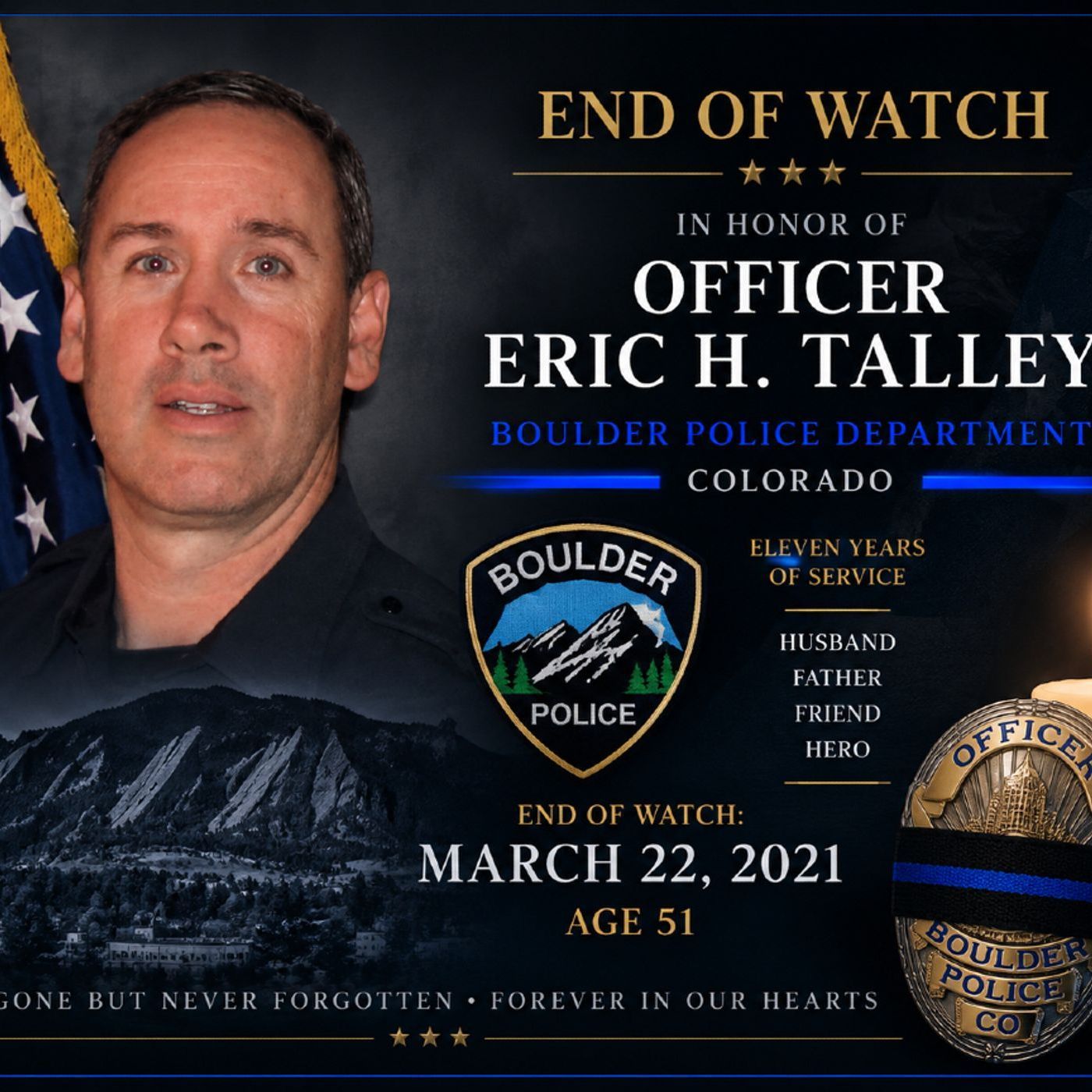
On March 22, 2021, Boulder Police Officer Eric H. Talley responded to an active shooter at the King Soopers grocery store in Boulder, Colorado. Within seconds of arriving, the 51-year-old father of seven ran toward the danger. He would not make it back out. But Eric Talley’s story didn’t begin that afternoon. In this Fallen Hero episode of 8158 Podcast: Stories of Sacrifice, Rico goes beyond Eric’s End of Watch to remember the man behind the badge—a husband and father, big brother, computer scientist turned police officer, Star Wars fan, golfer, department “tech guru,” drone team member, and even the officer who once crawled into a drainage area to rescue a mother duck and her eleven ducklings. Pasted text Pasted text At age 40, Eric left a successful career in technology to pursue a calling to law enforcement. Eleven years later, when the moment came that every officer hopes never comes, Eric made the choice he had once told his mother he would make: he went inside. Pasted text Pasted text This episode honors Eric’s entire life—not simply the way it ended—and remembers the nine civilians whose lives were also taken that day. Pasted text 💙 Officer Eric H. Talley Boulder Police Department, Colorado 11 Years of Service EOW: March 22, 2021 Age: 51 His shift ended that day. The light he left behind did not. Pasted text #8158Podcast #StoriesOfSacrifice #FallenHero #EricTalley #BoulderPolice #EndOfWatch #EOW #LODD #HonorTheFallen #NeverForget
Rico: Welcome back to another episode of 8158 Podcast or it's a sacrifice. Today's episode is a Fallen Heroes episode, and this fallen hero we honor today is Officer Eric H. Talley. Boulder Police Department, Colorado. End of watch, March 22nd, 2021. Age 51, 11 years of service. And his quote There are things worse than death. There are moments when a person's entire character is revealed by a single decision. Not because they know anyone is watching, not because they expect recognition, and certainly not because they know how the story will end. They simply have seconds to decide. What am I gonna do? On the afternoon of March twenty second, twenty twenty one, people inside a grocery store in Boulder, Colorado were running for their lives. Some hid, some barricaded themselves. Some desperately called nine one one. Police radio came alive with the words every officer understands immediately. Active shooter. Among the officers responding was fifty one year old Boulder Police Officer Eric Talley. Eric was a husband, a father of seven, a computer scientist, a Star Wars fan, a golfer, A guy who apparently drank enough Mountain Dew that it became part of how coworkers remembered him. He was the officer people called when they couldn't figure out their technology. He flew police drones, he played board games, he even rescued ducklings. He had spent the first part of his professional life behind computers before deciding at age forty that he wanted something more from his life. And before March twenty second, Erard had once discussed the possibility. of an active shooter with his mother. Like most mothers would, she wanted her son to wait for backup. Eric's answer essentially came down to this there are things worse than dying. For some, one of those things would be standing outside while innocent people were dying inside. Years later, Eric's mother would remember that conversation. Because on March twenty second, twenty twenty one, the hypothetical became real. Eric arrived at King Supers, and within approximately twenty seconds of arriving, he was running inside. But he never came back out alive. This is not simply the story of how Officer Eric Talley died. This is the story of why the people who knew him weren't surprised that he went in. And I am Rico, and this is eighty one fifty eight stories of sacrifice. Eric's mother Judy publicly recalled their earlier conversation about an active shooter response after his death. Long before anyone called him Officer Tally, Eric was a big brother, and according to his younger sister, Kristen Brooks, he took that job seriously. Eric was proactive. When they were kids, Kristen remembered that if she got into trouble, Eric sometimes took the blame. If someone picked on his little sister, Eric made sure they understood that was not a good idea and it was not gonna fly. There's another childhood story about Eric that stayed with Kristen for decades. She was afraid of the dark. Eric found her a night light, and he taught his little sister something. Darkness might fill an entire room, but darkness couldn't extinguish that little light. It seems like such a small childhood moment, a brother helping his scared little sister sleep. But decades later, after Eric was gone, that lesson would take on an entire different meaning. Because the little boy who told his sister that light could survive darkness grew into a man who spent much of his adult life walking towards other people's darkest moments. Eric was born in Houston, Texas in nineteen sixty nine. He was intelligent, technically minded, curious, and computers eventually became his professional world. This wasn't somebody who entered adulthood knowing he'd spend his career wearing body armor. Eric went to college. He eventually earned a master's degree in computer science from Ball State University in two thousand one. Then he entered the technology industry for years. That was Eric Talley's career. Computers, systems, technology. The kind of work where the emergency you're dealing with is usually measured in crash servers rather than human lives. He had a stable profession. He had an advanced degree. And most importantly, he was building a family. CPR documented Eric's master's degree in computer science and his years working in technology before law enforcement. Eric married Leah in nineteen ninety three. Their marriage would span nearly three decades. And together they built what can only be described as a very full house. They had seven children. Seven. If you're a parent listening right now, you already understand that Eric wasn't exactly going home after work for peace and quiet. There was a life everywhere. School, meals, laundry, noise, schedules, birthdays, arguments. And laughing. Seven different personalities. Seven people who called him dad. Leah homeschooled their children. Eric worked. And family was the center of his world. His younger sister described them as an extremely close family. And because seven children required some serious logistics, Eric eventually owned a fifteen passenger van. Not exactly the stereotypical police cruiser. But that's one of the details I love about telling fallen hero stories. Because somewhere between the uniform, photographs, and official memorials was a dad trying to transport a family of nine. Eric loved his kids. His father Shay later said that what he wanted people to remember about his son, yes, Eric was a police officer. And yes, he died a hero. But first, he was a dad. Eric and Leah's seven children were still young when their father died. Reports immediately after the shooting put their ages roughly between elementary school age and young adulthood. Before we turn Eric into some larger than life heroic figure, there's something important we need to establish. Apparently, Eric Talley was the kind of a nerd. And I mean that with complete affection. He loved Star Wars. Hell, I love Star Wars. I'm a huge Star Wars geek myself. He also loved board games. He liked golf. He loved technology. And according to coworkers, Eric had a serious relationship with Mountain Dew. When people remember him after his death, Those little things came up again and again because that's how we actually remember people. Not a resume through quirks, inside jokes, habits. The thing they always drank, the movie they quoted too often, a person everybody called when the Wi Fi stopped working, and even after Eric traded information technology for law enforcement. His computer skills followed him into the department. Police officers would call him with technical problems. Sometimes those problems weren't even police problems. Can't get your home Wi-Fi working. Call Eric. Computer's doing something weird. Eric probably knows. Chief Maris Harold later called him the department's technical guru. There was another part of Eric's personality people remembered. He liked helping. Not only when the problem was dramatic. Sometimes helping meant solving somebody's computer problem. Sometimes it meant supporting a coworker. Sometimes it meant responding to someone experiencing a behavioral health crisis and taking extra time to make that person feel safe. And sometimes, apparently it meant rescuing ducks. His memorial service highlighted Eric's love for Star Wars, board games, golf, and Mountain Dew, as well as his reputation as the department's technical problem solver. In twenty thirteen, Eric received local attention for a rescue. Not a hostage, not a person trapped in a burning building, a mother duck and eleven ducklings. They had become trapped in a drainage area. Officer Tally squeezed his way through the drainage grate and rescued them. His police chief later joked that by all accounts the mother duck was grateful. It's a funny little story. But again, look at the pattern. Something needs help. Eric goes towards it. Whether the problem is someone's computer, a scared child, a coworker, a family, eleven ducklings, or eventually hundreds of people inside a grocery store. Eric's instinct seemed to be, how can I help? The twenty thirteen duck and duckling rescue was specifically remembered by Chief Maris Herold at Eric's Memorial Service. Eric's life could easily have continued in technology. He had the education, he had the career, he had seven children depending on him. Changing careers at forty isn't easy under the best of circumstances. Changing careers at forty to become a police officer. That's another level. There was also a significant financial component. Law enforcement didn't necessarily mean more money. It meant starting over. Academy, training, Probation, shift work, weekends, holidays, risk. and Eric didn't even have a guaranteed police job waiting for him when he entered the academy. So why do it? According to the family and friends, something happened that changed his perspective. One of Eric's closest friends was killed by a drunk driver. Eric began thinking differently about his life. He felt called towards law enforcement. At around 40 years old, a computer scientist went to the police academy. Imagine being in the academy. There are probably recruits in their early twenties. And then there's Eric. A master's degree holding father of seven who spent years working at IT. He wasn't there because he couldn't figure out what else to do. He had already built a career. He chose to leave it. A friend who trained alongside him later remarked on how unusual that was. Eric gave up money. He gave up time with his family. He entered the academy without knowing where it would lead. But he did it anyway. In twenty ten, it led to the Boulder Police Department, Officer Eric Talley was born. Family and friends said the death of one of Eric's close friends in a DUI crash helped motivate his move from a stable IT career into policing around age forty. Eric joined Boulder Police in twenty ten. And over the next eleven years, coworkers saw exactly the same qualities his family had known. He helped, he cared, he was technically gifted. He was dependable. Letters and phone calls received by the department described extra steps Eric took when helping people. Chief Herald later talked about messages from behavioral health professionals and members of the public who remembered his compassion. That's worth emphasizing. Police work frequently means meeting people on the worst days of their lives. Someone may be terrified, angry, mentally ill, addicted, grieving, confused. And sometimes the most important thing an officer does isn't an arrest. It's taking another minute, explaining, listening, helping somebody calm down, making a person feel like they're still human. And that was part of Eric's reputation. He was also building a new skill. In twenty seventeen, Boulder Police created a drone program. Eric was one of the first officers involved. Now the computer guy and the police officer had found a place where both halves of his professional life intersected. Technology, mapping, drones, police work. Eric became deeply involved. He participated in more in one hundred drone operations and worked with three D mapping and modeling. And there was another reason this role mattered. Eric had seven children. He understood risk. He had started considering how he could continue serving while reducing some of the danger of frontline patrol work. He wanted to be around for his family. Eric joined Boulder's drone program in twenty seventeen and became one of its technically skilled members. Eric didn't leave his knowledge at work. He taught his children things, including life saving skills, CPR, emergency response, the kind of things many families say they should learn someday. Eric made sure his kids actually learned them. And shortly before his death, the training mattered. One of Eric's children had swallowed a quarter. Another of his sons responded using What his father had taught him. He helped save his sibling. The Boulder Police Department recognized the boy with a lifesaving award. Think about the symmetry in that. A father whose entire career was about helping people had taught his children how to help too. And one son used those skills to save another. Days later their father would be called upon to use everything he'd learned to try to save strangers. At some point before March twenty second, Eric had a conversation with his mother, Judy. The subject was active shooter. It's the kind of conversation parents of police officers probably hate. Judy wanted to know what Eric would do. She wanted him to wait. Call for backup. Don't go charging in danger alone. That's mom talking. Not policy. Not tactics. Just mom. Please wait. Please don't be the first one through the door. Eric's response would later become one of the defining statements associated with his life. He told his mother there were things worse than death. And for Eric, standing outside while people were dying inside would be one of them. Think about what that tells us. Eric wasn't saying he wanted to die. Quite the opposite. He had seven reasons at home to desperately want to live. And Leah and parents and siblings and coworkers. Eric wanted to go home. But he also understood what the badge meant when someone else's family was trapped inside. At the time that was hypothetical. Then came march twenty second of twenty twenty one. Judy Talley later publicly recounted this conversation during the dedication of a Boulder Post Office bearing Eric's name. It was Monday afternoon in Boulder. King Supers on Table Mesa Drive look like what grocery stores everywhere look like in the middle of the weekday. Employees working, people shopping, someone grabbing dinner. Someone picking up one forgotten ingredient. Someone stopping after work. People pushing carts, people standing in checkout lines. Nobody walked through those doors except the building to become a site of one of Colorado's worst mass shootings. Just before two thirty PM, a gunman arrived in the parking lot. He got out of his vehicle, he began shooting. People were struck outside. The gunman moved towards the east entrance, then inside. The shooting continued. At two thirty PM, Boulder Police Dispatch received its first nine one one call. Within approximately one minute, officers were dispatched. The radio traffic indicated an active shooter. Callers were barricading themselves inside. Initial information even raised the possibility there might be more than one shooter. For responding officers, the situation was chaotic. They didn't have the luxury of knowing what we know now. They were driving towards a building where people were actively being killed. The Boulder County District Attorney later review provides the official minute by minute framework for the police response. Before we continue with Eric's story, we're gonna stop. Because nine other people died that afternoon. They deserve names. Not the other victims. Names. Shalona, Barta Kowe, Susan Fountain, Terry Lecker, Kevin Mahoney, Leanne Murray, Ricky Olds, Nevin Stantsk, Denny Strong, and Jodie Waters. And let's not forget Officer Eric Talley. Ten people, ten families, ten lives that should have continued beyond March twenty second, twenty twenty one. Eric's heroism does not diminish their loss. Their loss gives us the context of his heroism. Because these were the people Eric and his fellow officers were racing towards. Boulders remembrance materials and contemporary reporting identify all ten victims. Eric heard the call. Active shooter. King supers. People inside. Eric responded. Maybe there was a moment during that drive when the conversation with his mother crossed his mind. Maybe he thought about Leia. Maybe he thought about his seven kids. Maybe he thought only about getting there. We don't know. And we shouldn't pretend we do. What we know is what happened when Eric arrived. He didn't stay outside. He didn't wait for the situation to become safe because the entire reason police had been called was that it wasn't safe. Eric arrived with fellow officers. The official investigation says officers Eric Talley, Brian Capaniaboco, and Pam Gannick entered the King Supers at approximately two thirty six PM. Boulder Police describes Eric as running inside within about twenty seconds of arriving. Twenty seconds. Read that slowly. Twenty seconds. That's barely enough time to comprehend what you're seeing. Eric moved towards the gunfire. The hypothetical conversation with his bomb was over. This was real. Inside the officers confronted chaos. The shooter was armed, people were hiding, others had already been killed. Eric and the other officers moved forward. Then shots were exchanged. Eric was hit. Officer Eric Talley fell inside the grocery store he'd entered to save people he didn't know. He was fifty one years old, the computer scientist, the Star Wars fan, the golfer, the Mountain Dew guy, the husband, the father of seven. The big brother who once gave his little sister a night light, the man who had told his mother he couldn't stand outside while people died. He didn't. Eric went inside. And he died there. But something else happened. According to Boulder Police, No additional victims were killed after Eric and the other officers entered and confronted the shooter. Other officers continued the response. The gunman was wounded. He was taken into custody. The killing stopped. Eric's police chief later said, there was no doubt his quick actions and bravery saved lives. Every end of watch eventually reaches the front door. A telephone, a spouse, a parent, a child. Somewhere outside King Supers was a family of nine. Leah, seven children, a family accustomed to dad going to work. Dad coming home, dad fixing things, dad teaching things, dad making jokes. Dad being dad. That family now had to hear that Eric wasn't coming home. There is no heroic language big enough to make that easier. No memorial replaces a husband. No procession replaces another Christmas. No headline says hero gives children their father back. Eric's father, Shay, said he wasn't surprised that his son had put himself in danger for other people. That's who Eric was. But Shay wanted people to remember something else too. Eric was a father, a police officer who wanted to serve a man with a good heart. Two years before Eric died, his children gave him something for Christmas. It was a poem. It was called Our Unsung Hero. They wrote about their dad, about the things he did for them, about the way he cared for people. And remarkably, they acknowledged the danger of his job. Their father went to work every day knowing there was a risk involved. The poem wasn't written after he died. That's what makes it so powerful. It wasn't a memorial language. It was written in twenty nineteen while Dad was still alive. While Eric could read it himself. While nobody knew what March twenty second, twenty twenty one would bring. After Eric died, the poem became part of his funeral program. His children had already found the words to describe their father before the rest of the country ever learned his name The Unsung Hero. CBS reported that the family's twenty nineteen Christmas poem was included in Eric's funeral program and read during the service. News of Eric's death spread rapidly. People learned that one of the ten victims wasn't someone who happened to be shopping. He was one of the people who ran inside after the shooting began. A boulder police patrol vehicle became a memorial. Flowers appeared, notes, flags, messages. People who had never met Eric stopped to pay respect. One survivor came to the memorial because even though he hadn't known Eric personally, Eric had shown up for the people like him. That may be one of the purest definitions of the public service. Eric didn't know who was inside King Supers. He didn't know their politics, their income, their religion, their job. Whether they'd ever thanked a police officer in their lives, he knew one thing. They needed help. He went. The memorial outside Boulder Police grew rapidly in the days after Eric's death. On march thirtieth, twenty twenty one, Colorado said goodbye to Officer Eric Talley, The procession itself was enormous. More than five hundred police vehicles participated, lights flashing, officers from across the region, people lined in routes, carrying flags and signs. Eric's memorial service was held at Flaturans Community Church in Lafayette. Inside were family members, friends, police officers, firefighters, paramedics, people who had worked beside him, people who knew him simply as Eric. His flag draped casket sat before them, and one by one people tried to explain who this man had been. They talked about his kindness, his family, his faith, his humor, his technical skills, his competitiveness, his mountain dew, his Star Wars obsession, his willingness to help. Chief Herald addressed Eric's children. She told them something simple. Their father was kind. More than five hundred police vehicles took part of the procession before Eric's public memorial service. During the memorial, Reverend Daniel Nolan offered a different way to think about Eric's death. Eric's life wasn't simply taken, he gave it. The distinction matters. Eric didn't choose the shooting. He didn't choose for innocent people to die. He didn't choose to leave Leah. He didn't choose to leave seven children without their father. But when he arrived, he had realized people were still in danger. Eric made a choice. And that was go. He had already told his mother what he believed. There were things worse than death. For him, standing outside while innocent people were dying was one of them. And when the moment came. His actions matched his words. The priest's characterization that Eric did not merely lose his life, but gave it, became one of the defining lines from the service. Remember Eric's little sister? Remember the night light? A little girl afraid of darkness? A big brother helping her understand that darkness couldn't extinguish light. After Eric's death, that childhood memory became something else entirely. Because Kristen had spent a lifetime knowing Eric as her protector. First in childhood, then as an adult. He still checked on her, still reminded her to take care of herself. The protective big brother never completely disappeared. And now she had to figure out how to live in a world without him. But the lesson Eric taught her as a child remained. Darkness doesn't automatically win simply because there's a lot of it. One light still matters. And Eric's family would carry that light forward. Eric's story didn't end with the funeral. In twenty twenty two, Boulder Police established the Eric Talley Memorial Award. It's given annually to a department member who demonstrates the qualities Eric was known for. Helping coworkers, putting the team ahead of themselves, making sacrifices to help other people, being there professionally and personally. Think about that. They didn't create an award for the officer who runs fastest or shoots the best or makes the most arrests. Eric's name was attached to an award for helping other people. That's his legacy. Boulder also continued remembering all ten people killed on March twenty second. The community gathered. Moments of silence was held. Eric's name remained attached to ceremonies and memorials. The Boulder Post Office was officially designated the Officer Eric H. Talley Post Office Building. And years later, scholarships bearing Eric's name began helping students interested in pursuing law enforcement careers. His name wasn't frozen in twenty twenty one. It kept moving forward. The Boulder Police Department created the Eric Talley Memorial Award in twenty twenty two specifically around his reputation for putting others first. Now we use the word hero a lot, sometimes so often that it almost loses meaning. However, Eric Talley's story gives us a chance to define it differently. Heroism isn't fearless. Eric had a wife, seven children, parents, siblings, friends, and a future. There was no reason to believe he wanted to die. Heroism isn't wanting danger. It's understanding the danger, understanding what you stand to lose. And deciding someone else's life still matters enough. Eric didn't know which families were hiding inside that store. But he knew somebody's mom was inside, somebody's dad, somebody's child, somebody's husband, somebody's wife, somebody's best friend. And perhaps because Eric loved his own family so deeply, he understood exactly what those people represented in somebody else. His sister said She knew what he would have been thinking. There were families inside. There could be children inside. Eric went. Before we close, we're going to say their names one more time because Eric Talley's end of watch cannot be separated from the tragedy he responded to. Tralona Bart Kwak, Susan Fountain, Terry Liker, Kevin Mahoney, Lynn Murray, Ricky Olds, Nevin Stanisik, Denny Strong, Judy Waters, Nine Civilians, and then Officer Eric H. Talley. Ten lives. ten Families march twenty second, twenty twenty one. Boulder, Colorado, Reremember all of them. When you hear Eric Talek's name, don't only picture King Supers. Picture a five year old being brother protecting his little sister. Picture the nightlight. Picture the computer scientist. Picture Eric meeting Leah. Picture a house with seven kids. Picture the fifteen passenger family van. Picture Star Wars. Board games. Golf, Mountain Dew, picture coworkers calling because their technology wasn't working. Picture Eric crawling through a drainage grate after eleven ducklings. Picture a forty year old man sitting in a police academy surrounded by younger recruits because he didn't decide his comfortable career wasn't enough. Picture a police officer helping someone through a mental health crisis. Picture a dad teaching his kids CPR. Picture one of those children using what dad taught him to save his own brother. Picture a drone flying overhead with Eric at the controls. Picture his children giving him a poem for Christmas. Our unsung hero. Then, and only then, picture the officer arriving at King Supers. Twenty seconds, a doorway, people dying inside, seven children waiting at home. And Eric going through the door anyway. Officer Eric H. Talley, Boulder Police Department, Colorado, Husband Talia, Father of Seven, Son, Brother, Computer Scientist, Technology Professional, Police Officer, Drone Team Member, Friend, Problem Sver, Duck Reserve, Star Wars fan, golfer, Mountain Dew enthusiast, Eleven years of law enforcement service end of watch march twenty second, twenty twenty one, age fifty one. Killed in the line of duty while responding to an active shooter at the King Supers grocery store on Table Mesa Drive in Boulder, Colorado. Officer Tally, your shift ended on march twenty second, twenty twenty one. But the light you left behind did not. Your family remembers, your department remembers, Boulder remembers, your brothers and sisters behind the badge remember, and today we remember. Rest easy, Officer Tally, we'll take it from here. This has been eighty one fifty eight Stories of Sacrifice and I am Rico. Every time we tell one of these stories, we come back to the same idea. An end of watch gives us a date. It doesn't give us the person. That's our job. Officer Eric Talley wasn't born on march twenty two, twenty twenty one. His story didn't begin at King Supers. It began decades earlier, with family, with little sister, with school, computers, marriage, seven children, a career change, a badge, co workers, community, thousands of complaints. Completely ordinary moments that ultimately make up a life. And maybe that's the most important thing to remember about fallen heroes. They aren't statues, they're people. People who complain when the Wi-Fi doesn't work, people who drink too much Mountain Dew, people who love Star Wars, people who embarrass their kids. People who have bills, people who argue with their spouses, people who laugh at stupid jokes, people who have plans for next week, people who expect to come home. But when other people's lives depend on somebody going through the door, he went. His mother had once asked him what he do in exactly that situation. Wait for backup? Eric already knew his answer. When march twenty second came, he lived it. And that is why Officer Eric Talley deserves to be remembered not simply for the way his life ended, but for the way he chose to live it. If this episode moved you, share it. Share Eric's story. Tell someone about the computer scientist who became a police officer at forty. Tell them about the father of seven. Tell them about the ducklings. Tell them about the nightlight. Tell them about the man behind the badge. Because when we remember fallen heroes only for their deaths, we miss the lives that made their sacrifices mean something to Leah and Eric's children, to his parents and siblings, to his friends, to the men and women of the Boulder Police Department, and to the families of all ten people whose lives were taken on march twenty second, twenty twenty one. We remember with you Officer Eric H. Talley Boulder Police Department End of Watch March twenty second, twenty twenty one. His light still shines. But until next time, take care of yourselves. Take care of each other. Check on your people. Tell them you love them and never forget every badge has a person behind it. Every uniform has a family waiting at home, and every end of watch has an entire lifetime that came before it. This is eighty one fifty eight Stories of Sacrifice.