
6G Agenda · 6G Agenda
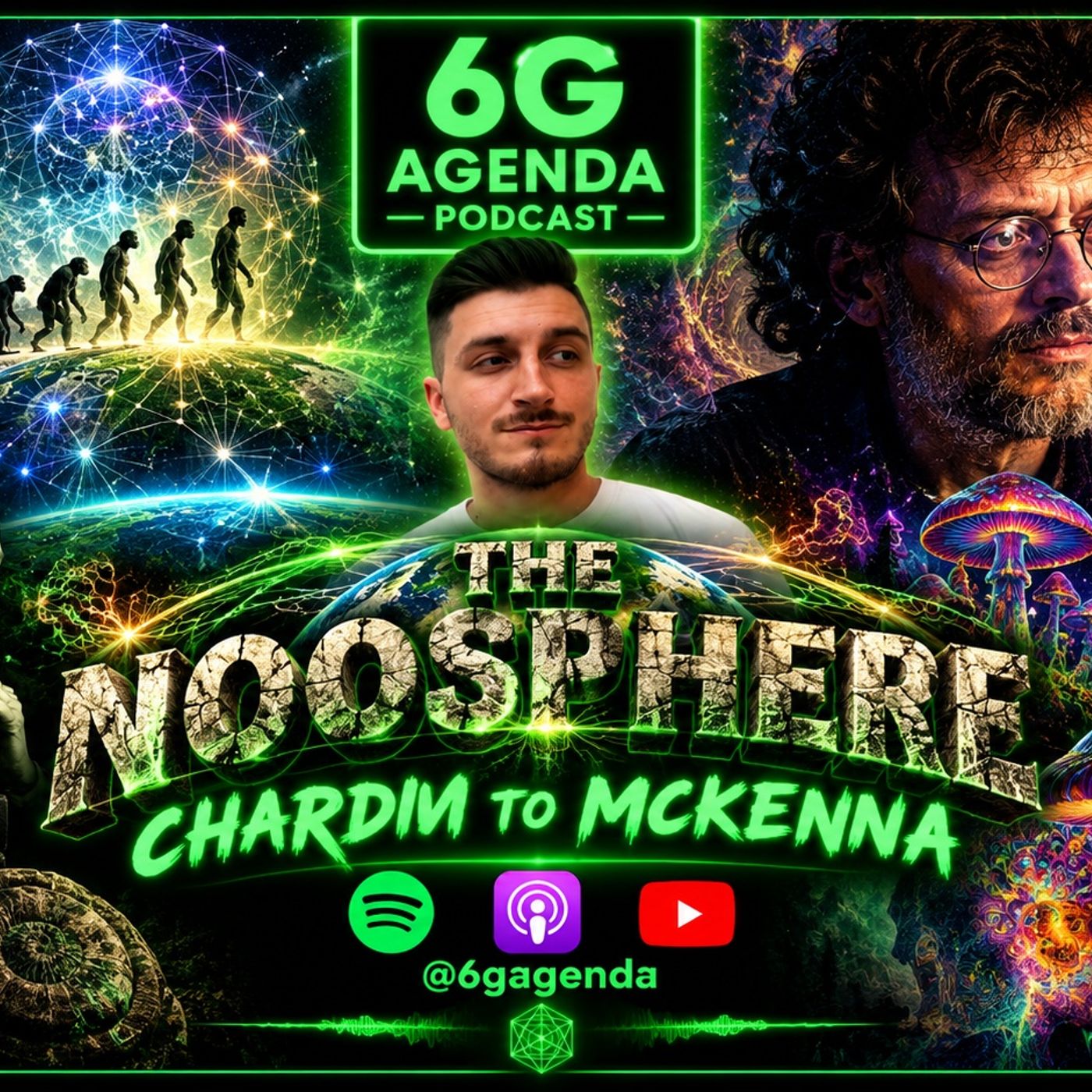
Yes, those ads are annoying, but it helps support the show! For Early Access, Ad-Free video episodes become a member on Spotify, YouTube or Join Patreon! In this episode of 6G Agenda, we investigate the concept of the Noosphere, tracing its evolution from the philosophical and theological writings of Pierre Teilhard de Chardin to the psychedelic futurism of Terence McKenna and the consciousness movement surrounding California’s Esalen Institute. The Noosphere describes a sphere of human thought and collective consciousness emerging alongside the biosphere. But what happens when this concept is connected to theories of evolutionary progress, technological convergence, global governance and the idea that humanity is moving toward a fundamentally different state of existence? We begin with Teilhard de Chardin, the Jesuit priest and paleontologist who envisioned evolution as a process moving toward increasingly complex consciousness and ultimately toward what he called the Omega Point. His ideas helped establish a philosophical framework for thinking about humanity as an interconnected system evolving toward a higher level of consciousness. From there, we move into Terence McKenna, whose psychedelic philosophy explored the Noosphere, novelty, technological acceleration and the possibility of a profound transformation in human consciousness. We examine how McKenna’s ideas about humanity’s future intersect with the broader Esalen movement and its experiments in psychology, spirituality, human potential and altered states of consciousness.But this episode takes a different angle. We connect these spiritual and evolutionary philosophies to the history of American elite organizations, Fabian socialism, Malthusian population theory and the eugenics movement. We investigate the historical relationships among these intellectual circles and ask whether apparently different visions of human progress sometimes share an underlying assumption: that humanity can—and perhaps should—be deliberately transformed. This brings us to Julian Huxley and Aldous Huxley, two brothers whose work explored human evolution and the future of civilization from different perspectives.Julian Huxley was a prominent evolutionary biologist, a leading figure in the history of modern evolutionary synthesis, and an advocate of eugenics during part of his career. He also popularized the term transhumanism in his 1957 essay of the same name, describing the possibility that humanity could transcend its existing limitations through conscious evolutionary change.His brother Aldous Huxley, author of Brave New World, explored psychological conditioning, social control, consciousness and the dangers of technologies that could shape human behavior. Aldous also participated in the Esalen community, where his interests in human potential and expanded consciousness overlapped with the work of figures such as Alan Watts and other influential thinkers. The central question is whether these...
0:38Speaker 1Alright, welcome to 6G Agenda. Trying to catch up here.
0:42Speaker 1I'm Andrew, your host, as always, here to talk about
0:44Speaker 1what they want. And yeah, hope you guys are having
0:48Speaker 1a great start to your weekend. Saturday evening, kicking off October.
0:53Speaker 1First week of October.
0:54Speaker 210-10-2026.
0:54Speaker 12-2-6 makes 10. 10-10-10, baby. Triple 10s. Just saying. Getting
1:09Speaker 1into Esalen. Institute, getting into what we're going to do
1:38Speaker 1with the human potential movement studies and all that. And like,
1:43Speaker 1where did this ideology come from? You know, and it
1:46Speaker 1seems to be that it came from a lot of
1:48Speaker 1this noosphere nonsense, right? Collective unconscious and all this other
1:54Speaker 1stuff that these guys talk about. So we are going
1:57Speaker 1to see what they mean by that. And so there's
2:00Speaker 1a lot of stuff to go over tonight, a lot