
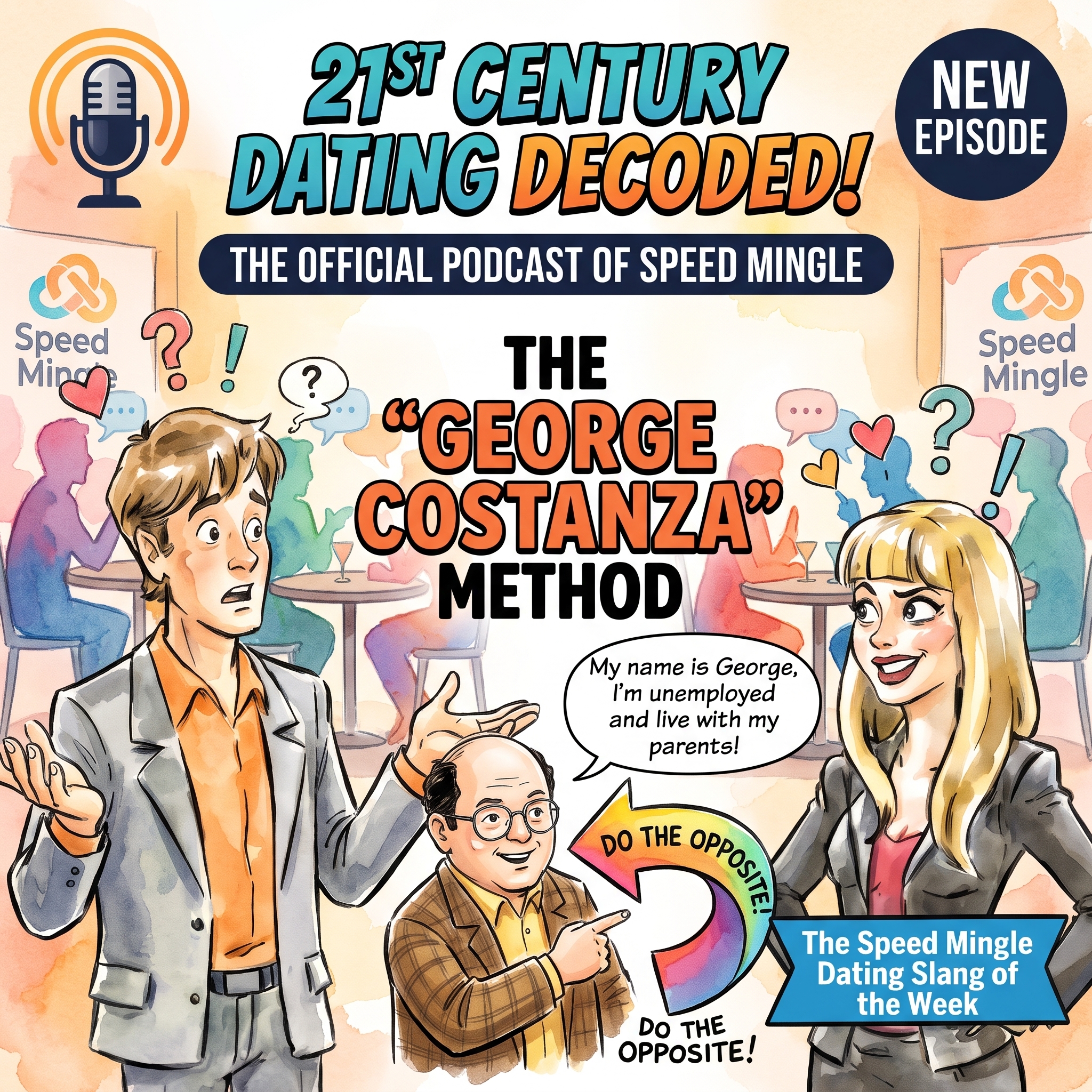
21st Century Dating Decoded!™ · HRBUniversal Group
Want a deep dive into 180-dating and breaking toxic relationship loops? Catch the latest episode of 21st Century Dating Decoded! with your hosts Zack & Alice as we break down the George Costanza method step-by-step. 📺 Where to Listen & Watch: Stream the Speed Mingle Network on Apple Podcasts, Spotify, YouTube Music, Amazon Music, Audible, iHeart Radio, Deezer, YouTube, Roku, Amazon Fire TV, Google TV, or on our mobile web app at SpeedMingle.mobi. 🌐 Official Hubs: 21stcenturydatingdecoded.com | TheSpeedMingle.com 📱 Social Media: @TheSpeedMIngle 🚀 GET INVOLVED IN THE SPEED MINGLE ECOSYSTEM Attend a Local Event: Stop endless swiping and take the initiative! Attend a local Speed Mingle event to "Mix, Match, and Mingle" in authentic, low-pressure environments. Become a Host or Venue Partner: Don't have a Speed Mingle event in your city yet? Contact us at Speed Mingle to bring curated social events to your area as a local host or venue partner! Support the Show: If you love the podcast, please smash that subscribe button, drop us a 5-star review, and share this episode link with that friend who still uses an expired filter on a dark headshot! 😉 💬 TAGLINE & SIGN-OFF: "Until our subsequent episode: remain deliberate, maintain protection, and consistently date with a defined purpose." #ContraDating #180Dating #GeorgeCostanzaMethod #SpeedMingle #21stCenturyDatingDecoded #DateWithPurpose #SlowBurn #RelationshipPsychology #DatingAdvice #DatingAppBurnout #PatternInterrupt #ConsciousDating #AttachmentTheory #SeinfeldPsychology #MixMatchMingle
The "George Costanza" method : Welcome to 21st Century Dating Decoded, the official Speed Mingle podcast. Let's welcome our host for today's deep dive. So I want you to imagine for a second that you're sitting in this really crowded diner in New York City. Okay. Setting the scene, I like it. Right. And you're just you're staring at your usual order. Maybe it's like a tuna on toast, something super mundane. The standard go-to. Exactly. And suddenly you realize this terrifying, just absolute truth. Like it hits you like a ton of bricks. no. What is it? That every single instinct you have ever had, i every romantic decision you've ever made in your entire life has just been unequivocally wrong. Wow. Just entirely wrong. Just entirely wrong. the people you were drawn to, the boundaries you thought you had, the red flags you somehow painted green, right? We all do it. The green paint comes out pretty fast. It really does. But all of it, all those instincts. led you exactly to where you are right now, which is probably, burned out, completely exhausted, and swiping on an app with the enthusiasm of someone doing their taxes. Which is to say zero enthusiasm. Less than zero, actually. Exactly. So welcome to 21st Century Dating Decoded. Today we are unpacking the speed mingle dating slang of the week. And it is a good one today. It really is. It's the George Costanza method. Our tagline for this deep dive is 180 dating. Have you tried dating the opposite of who you have dated in the past? It's it's a question that forces this really immediate and honestly kind of uncomfortable audit of your entire romantic history. Aaron Totally uncomfortable. Right. Because if you sit with that realization for even a second, you have to confront this possibility that your internal compass, you know, i it isn't just slightly off true north. Like it's not just a little broken. No, it might be actively like Deliberately pointing you toward the rocks. Steering you right into the iceberg. Well, I'm your host, and I'm gonna be bringing, I guess, the more analytical grounded perspective today because we are building this massive thematic thesis here. Yes, we are. And I'm your resident expert, co-anchoring this whole journey to bring the intuitive, candid, and hopefully somewhat witty perspective to the table. You always do. And our mission today is huge. We are pulling from this giant stack of sources. We've got Sociological studies. We have global dating app data from Hint app, Pew Research data. Lots of hard data today. Yeah, and some really deep dive relationship psychology articles. We're using all of this to figure out if deliberately dating your exact opposite, violently interrupting your own subconscious dating patterns is actually the ultimate hack to finding a real lasting connection. Aaron Because when you look at the macro landscape of modern dating, there is this staggering contradiction, right? nobody really wants to talk about it. What's the contradiction? Well, culturally, we have fully embraced raw, unfiltered desires. We've completely dismantled all those old rigid courtship rules, which, you know, is great in a lot of ways. Right. Nobody wants to go back to the nineteen fifties. Exactly. Everyone is out there aggressively chasing the spark. But in doing so, we've kind of completely abandoned structure, we've abandoned boundaries, and like most importantly, intentionality. We basically threw out the rule book because we craved freedom, but now everyone is just wandering lost in the woods, wondering why they keep stepping in the exact same bear traps. That is the perfect way to put it. Think about how people approach their professional lives, right? Versus their romantic lives. It's night and day. It really is. Like if you were a CEO and you were hiring for a mission critical role in your company, you would have a strategy. absolutely. You'd I'd have a whole plan. You'd write a detailed job description, you would carefully vet the applicant pool, you'd do structured interviews. But daters today, they're acting like a business hiring from a catastrophic applicant pool with literally zero strategy. They're just throwing spaghetti at the wall. Basically. They throw this massive net out into the digital abyss and just leave it up to fate. They just hope the perfect candidate magically falls into their lap based on like A vibe. Right. Because we want the romance. It sounds so romantic when you watch it in a movie, but as an actual practical strategy for finding a life partner, it's wildly reckless. It's completely reckless. Which, you know, brings us directly to you, the listener. Yes. Let's talk to the people who are actually in the trenches right now. Right. Like if you're swiping right now, or maybe you're recovering from what, your third failed situation ship this year. Off the situation ships. They drain you. They do. And you might be thinking to yourself, I just have a broken picker. I am fundamentally incapable of choosing good partners. I hear that from so many people. My picker is broken. But what if your picker is actually functioning exactly as it was programmed to? Like, what do you mean by that? What if the problem isn't that you are choosing wrong, but that you are consistently, stubbornly picking from the exact wrong pool of people? wow. Exactly. And that is where the diner epiphany comes in. The origin story of the 180 date. Okay, let's unpack this. We have to go back to 1994. For anyone who is familiar with the sitcom Seinfeld, there is this absolute masterclass in psychological disruption disguised as a comedy episode. It is brilliant. It really is. It's titled The Opposite. So you have George Costanza, right? He's notoriously neurotic, chronically unemployed, just disastrously unlucky in love. And he's having a total crisis in Monk Styder. A classic George meltdown. Classic. He tells his friends that his life is the exact opposite of what he wants it to be. every instinct he has ever had has yielded a terrible outcome. And then Jerry looks at him and delivers this line of pure unadulterated behavioral logic. He says, If every instinct you have is wrong, then the opposite would have to be right. It's so simple but so profound. So George immediately puts it to the test. Usually he would order to non toast, right? But instead he orders chicken salad on rye, untoasted with a side of potato salad. A complete menu pivot. And then he spots this beautiful woman sitting across the diner. Normally his instinct would be to just cower in fear, or, if he did approach her, he'd construct some elaborate, ridiculous lie to sound impressive. Like saying he's an architect or a marine biologist. Exactly. But instead, he walks right up to her, looks her in the eye, and says, My name is George. I'm unemployed. And I live with my parents. And the result is just instant magnetization. She is completely charmed by his radical honesty. Right. By doing the exact opposite of his natural inclinations. He doesn't just get a date with her. The domino effect of this whole opposite strategy eventually lands him his absolute dream job working for the New York Yankees. It's framed as sitcom gold, obviously, but there is a profound, truly actionable psychological truth embedded in that diner scene. So let's firmly define the slang of the week based on what our sources say. The George Costanza method, which is also referred to across the literature as 180 dating, contra dating, or even open casting. All great terms for the same concept. Right. It's the conscious, deliberate act of contradicting your established dating habits. It means you actively seek out partners who completely defy your usual type in order to break repetitive failing romantic cycles. You are intentionally crossing the street to avoid your usual demographic. Okay, but I have to push back here because I know exactly how our listeners are going to react to this when they hear it. Let's hear it. The dating pool is objectively a nightmare right now. People are exhausted. So when you tell someone, hey, go date your exact opposite, it sounds highly suspicious. Like it's a trap. Yeah. It sounds like you are telling them to just lower their standards. And settle for someone they aren't even attracted to just because the market is tough. Are we basically just rebranding, giving up? No, no, no. It is so vital to separate core values from surface packaging. 180 dating is the exact opposite of settling. Okay, explain the difference then. Well, if you want children, you do not 180 date someone who is adamantly child free. That's a core value. Right. That would be a disaster. Exactly. If you value deep intellectual honesty, you don't 180 date a compulsive liar. You never ever compromise on the foundational pillars of your morality or your life goals. So what are you compromising on? You're not compromising, you're becoming radically flexible on the surface level criteria. The aesthetic checkboxes, basically. Yes. The aesthetic, the energy, the career archetype. For example, if you always date the brooding, chaotic, creative type, right? the tortured artist. Yes, and you constantly find yourself acting as their unpaid therapist while they literally drain your bank account, you need to swap that out. Try dating a pragmatic accountant or someone in healthcare. A total shift in energy. Exactly. If your usual type is the extroverted life of the party person who constantly makes you feel like, you know, an accessory in their grand performance, try dating a quiet, grounded introvert. It's like an intentional pattern interrupt. That's exactly what it is. It forces you to stop engaging in these trauma bonding loops. It is about expansion, not subtraction. You aren't lowering the bar, you are opening a completely different door to see if healthy stability lives in a room you have previously just ignored. Aaron Okay, so if we know the charming performer archetype is a terrible long-term investment, why does the grounded anchor feel so repulsive to us in the moment? That is the million dollar question. Because if the anchor is objectively better for our survival and our happiness, there has to be some biological mechanism overriding our logic here. Why do we keep walking right back into the burning building? Aaron To understand that we have to look really deeply at the psychological concept of variable reinforcement. Your brain's reward center does not just love unpredictability, it is entirely hijacked by it. Aaron Let's use an analogy here from the sources because I think it perfectly captures the trap people fall into. Go for it. I think about the difference between a vending machine and a broken slot machine. Aaron I love this. analogy. Right. So a vending machine is fixed reinforcement. It's totally predictable. You put in a dollar, you press D four, and you get a bag of chips every single time. The rules are completely clear. Yes. And because the rules are clear, your behavior is perfectly reasonable. If the vending machine eats your dollar and gives you nothing, you don't spend the next six months standing in front of it crying. Right? You don't beg it to give you the chips. You just walk away. Because there's no mystery to solve. Exactly. It's broken, so you leave. Exactly. But now look at the slot machine. That is variable reinforcement. You put in a dollar, you pull the lever, and you get nothing. Right. You do it again, nothing. You do it a third time, and suddenly bells are ringing, lights are flashing, and you win fifty dollars. The jackpot. But you have no idea what triggered the win. And you have absolutely no idea when the next win is coming. So what do you do? You keep pulling the lever. You become completely obsessed. And this is the exact playbook of the charming performer archetype that we see in modern dating all the time. The slot machine dater. It is the defining architecture of a toxic situationship. The performer is magnetic. One day they text you back in five seconds. They plan this extravagant date and they make you feel like you are the absolute center of the universe. And the dopamine hit you get from that is just astronomical. Huge. But then they disappear for 48 hours. They give vague answers to your questions. They pull away for no apparent reason. And your brain just starts treating them like the broken slot machine. Exactly. Because psychologically, dopamine is actually the molecule of anticipation, not just the molecule of reward. Wait, really? It's about the buildup? Yes. The unpredictability creates this massive spike in dopamine because your brain is desperately trying to calculate when the next reward is coming. So when they finally text you back after ignoring you for two days, the rush you feel is incredible. It feels electrifying. It feels like earth shattering, meant to be chemistry. But if you actually look at a brain scan during this, that isn't chemistry. It is activated attachment anxiety masquerading as passion. Wow. You are literally confusing the adrenaline of sheer panic with the butterflies of love. Exactly. We culturally code that sick pit in our stomach as the spark. But now contrast the performer with the grounded anchor. The vending machine. The vending machine. They are dependable. They are direct. If they say they are gonna call you at 7 PM, they call at 7 PM. They are completely comfortable with quietness and stillness. They don't deflect conflict with this overwhelming charm, they just address it head on. But the tragedy of modern dating is how the person who is addicted to the slot machine views the vending machine. It really is a tragedy. When someone whose nervous system is wired for variable reinforcement goes on a date with a grounded anchor. They wildly misinterpret the anchor's emotional regulation. They read it as boring. Or even worse, they read it as detachment. Right. The chaotic data thinks, well, they text me back immediately and they aren't playing games, so they must not be mysterious. And since I'm not obsessing over them and crying to my friends, we must not have a spark. They view the lack of anxiety as a lack of connection, when in reality the grounded anchor just doesn't need to manufacture chaos to prove that they care. It is a staggering realization to accept that you might be actively repelled by healthy behavior just because your nervous system is addicted to the spikes. It's a hard truth to swallow. it's not entirely our fault. We have to acknowledge the Hollywood conditioning here. absolutely. The rom com damage is real. You're right. From a very young age, movies and television trained us to believe that true love requires high intensity friction. We are taught that romance is like a dramatic reunion in the pouring rain. Usually preceded by a agonizing heartbreak and some chaotic chase through an airport security line. Always an airport. But according to every sociological and psychological source we view for this deep dive, real enduring love is often quiet. It is repetitive, it's deeply respectful, and frankly, it can be a little mundane. There is this brilliant piece of analysis from one of our sources, The Modest Man, that outlines eighteen different ways we confuse peace for boredom. In a healthy relationship. That list is so good. It's an incredibly confronting read for anyone who is used to chaotic dating. it holds up a very harsh mirror. Let's dig into some of these because I think they will resonate uncomfortably well with you if you're listening. The first major one on the list is craving the chase, not the connection. Right. This happens when the entire value of the relationship is tied up in the conquest itself. Like it's a game to be won. Exactly. If you find yourself feeling totally disengaged the literal second the pursuit ends and the person finally commits to you, you aren't actually looking for a partner. You are viewing the relationship as a prize to be won just to validate your own ego. And with surprises on the shelf, you have no interest in maintaining it. You just want a new game. Precisely. Another massive trap from that list is equating predictability with dullness. Which goes back to the vending machine. Knowing exactly where you stand with someone shouldn't trigger an existential crisis. It really shouldn't. Predictability is the absolute bedrock of trust. You cannot build a life with someone if you don't know who they are going to be from one Tuesday to the next. Right. Are they going to be loving? Are they going to be cold? You can't plan a future on that. But if you only feel alive when you are uncertain, you are going to actively sabotage a stable partner, and that leads directly to the most destructive behavior on the list. Unconsciously picking fights just to feel something. Shaking off the stillness. That is so common. It really is. Because when peace feels entirely unfamiliar to you, it actually registers in your brain as a threat. Wait. Peace feels like a threat. Yes. Your subconscious thinks it's too quiet. Something terrible is about to happen. The other shoe is going to drop. So what do you do? You stir up conflict. You pick a fight over how they loaded the dishwasher, or you randomly bring up an ex just to recreate the emotional spikes you're used to. You want the adrenaline hit of the fight followed by the dopamine hit of making up. Exactly. You are basically creating your own variable reinforcement loop because the healthy partner won't do it for you. That is wild. And we see this in how people view being challenged by a partner too. in a chaotic relationship, you are challenged through loud arguments, through jealousy and friction. But in a peaceful relationship, a partner challenges you through kindness. Through self-awareness. Through holding up a mirror during deep, calm conversations. Right. Not every lesson needs to be loud. Maturity whispers. Maturity Whispers, I love that. That is the perfect encapsulation of the anchor archetype. But moving from the loud to the quiet inevitably brings up this cultural phenomenon we have to talk about. The ick. the ick. We all know the term. It's that sudden inexplicable wave of physical repulsion you feel towards someone you were previously totally into dating. It's all over TikTok right now. It is. But the psychological sources frame the ick so differently than social media does because Sometimes the ick isn't triggered by someone chewing loudly or wearing weird shoes, right? Right. It's not always about a weird laugh. Sometimes the ick happens simply because they text back promptly or because they lack a cynical guarded edge. We pull away not because they were doing anything objectively wrong, but because safety feels entirely foreign. And to really understand the mechanics behind that specific self-sabotaging ick, we have to look at the science of personality meta traits. Psychology today breaks human personality down into two overarching categories, stability and plasticity. Okay. Let's translate that out of the clinical jargon for a second. How do those two traits actually manifest in a dating context? Like if I'm sitting across from someone at a bar, how do I spot stability versus plasticity? Good question. So stability is your emotional level-headedness. It encompasses things like agreeableness and conscientiousness. Think of a highly stable partner as having an internal emotional thermostat that is permanently set to a comfortable 72 degrees. Perfect room temperature. Exactly. They do not swim wildly from hot to cold. If they get a flat tire on the way to work, they don't scream at the sky and have a meltdown, they just change the tire. Right. They just handle it. Now plasticity, on the other hand, is driven by novelty seeking. It's extroversion, it's exploration. It is the need for constant new stimuli. So a stable partner won't give you those massive movie trailer emotional highs, but they also won't drag you into those devastating, paralyzing lows. Precisely. But here is the biological catch, and this explains the ick perfectly. Human attention systems are evolutionarily wired to notice change. We notice variance. Like a predator moving in the bushes. We notice the movement. Yes. If a partner's emotional output is consistent, steady, and predictable. It registers less strongly in our brain over time. So even if their behavior is incredibly supportive, loving, and objectively wonderful, if it does not fluctuate, your brain might interpret that lack of variance as a lack of passion. wow. So you literally stop noticing how good they are because they aren't keeping your nervous system on high alert. Exactly. You get bored of seventy-two degrees, even though it's perfect. So to execute a one eighty date successfully, You are essentially launching an active rebellion against your own flawed brain chemistry. You are telling your nervous system to sit down and shut up while you learn to appreciate 72 degrees. It is a complete rewiring process. You are teaching your body that boredom isn't dangerous, it's just peace. Okay. So we have deeply established the why. The psychology is totally undeniable at this point, but who is actually out there doing this? Let's look at the demographics of the 180 date because the data reveal some really fascinating societal divides here. The data on this is super interesting. It is. We have a massive data set from the Hint app. They surveyed 13,764 adults globally, pulling from the US, the UK, Canada, the EU, Australia, and Latin America. And they found that forty four percent of single adults would deliberately consider dating someone. substantially outside their usual preferences. dating someone significantly older or younger than they ever have before. Exactly. They are completely throwing out boundaries they previously considered strict, non-negotiable rules. And did it work for them? Yes. Of those who actually went through with it, the ones who executed the 180 and dated outside their usual parameters, 58% reported that it felt refreshingly different and much more positive than their previous relationships. That's a huge success rate for an experiment like that. But when we look at who initiates a 180 date as a conscious, deliberate strategy, the demographics are fiercely divided by gender. The gender divide here is stark. Women are significantly more likely to deliberately initiate a 180 date as a strategic move. Why is that? It ultimately comes down to the mechanics of selectivity versus volume on dating apps. Women naturally filter with much greater precision. The data consistently shows that women swipe right anywhere from just five to fifteen percent of the time. They are super selective. Highly selective. Because their filtering is so hyper-selective, their type becomes incredibly rigid and defined very early on in their dating lives. They know exactly what they are looking for, down to the height, the career, this specific banter style. Right. So when that very specific rigid type fails them repeatedly, when dating the magnetic charismatic performer leads to their fifth situation ship of the year. And total emotional burnout, the pattern is glaringly obvious to them. Because they keep ordering the exact same tuna sandwich and it keeps making them sick. Exactly. They have a clear checklist that they can point to and say, This exact combination of traits is destroying my peace. So they can intentionally deconstruct it. Plus, we really have to acknowledge that women are culturally far more immersed in relationship psychology. definitely. They are the ones reading the books. Yes. They're consuming content on attachment theory, trauma bonding, pattern recognition. They possess both the vocabulary and the motivation to dismantle a broken picker. Now contrast that with men. Men swipe right at vastly higher rates, often forty to sixty percent, and in some demographics even higher than that. They are casting a much wider net because structurally, they generally face lower match rates. Right. It's a completely different experience on the apps. Because they are playing a volume game. Dating outside their usual type isn't usually an active philosophical experiment for men. It's often just circumstantial. It's the natural consequence of having a massive, highly varied funnel of dates. They aren't saying, I need to rewire my nervous system. They're just saying, sure, I'll go out with her. Except in one very specific fascinating scenario that's mentioned in the sociological sources. The post divorce pivot. Yes. This is where men become highly intentional about the 180 date. Right. When men do deliberately seek out an exact opposite, it is almost entirely after the collapse of a long term marriage. A man who is leaving an intense, highly critical or demanding long term dynamic will actively seek out a laid back, low conflict, deeply affectionate partner. He executes a complete one eighty as a direct reaction to severe marital burnout. Exactly. He realizes the traits he valued at twenty five are not the traits he needs at forty five. That makes complete sense. Survival dictates the pivot. But the sources also look at orientation and cultural factors, which add entirely new dimensions to how people use this Costanza method. this part is fascinating. Bisexual and pansexual individuals actually hit what the research calls the structural peak of 180 dating. The structural peak. Yeah, because they have the broadest potential spectrum of partners. Their 180 pivot doesn't just mean changing personality types, it can shift across gender lines or relationship styles entirely. Aaron What does that actually look like in practice? Give me a scenario of a structural peak 180. Okay, so imagine a bisexual woman who has spent the last five years exclusively dating men. She is completely exhausted by the emotional labor, the weaponized incompetence, and the rigid gender role she's experiencing in heterosexual dating. Aaron She's just totally burned out. Her 180 pivot might involve shifting entirely away from men to date women or non-binary individuals, specifically seeking a more egalitarian emotional dynamic. Aaron That's a massive pivot. It is. Or consider someone who is burned out by the endless scheduling complexities and the deep emotional processing required in polyamory. They might do a 180 and seek strict traditional monogamy. The structural options for a pattern interrupt are just infinitely wider for them. Aaron And culturally, the sources point out. how second generation immigrants utilize the 180 date to navigate immense familial pressure and this is a huge factor. It's a really unique application of the method. Right. Yeah. Many daters in these demographics are raised with incredibly strict, family templates. Right. There there's heavy, explicit parental, parental, expectations, to marry within a specific, sub ethnicity or a specific caste. specific shared religion or you know to choose a partner with a prestige, high high earning, you know, profession and that kind of thing. Your classic, you know, doctor, lawyer or engineer expectations. Exactly. And when those daters feel stifled by the patriarchal expectations or the intense parental interference that often accompanies those rigid templates, their one eighty is profound. Aaron Powell It isn't just about romance at that point. It is about autonomy. Yes. They will pivot completely to partners who prioritize individual freedom, maybe creatives or people entirely outside their culture. They break free from the familial conformity altogether. And it becomes a deeply necessary strategy for protecting their own identity and their emotional well-being. So we know the psychology, we know the demographics, and we know why it's necessary. But here is where it gets really interesting for the listener. Let's get to the tactics. Right. How do you actually execute this? If someone listening right now is nodding along in their car, realizing their picker is fundamentally broken, how do they tactically pull off a 180 date without it feeling like this massive awkward chore? Because it's gonna feel unnatural at first. It absolutely requires a framework. Because as we've established, your nervous system is going to fight you every step of the way. It's gonna scream at you that there is no chemistry simply because there is no anxiety. You need rules to keep you on track. And the sources outlined four core rules for a successful 180 dating. Rule one, the pace test. This one is huge. This is all about prioritizing observation over adrenaline. When you start dating someone who is the opposite of your toxic type, you have to continually ask yourself a question. Which is Is this connection happening at the speed of truly getting to know a human being? Or is it happening at the speed of a performance? Aaron Because a performance inherently compresses time, doesn't it? Yes. A performer has to skip the time part of dating, because time inevitably exposes a performance. You cannot keep the mask up for six months. The real them will always slip out. Exactly. So a performer replaces time with intensity. They text you all day, every day for a week, compressing a month of communication into a few days to create this illusion of intimacy. They make grand, sweeping declarations about your future on date two. Future faking. Yep. They replace the slow, mundane, boring accumulation of actual trust with a fireworks show. If the pace feels unnaturally fast, intensely flattering, and swept up, you are likely dealing with your old performer type, not an anchor. Which leads right into rule two, the three date rule. This rule is entirely non negotiable if you are serious about 180 dating. Okay, why three dates specifically? With your usual toxic type, you rely on that instant lightning strike spark on date one. in five minutes if you want them. But with a grounded, stable person, someone who doesn't perform for you, attraction builds as a slow burn. It takes time to appreciate 72 degrees. It really does. So unless there is a blatant red flag, unless they are cruel to the waiter or you feel active visceral physical revulsion, you must give them three dates. You have to give the slow burn enough oxygen to catch fire. But practically speaking, surviving three whole dates with someone you aren't instantly obsessed with can feel draining. That is why you need rule three ninety to one hundred and twenty minute caps. You have to protect your energy. Set firm and movable time limits on those early dates. You say, I would love to grab a coffee on Saturday. I have about an hour and a half before I need to meet a friend for errands. And what does that actually accomplish? It does three things. First, it prevents small talk exhaustion. Second, it dramatically lowers the stakes, making it easier to say yes to the date in the first place. And third, and honestly most importantly, it leaves room for anticipation. Always leave them wanting more. Right. You do not want to overextend the date, run out of things to say, and burn out before you even reach date two. Leave while you are still curious about them. And what you actually do on those capped dates matters immensely. Rule four is Collaborative dates. Avoid the classic interview style dinner where you just sit across a dimly lit table from a stranger and interrogate each other's resumes. You have to avoid the interview date because that setup heavily favors the charismatic performer. Exactly. Performers thrive in a verbal sparring match. They do. They know exactly how to charm across a table. But for a quieter, more pragmatic 180 type, say the introverted accountant we talked about earlier. An interview dinner is just high pressure awkwardness. You won't see their best self. So what should you do instead? Instead, you need to go to a museum, play mini golf, browse an indie bookstore, or go to an arcade. You have to share what the sources call a third focal point. Yes. When you share a third focal point, like a museum exhibit or a minigolf course, the intense pressure to perform verbally is instantly removed. You are looking at the same object, not just staring intensely into each other's eyes. It takes the heat off. It does. And you get to actually observe how this person moves through the world. How do they handle losing at mini golf? Do they hold the door for strangers? How do they share physical space with you? You learn more about their character in an hour of activity than you would in three hours of curated dinner conversation. That is incredibly practical advice. But what about the internal monologue during the date? Because I know I would be overthinking everything. How do we manage the anxiety of trying something so radically new? The best pre date anxiety hack we found from the relationship experts is to shift your mindset to focus on curiosity over performance. Okay, unpack that. Well, usually when we walk into a date with our usual type, we are incredibly self conscious. We treat it like an audition. We wonder will they like me? Am I dressed right? Am I sounding impressive? You're just entirely focused on yourself. Right. You become an investigator of them rather than a performer of yourself. It completely flips the dynamic. Your attention moves outward instead of inward. I see. Instead of monitoring your own jokes to see if they laugh, you actually listen to what they are saying. You ask yourself, what will I learn about how this person views the world today? And ironically, people connect much more deeply with someone who is genuinely interested in them than someone who is just trying to impress them. That's so true. I also highly recommend the eyes closed test mentioned in the research. That one is brutal, but so effective. It really is. The idea is if you were sitting across from this person and you completely lost your vision. if physical aesthetics, their height, their jawline, their fashion sense were completely off the table, would you genuinely enjoy their inner world? Would you enjoy the way their mind works? Exactly. It violently strips away all those superficial checkboxes we desperately cling to. But as you navigate all of this, there is a major trap we have to warn listeners about. You cannot fall into the trap of rehabilitating. this is a fatal flaw for so many people. You find someone nice and stable, but then you immediately try to fix them. You date your 180 opposite, they treat you wonderfully, they communicate well, but then your old habits creep in. You start thinking, they are so great, but they would be perfect if they just dressed a little edgier, or if they were a bit more aggressive and ambitious in their career. You try to subtly mold them to match the aesthetic or energy of your old toxic type. Yes. You have to take them as a finished product today. If you are trying to inject them with an artificial edge, you're just treating them as a home renovation project. And you have entirely missed the point of the 180 Day. You're literally trying to turn the vending machine back into a slot machine. That is such a vivid way to put it. Don't break the vending machine. So Let's address the reality of dating. What does this all mean if you do everything right? you follow all the rules. Yep. You go on the collaborative date, you keep it under two hours, you push through the lack of anxiety, you give it three full dates, and you are just truly, genuinely not feeling it. The piece isn't just unfamiliar, it's actually just a fundamental lack of connection. It happens. It really does. Not every 180 date is going to be your soulmate. Sometimes your opposite is just someone you don't. Click with. And that brings us to the crucial art of the graceful exit. We looked at guidelines from best therapists and dating coach Samantha Burns on how to ethically handle rejecting a second or third date when you are practicing intentional dating. Because if we are preaching intentionality, ghosting is absolutely not an option. Trevor Never an option. The anti-ghosting protocol is strict here. Ghosting, doing a slow fade, pulling a houdini act, these are cowardly behaviors that have Absolutely no place in intentional dating. It's just disrespectful. It is. Leaving someone completely clueless damages their self-esteem, and worse, it ties up their emotional bandwidth. They sit around obsessing over your non-communicative behavior, wondering what they did wrong, instead of just moving on and finding their person. Aaron But the good news from the therapists is that early on in the dating process, texting your rejection is completely acceptable. Aaron Powell It is actually the preferred method for many people. If it has only been one or two dates, you do not owe them a heavy dramatic phone call or a tense in person coffee meeting. Those could be so awkward anyway. They are. In fact, most people prefer receiving a text because it affords them the space and dignity to process the rejection privately. They don't have to manage their facial expressions or pretend to be totally okay in front of you. That makes total sense. So let's give the listeners some actual usable templates from the sources because finding the words is always the hardest part. You stare at your phone not knowing what to type. Okay. Let's break them down. If you want to take the direct approach, what do you say? The direct approach is best when they have explicitly asked you out again and you need to shut it down clearly. You text, I appreciate you asking, but I'm not interested in dating. I wanted to be honest with you. Or Thanks for reaching out, but I'm not feeling a romantic connection. It's clean. It leaves absolutely zero room for misinterpretation or false hope. Exactly. But what if you want to soften it a bit? Let's say you had a pleasant time, but the spark just isn't gonna happen even after three dates. The kind middle ground. Aaron This is perfect for after a date or two where they were perfectly nice, but it's a solid no. You say, I had a really fun time getting to know you, but I'm not feeling the chemistry I'm looking for. Or you seem great, but I don't think we're the right match. I hope you find someone who appreciates what you bring. Aaron Firm but highly respectful. Yes. And then there's the gentle letdown. This is for when they are super into you. They are a genuinely great person, and you just feel bad about ending it. You're really great, but I'm not in the right headspace to pursue this right now. Or I've loved our conversations, but I think we're looking for different things long term. Okay, those are excellent practical tools. But the sources also provided a strict, heavily bolded list of what not to say. This is so important. Do not use vague, open-ended responses. Do not say maybe sometime if you actually mean no. Don't say, I'm just so busy with work right now, unless you are f actively following it up with a specific date to reschedule. Because vague answers are just a slow, torturous form of ghosting. They absolutely are. And absolutely no overexplaining. Please, no overexplaining. You do not need to send a bulleted list of their flaws or a five hundred word essay on why your personalities clash. I don't feel a connection is a complete sentence. You don't need to tell them you hated their shoes or their laugh annoyed you or that their career isn't ambitious enough. Exactly. And finally, avoid the pity we can be friends line. Never ever offer friendship unless you genuinely actively intend to invite them to your next group outing. Just be clean, be clear, and let them go with their dignity completely intact. Now, to truly understand why being intentional with these 180 dates and being clear with our communication is so vital right now, let's zoom out. We need to look at the big picture. Let's look at the stats. We pulled Pew Research data to get a macro view of the singles landscape in America. And the numbers explain a lot about the burnout we are all feeling. The macro context here is crucial because it actually validates the exhaustion so many daters are experiencing. You aren't Crazy for feeling tired. Right. According to Pew, thirty-one percent of all US adults are currently single. That is a massive demographic block. But here is the wild part. The stat that explains why the apps often feel like a ghost town. Fifty percent of those singles are not looking for a relationship or even casual dates right now. Half of the available single market has entirely opted out of the dating pool. Yes. They just tapped out. They cite having more important priorities. Focusing on career or mental health, or they simply enjoy the peace of single life way more than the chaos of modern dating. And when you break it down by demographics, it gets even more targeted. Fifty one percent of men under the age of thirty are single. That is a huge concentration of young single men navigating this really complex landscape. Men on the flip side. Meanwhile, women are most likely to be single later in life. Forty nine percent of women aged sixty five and older are unpartnered. Heavily reflects differences in life expectancy, divorce rates, and marriage age trends. But if we focus back on the 50% of singles who are actively looking, how are they actually meeting people? Introductions through family and friends are still the number one method, sitting at 32%. The old-fashioned way. But online dating is a massive, unavoidable force, especially for specific groups. Twenty-one percent of partnered adults under 30 met their partner online, and for the LGB community, it's even higher at 28%. And that vast, overwhelming, algorithm driven digital pool is exactly why intentionality and filtering out your bad patterns through strategies like 180 dating is more critical than it has ever been. Because the apps give you the illusion of infinite options. But if your picker is broken, a dating app isn't a tool for connection. What is it then? It is just a highly efficient machine for repeatedly making the exact same mistake at scale. that's dark. It's an endless scrolling buffet of your worst habits. Precisely. The swipe fatigue, the ghosting, the constant superficial filtering, it degrades our humanity over time. It trains us to view people as disposable commodities rather than complex individuals. Which is exactly why we need to pivot from the problem to the ultimate structural remedy for this modern dating burnout. We've talked deeply about the psychological traps, the neurochemistry of the slot machine, and the tactical rules of dating your opposites. So what's the solution? Now let's introduce the ecosystem designed to actually facilitate this healthy behavior. We are talking about the Speed Mingle ecosystem. Yes. Speed Mingle is a platform explicitly designed with intentionality baked into its very core. It takes everything we just discussed today, the need for collaborative dates, the need to bypass the superficial swipe, the need for time-capped interactions, and builds a structural solution completely around it. six highly intentional modalities to completely change how you meet people. Let's break those down because they directly map onto the psychological solutions we've outlined today. First, there's speed mingle anywhere. Okay, what does that do? This provides authentic face-to-face video interactions from the comfort of your own home. Think about how this solves the pace test problem we talked about. Right, the texting illusion. Exactly. It cuts out the endless fantasy building text messaging illusion. You see the person, you hear their voice, You gauge their actual energy and instantly if there is baseline compatibility before you ever leave your house or invest weeks of emotional energy. That saves so much time. Then you have Speed Mingle Social. These are relaxed, non-hosted weekly gatherings that establish local venues. It is low stakes and high comfort. Just easy mingling. Yeah, you just show up, grab a drink, and organically mingle with people who are also looking for genuine structured connection. It removes the high-pressure interview dynamic entirely. But if you want to perfectly execute that collaborative date rule we discussed, the one where you absolutely need a third focal point to relieve the verbal pressure, you need speed mingle happenings. this is the master stroke of the platform. It really is. These are curated activity based events. They completely eliminate the awkward resume reading small talk. You are doing a shared activity together, which takes the pressure off conversational performance. You get to see them in action. Yes. It lets you see how someone actually navigates the world, how they handle instructions, how they laugh at themselves. It is the absolute perfect psychologically safe environment for a 180 date. And Speed Mingle understands that connection isn't just about romance either. They have Speed Mingle neighbors, which are high energy social events designed purely to turn local strangers into friends. So no romantic pressure at all. Zero romantic pressure, just the goal of expanding your social circle in your community. Which is vital because as the sociological sources noted, expanding your platonic social circle is actually one of the most effective ways to indirectly meet romantic partners who fall outside your usual rigid type. Absolutely. A wider net of friends brings a wider net of diverse introductions. And for career growth, there is speed mingled B2B. Networking. Exactly. This is a high octane, round robin professional networking format to maximize your career circle efficiently, applying the exact same rules of structured Time-capped intentionality to business. And finally, looking ahead to the future of the platform, they are launching Speed Mingle one-to-one in the fall of 2026. This is going to feature pre-vetted, personalized, low-pressure meetings based on real psychological compatibility, not just the superficial checkboxes of an algorithm. It is a complete holistic ecosystem for intentional connection. So if you were listening to this right now. And you're realizing that you need to break your dating cycles, it is time to take initiative. Stop pulling the lever on the broken slot machine. We highly encourage you to attend a local Speed Mingle event to mix, match, and mingle. And if there isn't an event currently available in your specific area, don't wait around. Be the catalyst. Contact Speed Mingle directly to become a local host or a venue partner. Bring this intentional, healthy dating structure to your own community. You can watch and listen to this deep dive across all major platforms. We are on Apple Podcasts, Spotify, YouTube Music, Amazon Music, Audible, iHeartRadio, Deezer, YouTube. You can also find us on Roku, Amazon Fire TV, and Google TV. Just search Speedmingle Network. Or if you are on the go, use the mobile web app at speedmingle.moby. For all the official information, to find events and to learn more about the modalities, Visit our hubs at 21st Century Dating Dakota.com or thespeedmingle.com. And be sure to connect with the community on social media at the Speedmingle. Before we wrap, please smash that subscribe button, drop us a five-star review, and specifically share this link with that friend who still uses an expired filter on a dark headshot and complains that there are no good people left. We all have that friend. You know exactly who I'm talking about. Send this to them. Help them out. But before we officially sign off today, I want to leave you with one final deeply provocative thought to mull over regarding the Costanza method. Leave us with something to think about. Let's fast forward. Let's say you do it. You successfully complete a one eighty date. You push through the initial discomfort, you let the slow burn happen, you survive the lack of adrenaline, and you eventually find true, profound, lasting peace with someone completely and totally outside your usual type. The ultimate success story. The absolute dream scenario. But If you achieve that, what happens to your own sense of identity? Wait, what do mean? If the chaotic, dramatic, anxiety fueled type of love you always chased is fundamentally gone, and you are no longer the anxious chaser or the savior or the emotional manager of a performer, do you have to completely rediscover who you are in a relationship? wow. When the chaos disappears, who are you in the quiet? That is a Haunting, beautiful question to carry into your next date. Well, until our subsequent deep dive, remain deliberate, maintain protection, and consistently date with a defined purpose. Until our subsequent deep dive, remain deliberate, maintain protection, and consistently date with a defined purpose. Welcome to Speed Mingle, where making real connections happens in Stream, swipe, socialize, your ultimate connection network. Jump in now. Thanks for tuning in to the Speed Mingle Network.